Editing: When is Too Much Too Much?

Sunday, May 04, 2008
Have you ever written something so passionate, full of voice, fury, and fire, only to have it edited to shreds? Or to complete boredom?

I read a post on Seth Godin's blog, Sucking Out All the Juice, where that very thing happened to him---and I've heard it before.

Here's the beginning of Seth's post:

"Just got some work back from a new copyeditor hired by my publisher. She did a flawless job. She also wrecked my work. Totally wrecked it.

By sanding off every edge, removing every idiom, making each and every fact literally correct, she made it boring and dry and mechanical.

If they have licenses for copyeditors, she should have hers revoked."

Ouch! Seth sure speaks his mind. But he's a bestselling author and an idea genius. His out-of-the-box thinking is what people love about him, and the reason why they buy his books and read his blog.

So, when is too much too much?

Well, the first thing is to understand what a copyeditor does. In a nutshell, the copyeditor's job is to hit the Five C's: to make the copy clear, correct, concise, comprehensible, and consistent. Typically, copyediting involves correct spelling, terminology, punctuation, and grammatical and semantic errors; ensuring that the typescript adheres to the publisher's house style; and adding standardized headers, footers, headlines, etc.

That is a specific description that can be unspecific, depending on the copyeditor's taste and style guide. Most book and magazine editors use the Chicago Manual of Style--an industry (and a WOW!) standard. But what if your voice is so distinct that a standard guide can't do it justice? That's where the gray area starts, and your doubts about your writing style begin...

Seth Godin continues, "I need to be really clear. She's not at fault. She did exactly what she was supposed to do. The fault lies in the job description, not the job. If the job description of your lawyer or boss or editor or client is to make sure everything is pure and perfect and proven and beyond reproach, they are making things worse, not better. (Unless you're in the vaccine business)."

Pure, perfect, proven, and beyond reproach isn't what makes for an epic novel, but it surely makes for comprehensive reading. But who's the judge? Many of the classic masterpieces that have molded our literary language today have been less than perfect. Some "fictional" classics were beautifully flawed and ahead of their time, containing innovative language or ideas---ideas that shaped our society, influenced change, and revolutionized generations.

But what if you're writing a nonfiction book?
Well, the boundaries are going to be a lot more strict, no matter how you look at it. Even if it is "creative" nonfiction. You could call this a case of uncreative editors, or you could break it down to an editorial standard, but how do we draw the line? Honestly, I don't know.

Seth's post continues:

"Almost everything you do has some sort of copyediting filter. It might be the legal eagle or the graphic supervisor or the customer service police. They're excellent at making round things fit perfectly through round holes.

Boring and ignored is fine with them, because no one complains.

Fortunately, copy editors have a remedy. It's a word called STET. Which means, "leave it alone, it was fine." Time to teach that to your editors, wherever they may be. Maybe there should be a t-shirt.

If all you want is safe, have baby food for dinner. Just leave me out of it."

So, what I want to know is:

* Have you ever been edited too much?

(To the point you think it squashes all the Oomph out of your voice?)
Read More »

WordClay Short Story Anthology Contest - No Entry fee!

Saturday, May 03, 2008
Website: www.wordclay.com

Deadline: May 31, 2008 (11:59 PM ET)
No Entry Fee

Prizes:

Grand Prize Winner: A check for $500; A printed and bound copy of the published Anthology of the top 15 stories

One Runner-Up: A check for $250; A printed and bound copy of the published Anthology of the top 15 stories

Fifteen Short Story Anthology Finalists: A Printed and bound copy of the published Anthology of the top 15 short stories

-----

How to Enter:

Step 1: Participants need to register here. By registering, you ensure that WordClay will be able to contact you if you win prizes or are selected as a finalist.

Step 2: Email your short story and cover letter to contests@wordclay.com as separate attachments, in MS Word files. Up to three entries per contestant.

Maximum Length: 5,000 words

Please see the full guidelines of how to format your entry:
http://www.wordclay.com/promopages/shortstorycontest.aspx

  • There are no entry fees, no subsidy payments and no purchases of any kind required to enter and/or win the contest.
  • There are no previous publishing requirements required to enter this contest.
  • Entries are judged on the basis of originality, creative imagination, characterization, artistic quality and the adherence to length limitations. All decisions by the judges are final.
  • Each writer retains the copyright to his or her work.
Finalist Judges can be seen here.

--------

Check it out ladies! It's free to enter, so why not give it a shot?
Visit: http://www.wordclay.com/promopages/shortstorycontest.aspx for complete guidelines. And good luck!
Read More »

At the Movies

Friday, May 02, 2008
Certain things happen over and over in movies that just don't reflect real life. For some Friday fun, we'll take a look at a few of these silly Hollywood clichés. Here are a handful of examples from a longer list called Things We've Learned from the Movies:

* During all police investigations, it will be necessary to visit a strip club at least once.

* The ventilation system of any building is the perfect hiding place. No one will ever think of looking for you in there and you can travel to any other part of the building you want without difficulty.

* In school, teachers will always be interrupted mid-sentence by the end-of-class bell.

* Television news bulletins usually contain a story that affects you personally at that precise moment.

* It is always possible to park directly outside the building you are visiting.

* A detective can only solve a case once he has been suspended from duty.

* Police Departments give their officers personality tests to make sure they are deliberately assigned a partner who is their total opposite.

* If staying in a haunted house, women should investigate any strange noises in their most revealing underwear.

* The Eiffel Tower can be seen from any window in Paris.

* A man will show no pain while taking the most ferocious beating but will wince in agony when a woman tries to clean his wounds.

* All grocery shopping bags contain at least one stick of French bread.

* Once applied, lipstick will never rub off - even while scuba diving.

* Mothers routinely cook eggs, bacon and waffles for their family every morning, even though the husband and children never have time to eat them.

* Any person waking from a nightmare will sit bolt upright and pant.

* Building ventilation ducts are always clean.

* Grocery shopping bags are made out of brown paper and there is always enough shopping to fill two bags exactly.

*Large loft-style apartments in New York City are well within the price range of most people - whether they are employed or not.

*At least one of a pair of identical twins is born evil.


Maybe you have some of your own ideas to add to the list.

--MP
Read More »

Look To Your State!

Thursday, May 01, 2008
On the Premium Green discussion group (for information on how to join this group, check out http://www.wow-womenonwriting.com/markets.html ), we recently had a discussion about critique groups. One writer suggested looking to state groups to find a critique group. That was a great suggestion!

I have a lot of experience with one state group in particular. I recently finished serving as president of the Missouri Writers' Guild (http://www.missouriwritersguild.org/). This group has 13 chapters throughout Missouri and Kansas. From these 13 chapters, several smaller critique groups exist--some online but most face-to-face.

But state groups are important not just because you can find someone to read your work, they provide exposure to successful national and regional speakers such as authors, editors, and agents. Hundreds of writers join these groups, which provides hundreds of networking opportunities. The Missouri Writers' Guild (MWG) offers their members an online bio, an ad on the speakers' bureau, their own web page, a quarterly newsletter full of useful information, and contests for published work. I have met hundreds of writers and have felt part of a community since joining MWG, and I still belong even though I live in Illinois. In many state organizations, such as the MWG, you don' t have to live in the state.

Oklahoma Writers' Federation, Inc (http://www.owfi.org/) is another great state organization. Like the MWG, the Oklahoma group sponsors a yearly conference full of wonderful speakers from all over the United States. This conference is usually held the first weekend of May and in a beautiful Embassy Suites hotel in Oklahoma City--that means a FREE great breakfast buffet with made-to-order omelets and a FREE happy hour with snacks. (You can tell I'm a writer, I'm looking for the FREE stuff.) Every time, I've attended this conference, I've learned a lot, met lifetime friends and contacts, and had a blast. It's probably too late to go this year now, but look into this state organization, and mark your calendars for 2009. Same for the MWG conference, which usually offers one-to-one pitches with editors and agents. Their conference is April 3-5, 2009.

Another way to belong to a state group is to join a national group, and then you're automatically a member of the state chapter. I am a member of the Illinois Society of Children's Book Writers and Illustrators because I paid my national dues. The IL-SCBWI is a wonderful, active organization, which I am a part of for "FREE" because I pay no extra dues to the state chapter. A lot of national groups are organized in a similar way, so check these out, too.

It's important to connect and network with other writers when you're a writer--not just for critique but for information, education, and opportunity. State groups are great at providing these three important tools. If you are looking for a group, you can do an Internet search on a search engine such as Google (http://www.google.com/) for (State Name) Writing Groups. When I did it for Missouri, Illinois, and Oklahoma, a ton of groups popped up--local and state. And remember, you don't always have to live in the state to be a member. In today's technology age, you can honestly live in Timbuktu and still join up!

The important thing is get connected and soon.

Happy Writing!
Margo Dill
http://www.margodill.com/
Read More »

The List

Wednesday, April 30, 2008
By Valerie Fentress

We all want to be on it. We all want to bask in the glory of the prestige, but how do books reach the New York Times Best Seller List?

Well the best way to make a goal is to know how the beast operates. And surprisingly the list isn't put together by the New York Times Book Review department. (Which could be a blessing or a curse, depending) The list is actually put together by the News Surveys department.

The list is based on weekly sales reports obtained from selected samples of independent and chain bookstores, as well as wholesalers, throughout the United States. The sales figures are widely believed to represent books that have actually been sold at retail, rather than wholesale figures, as the Times surveys a number of actual booksellers in an attempt to better reflect what is actually purchased by individual buyers.

"According to Alan T. Sorensen of Stanford Business School, who studied sales of hardcover fiction, the majority of book buyers use the Times’ list to see what is worth reading. Therefore, according to Sorensen, relatively unknown writers get the biggest benefit from being on the list, while for already best-selling authors such as Danielle Steel or John Grisham, being on the list makes virtually no difference in increasing sales." (^ "Readers Tap Best-Seller List for New Authors", Stanford Business Magazine, February 2005. Last accessed December 2006. See also Alan T. Sorensen, Bestseller Lists and Product Variety: The Case of Book Sales, May 2004.)

So how does one get their book on the Best Seller List? Most of the efforts in increasing sales has to do with marketing and public relations. The more hype you create through interviews, book signings, and the efforts made by your publisher/agent. Each play a large roll in creating a buzz within the book world, which in turn will get more and more of the individual buyers interested.

So it is important to learn the steps to marketing that manuscript as it is knowing how to write it. The NYT list changes weekly, which shows us it is possible. And a lot of is comes down to timing and effort.

Best of Luck, and I hope on day to see you on the list.
Read More »

Interview with WOW! Flash Fiction Winner, Cynthia Boiter

Tuesday, April 29, 2008
WOW!'s Winter 2008 Flash Fiction First Place Prize goes to Cynthia Boiter, an award-winning freelance writer whose work has appeared in Southern Living, Woman's Day, and Family Circle, among other national, regional and local publications. When she is not writing, she is a member of the adjunct faculty in the Women's Studies Program at the University of South Carolina. She is currently working on a book with her husband on beer and travel, tentatively titled, Bob, Beer and Me.

If you haven’t already read Cynthia's story about a brief conversation between a husband and wife that says more without words than with them, please do so: Dobie. And don’t forget to come back and read our interview with this talented woman, whose well-deserved first place win should come as no surprise.

* * * * * *

WOW!: Cynthia, you have an impressive, award-winning writing background. Did you have any idea you might win first place in our contest?

Cynthia: I actually happened upon this contest the evening that it was due and decided to give it a shot – so I banged this piece out, sent it via email to one of my daughters to see if it made any sense, and decided to give it a shot. I had no idea what to expect – I hadn’t even read any of the previous winners at that point because I was pressed for time.

WOW!: Your decision to give the contest a shot definitely paid off! Your story contains excellent descriptive passages, especially the use of color. Do you have any of the creative interests in your personal life that Timbro is trying to steer Dobie away from?

Cynthia: I like to think that I live my life with an eye toward creativity. I think we all have that capacity within us – to create, to make our environment pleasing and interesting. I love color and texture and whimsy and I’m a huge patron of the arts – but other than the little bit I can do with words; I wouldn’t call myself “talented.”

WOW!: Our readers may beg to differ on that, Cynthia, as you have a talent for creating such believable characters. How did the characters of Timbro and Dobie come about?

Cynthia: When I was a young woman I read Alice Walker’s In Search of Our Mothers’ Gardens, and that was, I believe, the single most influential book of my life. Being from the South and a descendent of families who worked the land for little pay, I realized when reading Alice, that the women in my own background may have been talented artists who had no canvasses for their artistic abilities. They couldn’t have afforded the tools and provisions to pursue creativity, nor would they have had the time or the encouragement, given that they were mere “women”—so in all likelihood, like Alice’s mother, they captured their canvasses wherever they could – in the garden, in the clothes they sewed for their families, in their pantries. This realization both thrills me and breaks my heart. So, maybe with stories like Dobie’s, I can channel a little of the creative energy of my own ancestors onto the page.

WOW!: I like how the story ends, with Dobie humming, as if she knows something her husband doesn't. She's already so creative, perhaps without realizing it. What would you tell Dobie if you could tell her anything?

Cynthia: First of all, I would talk to Timbro! I’d give him a little lesson in how lucky he is to live the life that Dobie has made for him. I’d ask him where he thought his meals and his clean clothes and happy home would come from if Dobie weren’t there doing the equally important work she does – and how would he be able to do his work if Dobie didn’t do hers. Being a woman, Dobie, of course, is already aware of this. I would tell her 3 things: To keep the faith; to teach her daughters well; and to put back secret money of her own whenever and wherever she could!

WOW!: Excellent advice for both of them, especially for women who aren’t allowed to have much control in a relationship. You are a talented writer in all fields, but which is more challenging for you to write: fiction, non-fiction or poetry?

Cynthia: Well, I’m not a good poet – I’m totally unschooled in it and, while I had some success when I was young, I think that was when the bar wasn’t very high because I haven’t been very successful as an adult. That said, sometimes poems just hit me in the face and I have to write them down. I suspect they’re very amateur. In terms of fiction or non-fiction – I have to want to write something to do it well. Non-fiction isn’t difficult, but I’m my own worst enemy and I’ll procrastinate until the last minute just like in college. With fiction though, I sometimes feel like the words just come from somewhere else and my fingers just type them out. I love that, but I can’t always count on it happening. So, I’m probably equally challenged by all three.

WOW!: Very interesting and something that other writers can relate to. What themes do you like to explore in your writing?

Cynthia: Well, obviously I love giving voice to women whose voices may have gone unheard, and I really like looking at the interaction of individuals both with their social environment and with the earth itself. So I often write about people who live off the land in one way or another – I almost always write about Southerners – real, working-class Southerners – not those media created Belles, but real women with dirt under their fingernails. And the other thing that I really enjoy doing is looking at a moment in time – one moment or decision or intention that illuminates a step forward for the character—an emotional or intellectual or spiritual moment of growth.

WOW!: You definitely captured such a moment in Dobie. Is there any type of character you haven't yet written about that you'd like to create?

Cynthia: Well, I rarely write about men, although I’m working on a short story about a boy now and I finished one about a man who had totally repressed his feminine side due to an incident from childhood, not long ago. What I want to do is to take a look at a typical man—in many ways, one like Timbro – and explore why they are the way they are. I want to look at all those repressive, stressful messages that living in a patriarchal society piles on them – and I want to find the authentic self in his character – I want to help him be free.

WOW!: It’s always wonderful when authors try to capture a character from a different perspective like that. Now, what type of writing inspires you?

Cynthia: I don’t want to sound flip, but “good” writing is what inspires me. You know, the orchestration of words – the flow and construction of a beautiful sentence and the use of the most absolutely precise word. That floors me. So, sometimes it Anna Quinlan in the back of Newsweek, and other times its Barbara Kingsolver or Zora Neal Hurston. I like it when words make me feel them.

WOW!: What advice do you have for aspiring women writers?

Cynthia: Be patient with yourself. Try to not beat yourself up but let the muse take you where she wants you to go – not where you think you should go. I, just 5 months ago, came off of a period when I could hardly write. Five years ago my family experienced what I call the “year of death” – my Dad and my Brother and our Golden Retriever all died within a few months of one another and I think I went sort of numb. I wrote very little during that time and I got to the point that I didn’t identify myself as a writer. Combined with that is that I also have what I think may be a real fear of both failure and success, which takes constant rationalization on my part. Then suddenly, I was entering my 49th year of life and I guess the ice cracked. I started writing and I promised my daughters that I would put a collection of my short stories out there and see if anyone thought they were worth reading – and that I would do that before my 50th birthday – which is just about 6 months away. A year ago I wouldn’t have agreed to that kind of timeline – but now, I think I’ll follow through.

WOW!: I really hope you do follow through and I think a lot of readers out there hope the same thing. It’s good that you were able to return from a difficult period in your life back to pursuing your talent. Also, I know you're working on a book with your husband. Are there any plans for a novel in your future?

Cynthia: Oh, I’ve started a couple but then put them aside. But, your site and this contest have encouraged me – maybe it’s time to pick them back up again!

* * * * * *

If you haven't done so already, please read Cynthia's story, Dobie. And remember, every Tuesday we'll be featuring an interview with one of the top 10 winners from the Winter 2008 Flash Fiction contest. So, be sure to check back and see who's up next!For more details on WOW! Women On Writing's current contest, please visit: http://www.wow-womenonwriting.com/contest.php.
Read More »

Finding Inspiration, Part Deux

Monday, April 28, 2008
by LuAnn Schindler

The last time I blogged for The Muffin, I wrote about places to find inspiration. Today, I'm going to offer four more ideas of obvious--but not always utilized--places to find new story ideas.

Consider people you know. Are they an expert on a topic? Make of list of the experts in your life and brainstorm for ideas. A teacher from a neighboring school district is an expert chess player. I asked for his help for a story about teaching chess to kids and--checkmate! I sold a story, along with two sidebars and photos, to an area newspaper.

Take a look at current fads and trends. What's hot in your community? For that matter, what is hot in a particular area you are interested in? A local school funded a 24/7 learning initiative and purchased Apple laptops for all 7 - 12 students. As a former classroom teacher--and a current substitute--I find anything relating to education an interesting topic. I interviewed students, teachers and administrators from the district and had a two-day, four-story feature in an area newspaper.

My daughter works for our state economic development office and she's always giving me good ideas or tips concerning government publications. I checked out the www.info.gov website, and after surfing for a short time, I found a site where you could check out historical buildings in each state. That's when I stumbled upon an early 1900s single-room jailhouse close to where I lived. That article was published in a regional magazine.

I like cheesecake. No, I REALLY like cheesecake. I've made them for fundraisers, for extended family, and sometimes, for us. After making oh-so-many cheesecakes, I've come up with several methods to avoid having the cheesecake top crack. I wrote those methods as a short "how-to" article and sold it to a cooking website.

My favorite way to keep track of ideas is to use Post-It notes. But every writer should have some kind of idea notebook. I have a small memo pad that I keep by my nightstand. In my purse, a notebook with a sturdy cover--purchased from the $1 bin at Target--lets me jot down ideas as they come to me when I'm away from my desk. I keep a small notebook in the glove compartment of the car, too. Because you never when --or where--the inspiration bug will hit!
Read More »

Got Prompts?

Sunday, April 27, 2008
By Jill Earl

Looking for a little something to get the imagination going for a story? A mental poke to jumpstart your writing? How about a prompt for size?

A simple online search will produce numerous links to more writing prompts than you can imagine. Below are some sites to check out for inspiration.

One of my favorites is the OnceWritten.com’ s Writing Spark newsletter. With a choice of either the paid daily or free weekly newsletter, you can receive prompts ranging from story ideas to conflict situations that will get you back on the writing path. And as a special bonus to paid members of the Daily Writing Spark newsletter, they can enter up to three entries in the bi-monthly Writing Prompt Contest.

http://www.oncewritten.com

Milli Thornton’s site Fear of Writing.com encourages writers with Fertile Material, sample prompts from her book, Fear of Writing. A subscription to her newsletter, Fear of Writing Gazette, provides free writing contests based either on the Fertile Material prompts or selected writing challenges set by editors Jennifer Turner or Milli herself.

http://fearofwriting.com/index.htm

At Writer’s Digest.com, clicking on the ‘Tips & Prompts’ tab at the top of thehomepage takes you to their Writing Prompts. Selections are listed chronologically and there’s a direct link available to the WD Forum if you want to post your response, giving you the opportunity to see what others have submitted.

http://www.writersdigest.com/WritingPrompts/


Finally, at CreativeWritingPrompts.com, pointing your cursor at one of the over 200 numbers listed reveals a pop-up box with that particular number’s prompt. That’s almost a full year’s worth!

http://www.creativewritingprompts.com


So if you’re stuck in your writing, get prompts. They may provide the boost you need for that next story idea.
Read More »

To Pay, or Not to Pay

Saturday, April 26, 2008
Today, while watching my three-year-old son push his old, battered, blue engine along the tracks of a train table at Toys ‘R’ US, I ran into an old writing buddy. As her son joined mine at the train table, we started talking about, what else, writing. The topic soon turned to the value of writing classes. Why do we spend money on writing classes or programs?

I’m an ardent supporter of getting all the support that you can use and afford in your writing. I’m currently a student with the Institute for Children’s Literature and have a lot of faith in the program and my instructor. As I spoke with my friend at the toy store, I explained to her why I was willing to shell out the dough for my writing program. Simply put, I knew I wanted to become a professional writer and publish books for children, but I didn’t have a clue of how to do it. Not to mention, the confidence that I had in my writing at that time was at a deficit and I needed the support and eye of a professional. The flexibility that the ICL offers as a correspondence course was also a great selling point. So for me, the choice to enroll at the ICL was easy.

My writing buddy took a different approach to achieving her writing goals. She is reluctant to spend a large sum of money for a writing program. After taking an online course with Writer’s Digest, she opted to enroll in a short-term continuing education class at a local university. For her, the benefits of working with an instructor and other writers are very important. Though the time commuting to and from her class is tiring – she’s a single mom and works full-time – the camaraderie of the group is very rewarding. And the cost of the class doesn’t pinch her budget – too much.

The real test, in my opinion, of the value of writing courses, is whether your writing skills improve as a result of having participated in the course. Do you take away skills that enhance your craft, thus, your chances of breaking into print? Personally, I feel that my knowledge, skills, and confidence as a writer have enhanced tremendously since I started with the ICL last year. As for my friend, she’s happy with her class and the friendships that she’s made, but is looking for a little more – something more concrete – that will help her take her writing to the next level and learn about the publishing world.

So, what do you think about writing programs and courses? Do they add value your to skills and success as a writer? I’d love to hear about your experiences with writing programs of all stripes – MFA, correspondence, continuing ed, online, writer’s workshop, etc Does it pay to invest time and money into writing programs? Are some more useful than others?


Kesha
Read More »

Guest Blogging: Writing in Someone Else's Space

Thursday, April 24, 2008
Today, I am guest blogging at Maggie Marr's blog. She's the author of Hollywood Girls Club and Secrets of the Hollywood Girls Club.

Pop by, check her out, and leave some WOW! blog love.

Writing in Someone Else's Space
Guest blogging can be a great way to get your name out to a new audience. It allows you to promote your product or service, and helps build your platform as an expert in your field. Hosting a guest blogger can add variety and interest to your blog, provide new information to your readers, and give you a break from having to create your own content for a day. Overall, it's a win-win situation.

When you receive an invitation to appear as a guest blogger, there are a few things you need to do to make it a good experience for you, your hostess, and her readers.

Ask Your Hostess
Just like the etiquette for attending a dinner party, find out if there is anything you can bring for the table. Does your hostess want you to write about a topic of her choice? Is she planning to send you a list of interview questions to answer? Is she giving you free rein to write whatever you want?

Research the Space
Read at least one month of previous blog entries. See what your hostess talks about. Is her tone humorous or serious? Does the blog focus on providing entertainment or information?

Who are her readers? Read the comments sections of the most recent posts to get a feel for what motivates her readers and gets them engaged in responding.

What about the use of language? Is it academic, casual, or trendy slang? How long are the posts? Does she include resource links, pictures, or video?

Taking the time to assess her writing space will help your turn out a post that suits her needs and promotes you well.

Content Content Content
This is where you put your fingers to the keyboard. Of course, what you write about will depend on the arrangement you make with your hostess. If you are answering interview questions, keep your answers brief and interesting. If you are promoting your expertise, provide some solid take-away information for her readers. If you have carte blanche, try to find a way to incorporate your promotion with that of your hostess. Using an anecdote to relate your story to hers in some way will help you stay close to the theme of your hostess' blog.

Dos and Don'ts for a Guest Blogger
  • DO let your personality shine through in your blog post.
  • DO check and recheck for typos and grammar errors in your post prior to sending it to your hostess.
  • DO monitor her blog during your guest day and respond to any comment posts.
  • DON'T get into a flame war with any of her readers.
  • DO promote your guest blog day on your blog and to your list.
  • DON'T forget to thank your hostess for the opportunity.
  • DO reciprocate and invite your hostess to guest blog on your site.
Most of all, have fun with it!

Read More »

Your Life, in Six Words

Wednesday, April 23, 2008
Talk about boiling things down to their essence. I recently learned of an interesting book called Not Quite What I Was Planning: Six-Word Memoirs by Writers Famous & Obscure. Complied by the editors of online magazine SMITH, it contains over 1,000 six-word memoirs, including additions from many celebrities including Stephen Colbert, Jane Goodall, Dave Eggers, and more.

A few examples from the famous, particularly some that might appeal to writers:

"Couldn't cope so I wrote songs"
Aimee Mann

"Revenge is living well, without you"
Joyce Carol Oates

"I asked. They answered. I wrote."
Sebastian Junger

The entries from the "obscure," a.k.a regular people, are equally good. Here's a sampling--some funny, some touching:

"70 years, few tears, hairy ears"

"Naively expected logical world. Acted foolishly".

"Never really finished anything, except cake"

"Joined army. Came out. Got booted.”

"Extremely responsible, secretly longed for spontaneity."

"Cursed with cancer. Blessed by friends" (from a nine year old)

"No wife. No kids. No problems"

“I like big butts, can’t lie”.


Can you tell your story in six words? SMITH is collecting submissions for their next six-word memoir book. It may be fun to give it a try.

--MP
Read More »

Authors: Learn How to Be Media-Savvy with Alice Collier

Tuesday, April 22, 2008
An Interview with Alice Collier, the TV Image Coach

WOW: Welcome to WOW! Alice, we're thrilled to be chatting with you today. I read on your website that you worked for 15 years as a television news anchorwoman, and also as a talk show host and producer. That's fabulous! I'm sure our readers would love to know how you got started in such a fascinating line of work.

Alice: It is truly a miracle that I was ever on television. I've never taken a journalism course in my life. I was studying to be a lawyer when my father tragically died in a freak accident in our home. Later that year, my mother was asked to be a guest on a Detroit television show to talk about running his company. I went with her to the television station, and I walked into the newsroom during a breaking news story. I could feel the high energy in that space. It was incredibly exciting to me. I felt like I belonged. There were news crews running all over the place trying to prepare for live shots--producers, anchors, reporters, and photographers were screaming and yelling, throwing papers, and just going wild. I said to myself, "This is what I want to do! I'm going to do this!" You can read whole story in the Success Strategies. It is due for release next month.

WOW: I can't wait to read that! What an amazing story. And I'm sorry to hear about your father. It seems that day in the newsroom clearly redefined your professional focus, but what was it like when you first started out? Were you nervous in front of the camera like most people?

Alice: When I had my first television interview, I was told that I would never make it in the industry because I was too pretty. I am very passionate about what I do, and I give it my all once I make up my mind, so you can imagine how that comment rubbed me. I leaned over, looked that news director in the eye, and said, "Not only will I make it in this business but someday I will have your job." He hired me on the spot.

I am a very outgoing person, and it's almost second nature for me to be in front of a camera. Maybe as a young reporter I would get a little nervous but not now; I do get very excited though when I get to do interviews where I feel my story is really making a difference in people's lives.

WOW: I admire you for sticking up for yourself, and for landing the job. So, did you have someone to mentor you in the early years?

Alice: Oh yes, I have had several mentors help me in different areas of my professional career. One of whom is the investigative reporter who actually hired me for that internship. He is now NBC's National Correspondent out of Washington D.C., Steve Handelsman.

Steve was instrumental in teaching me how to ask even the toughest politician or interviewee the right questions. He taught me how to be dogged about getting an authentic answer, and to be courageous and poised during the most difficult interview.

I then had the great opportunity to interview Barbara Walters while I was working in Cleveland, Ohio. As a young journalist, she gave me one of the best pieces of advice I have ever received. She said that I should study the anchorwomen whom I most admired and wanted to be like. So, of course, I studied Barbara, as well as Jane Pauley and Carole Simpson. To me, these were exceptional journalists and outstanding women. They were respected journalists, poised on camera, and were dressed impeccably well, I thought. It's so funny because when I go places, people will say to me, "You know, you remind me of Barbara Walters!" And it's no wonder because she was one of the women that I admired and modeled.

I say that very thing to my coaching clients: watch and study other authors whom you admire on television. Watch them being interviewed, listen to the questions they are asked and how they respond. In doing so, you will develop your own unique style, just like I did as an anchor, and you will become a great success.

WOW: That's good advice. We can all learn from example. And for authors, it's a dream to land a TV interview, but most don’t know how to go about garnering one. Do you have any suggestions for authors who haven't yet booked an interview, but would like to?

Alice: Let me suggest three ways to get media attention. First, develop your image. Find your unique self, the one who wants to be a bestselling author, and I certainly can help you do that. I look forward to working with you to put forth your very best you, the YOU that television reporters, anchors, and talk show hosts will find entertaining and engaging.

Secondly, determine what you want to say on television, and make sure you have defined those message points, and you are able to speak them well. I would happy to go through these with you. We'll break it down so that you are very clear and concise with what it is you want to say and what you believe the TV talk show or news show will enjoy hearing.

And thirdly, find creative ways to get that message out to the TV stations, and this involves publicity. I suggest you start by contacting your local TV stations, but NO stalking though! Stalking is scary. I've had it happen to me, and it's no fun. We can certainly talk about these things and much more because there are many interesting ways to attract the attention of your local media.

WOW: Yikes! I know what you mean. I've even had a stalker...but that's another story for another time. Your points are excellent. Thank you for the advice. So, after an author has booked a TV show, why is it important to know if the interview will be live, live on tape, or taped?

Alice: These 3 formats uniquely effect the pace and content of your television interview. Let me explain:

A "live" show is just that: live. It is being broadcast in the same moment that you are being interviewed. You must be raring to go and maintain that momentum throughout the entire show. There is no time to slowly get your bearings and warm-up to this strange, new situation. You've got to be on point from the get-go. Remember, stick to your message points, stay engaged, and give every second all you've got.

A "live on tape" show is basically a show that is being taped as if it were "live." Just as you would in a live show format, you want to come out ready and raring to go. Know your message points ahead of time and get into the meat of your material right away. Very little editing, if any, is required for this type of program, but as far as you're concerned, this is still a live show.

A taped format is when your interview is taped to be aired at a different time. You need to be prepared to talk at length and in-depth about yourself, your book, and your experience in writing your book. The key is to speak in dynamic soundbites so that the reporter has a lot of content from which to choose when editing.

It is very important to know the format ahead of time so you can prepare accordingly and make the best use of this terrific opportunity to sell your book! For more information on this, you can download my FREE audio course at www.tvimagecoach.com.

WOW: That's very useful info, and I'm sure our readers will want to take advantage of your free audio course. Alice, in your opinion, what makes for a great guest on a TV show?

Alice: Be yourself. Be truthful. Be authentic, and never, ever try to pretend to be someone you aren't or that you know something you don't. Not only will the interviewer pick up on it, and then bury you in it, but you will lose all credibility with the audience.

WOW: What are some of the ways you help women authors achieve this?

Alice: Empowering you to relax and give yourself permission to be human. Stumbling over words and other unplanned happenstances are all part of normal everyday conversation (at least, they are for me!), and any good TV talk show host welcomes all aspects of one-on-one, human-to-human conversation. Relax and have fun!

WOW: That is the key. But, on occasion, I've seen some not-so-nice interviewers spin topics in an attempt to pry information out of their guests. Is there any way to prepare for this, in case it happens?

Alice: Oh yes. If an interviewer asks a question that you are not comfortable with, it's okay to tell them "I am uncomfortable answering that question," or "I feel that question is too personal." They will respect that. Be graceful, though!

WOW: Now, most authors are shy--since writing is such a solitary endeavor. Is there any hope for the painfully shy author who'd rather be doing anything other than speaking in front of an audience?

Alice: Absolutely! It is in an interviewer's best interest to make an author as comfortable and relaxed as possible before the lights come up and the cameras are turned on. If someone is painfully shy, the interviewer can prepare them as to what they can expect during the interview so they won't be as uncomfortable as they might be if they were not prepared. It does not do an interviewer any good to make a shy person uncomfortable because then they don't get their story, the author doesn't get to tell their story, and the audience doesn't get to hear their story.

WOW: In your opinion, what's the best way an author can sell her book to the audience during an interview?

Alice: Tell a story. People love to hear stories, so tell your story. Tell a story from your book--sort of like a teaser. Don't tell the whole story, but certainly tell a bit of it, and then let them know that they can read all about that in your book.

You can also tell a story about yourself when you were writing the book. Be excited about it; make it very interesting. You must be fascinated with your story in hopes that the viewer will be entertained, and will want to rush out and buy your book.

WOW: I like that idea of the teaser, and the writer's journey. I know it's simple, but just hearing you say it makes me realize that it doesn't have to be as complicated as many think it is. I also noticed on your blog that you have coaching services and workshops coming soon. How exciting! Can you tell us a little about what's in store?

Alice: I have an exclusive TV Smarts for Women Authors Media Training Workshop that will help make you a TV superstar and skyrocket your book to bestseller status coming up this July 23rd and July 24th in Orlando, Florida. There will also be an optional third day for private one hour one-on-one coaching sessions with me for those who attend the workshop, but space is extremely limited, and will be on a first come, first serve basis.

If someone misses the one-on-one coaching session at the workshop in July, they can contact me to schedule an appointment for exclusive coaching with me in Orlando. There are two different sessions to choose from: the half session which is four hours, and a full session which is eight hours. These private coaching sessions are "hard core" and for the author who is highly motivated to be on a national television show, and truly desires to have a bestseller.

WOW: Thank you Alice for taking the time to share your expertise with our readers today. You are doing a great thing by helping women authors! Do you have any inspirational quotes or advice you'd like to leave us with?

Alice: Come out of the gate smoking! I just had a shy client who appeared on a national morning show. He was only supposed to be on for a five minute segment--or so he thought--but because he had worked with me, and had been coached to be his authentic self rather than a nervous wreck, the producers and the hosts of the show became so enamored with him that he ended up being on throughout their entire four-hour long program that day.

I would encourage people who think they want to be on television or have already been booked to be on television to call me. Together, like that client, we can turn a five-minute segment into a huge success.

WOW: Thanks again, Alice. You've shared a wealth of information here with us today.

To find out more about Alice Collier, TV Image and Media Coach, please visit her website: http://www.tvimagecoach.com and be sure to sign up for her Free eBook & Audio Mini-Course: “5 Things You Must Know Before You Market Your Book On TV.”

And visit Alice’s blog to keep up with the latest: http://www.tvimagecoachblog.com

And join her on www.facebook.com as one of her friends.
Read More »

Technical Times

Monday, April 21, 2008


By Valerie Fentress

Whether we like it or not technology is what runs the world, and even more so the writing world: Microsoft and Apple, desktop to laptop, email and the internet. These things permeate our homes, our workplaces, and even our writing. So what are some of the tricks and trends that we writers need to know?

Formatting

The first thing to understand and be aware of in your writing is the format of your work in progress. Fiction or non-fiction, article or novel, each come down to how they are presented once printed or sent as an attachment. Most publishing companies and magazine editors are usually pretty clear on what formatting to use when submitting work to them, so be sure you check their guidelines before sending anything their way.

But, in general, most want you to use 12pt. Times New Roman font, minus any pretty colors or graphics. The reason for not using fancy graphics and pictures is they rarely transfer well. Pictures have a way of relocating to odd places within a document when you email it to someone, often because of a differing set up between you and the editor you’re sending it to. Even if you print it at Kinko's or some other print shop, it’s hard to ensure that the graphic will remain where you intended. So, if you have unique pictures and graphics that enhance your WIP then attach them as a separate file with insert references in the original document. This way, your WIP goes to them in its purest form, without the editor having to figure out what you were trying to do.

Also, it’s best to have a one-inch margin on all sides of your document. Just so the document comes out uniformly. It’s not recommended to use justified alignment; it creates odd spacing that can hinder the editor reading process. Even though it does make the left and right margins look pretty, it can really mess up a reader's flow. When submitting documents, we want to make the reading experience for the editor pleasing so they choose our piece and want us to write for them again. It’s best to use left alignment, unless otherwise mentioned in the guidelines for that editor.

Also, don’t forget to DOUBLE SPACE (MS Word- Tool bar: Format-Paragraph-Line Spacing) This allows the editor to make notes in the document if they choose, and provides for easier reading, even though it often doubles the page count.

Always look to the guidelines of the publishing company or magazines to double check your formatting before submitting any piece of work.

Saving Files

Now, most writers I know are paranoid about saving their documents while writing, but I’m sure there have been moments of terror when the computer freezes or shuts down and you don’t know if those last few perfect sentences were saved or lost to the void. One saving grace is to set your save function to automatically save every ten, five, two, or every minute if you’d like. In MS Word, you can go to Tools: Options and click the Save tab. In the middle of the prompt is the option to automatically save at whatever increment is in the box. I set mine to save every two minutes, just so that I hopefully don’t loose a single perfect word.

Another important thing to remember when saving your work is to have a backup. Don’t just rely on your computer’s memory to hold all your precious pieces of wisdom. Be sure to make a back up CD, or use a back up flash drive to hold on to those precious works in progress. You can back up monthly, weekly, or daily depending on the amount of writing you do in those time periods. Backing things up will make sure that your words will be kept safe if your computer decides to rebel against you.

One note on working with flash or thumb drives: NEVER work directly off your thumb drive. Meaning: if you open your flash drive file and then open the document listed and then begin working and editing in it, you are in danger of not being able to save your work properly. A flash drive is only a storage device it is not another operating system like your computer. It’s almost like your computer is translating the information off the drive into the PC’s actions, so if your computer acts up in this process, your unsaved work can be lost in translation. There are file recovery programs that can help, but even those rarely are able to maintain the integrity of your document. So, if you use a flash drive, it’s usually best to make a copy on the immediate computer you are using, and work off of the copy before saving your final work back on to the flash drive. I know many writers who have lost several chapters of work by working from their flash drive instead of a copy on the computer, so be careful.

Internet Resources

Always be careful when using referencing from the internet. While it is a great resource, there is very little monitoring as to the truth/fact that is posted. There is only so much faith we can put into the information we are basing articles and plot lines on. It’s always good to double and triple check your information through hardback information at the local library, before submitting a piece of work based on poor information. Researching takes time and the more thorough you are the first time, the more the editor or publisher will appreciate it. This even goes for fiction writers, because the greatest fiction comes from the re-imagination of real events.

Happy Writing!
Read More »

The Birth of the Digital Newsstand

Sunday, April 20, 2008
Did you know that digital magazines are booming? It’s a market that has been out for less than five years, but it’s just now beginning to take off, and I can understand why. Have you ever wanted to read a magazine right now, at the very moment you think about it, but you can’t get to the bookstore, newsstand, or market? I know I have. Well, now you can go to a virtual newsstand and purchase that publication to view immediately. Not only can you read your favorite magazine right away, you can also interact with the content. Some magazines even go a step further--adding video and audio to the mix. I know nothing beats sitting down with a magazine and leafing through the glossy goodness, but it’s great to have that option available at your fingertips.

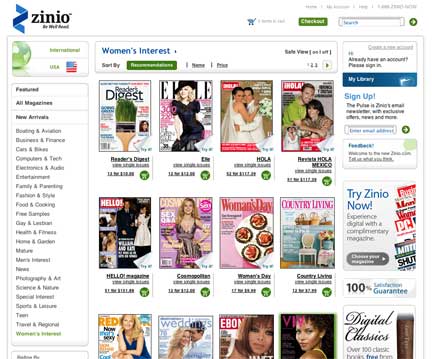
One of those sites is http://www.zinio.com, which calls itself "The World’s First 24/7 Global Newsstand" and has over 850 titles from 20 countries to choose from. Readers can purchase single issues or subscriptions, and read the magazines anytime, from any location, and in any language. Here’s a screenshot:


What does this mean to freelance writers?
In my opinion, I don’t think it will affect us at all. In fact, it may help. Statistics from "Digital Magazine Study" show that readers are more likely to visit advertiser’s sites on a digital version as opposed to print. That means that publishers can track the effectiveness of ads in real time--and we all know that a magazine with a lot of ads has more money to spend on freelance writers. In addition, writers may also receive extra payment for publishing the same piece online. Bonus!

What does this mean to publishers? By going digital, publishers lessen print and circulation costs, gain real time statistics, interactivity, and strengthen their brand. They also have the ability to tap into markets that may have been out of their reach before, such as international. On the production side, it’s not that much different than putting out a print magazine. There are companies that will take the print files that are done in programs such as InDesign, and convert them to a web friendly version, complete with analytics, rich media, and social capability. Sites such as:

www.nxtbookmedia.com
www.olivesoftware.com
www.texterity.com
www.imirus.com
www.editionduo.com
www.advancedpublishing.com
www.pressmart.net

But are readers willing to make the total switch? I still enjoy curling up with a good book or magazine, but like the idea of being able to view something immediately if I’m researching information. What do you think?
Read More »
Powered by Blogger.
Back to Top