Showing posts with label natalie goldberg. Show all posts

Friday Speak Out!: The Relationship of Writing: Mad Dash or Life-Long?

Friday, April 26, 2019
by Amanda Russell

When I think about the writing process and how creativity works for me, I cannot separate it from a regular practice.

I used to write a lot during my teen years and in college- those times when everyday life is intensified by complex ideas like who am I, what do I believe/think, where am I headed and the ever-present how do I get there?

As time progressed, I found that my muse was not ever-ready in the wings. It seemed that my existential searching was part of her fuel. So, I began to look for her, to wonder if she’d ever return. Then, I found her. Where? In practice.

My Writing Experiment

Several years ago, I was put to a challenge by a spiritual father of mine to make writing my rule. He had patiently listened to what I loved about writing, what I wanted to convey about the human experience and how. When he asked me what my practice was like, I was stumped. I did not have one! Then he put me to a challenge: write every day. Make writing your practice.

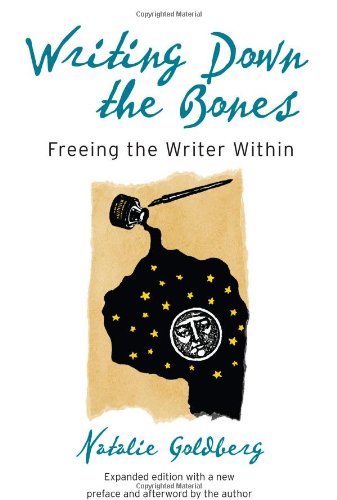
In searching for how to do this, I came across Natalie Goldberg’s book Writing Down the Bones. The author was attending sit meditation and inquiring about Zen Buddhism. “Why do you come to sit meditation?” her Roshi asked, “Why don’t you make writing your practice? If you go deep enough in writing, it will take you everyplace.”

In that book, I found the guidelines for what I now call my Writing Experiment. I set out to write every day following the rules for writing what Goldberg calls “First Thoughts”: In order to do this timed exercise all you need to remember is to keep your hand moving constantly, no crossing out or editing, no worrying about spelling or grammar, let go of the control, do not allow logic to get in the way, and go deep without fear or judgement. According to Goldberg, first thoughts allow a writer to “capture the oddities of your mind” and “explore the rugged edge of thought.” Yes please!

I began to do the timed exercise daily and found that the muse came back. But I was building a life-long relationship with her instead of the hot mad-dash that results from inconsistency. This practice filled many notebooks, and I began to realize that I was doing a lot of personal work in my writing, moving through times of uncertainty and processing all kinds of ideas and experiences from joy to grief. My forthcoming poetry chapbook, Barren Years, is a product of this experiment.

The other day my four year old son asked me, “Are you a fill-in?” I puzzled him back by answering, “No, Love, I’m a full-time.” Whatever he meant by that question, I may never exactly know, but it surfaces again and again in life as an invitation to show up and be present, to practice.

* * *
Amanda Russell is a poet living in New York with her husband and two children. When she is not busy with her family, she enjoys reading the work of Rainer Maria Rilke, Mary Oliver and Stanley Kunitz, spending time connecting with friends, gardening, writing, sewing and other creative endeavors. BARREN YEARS, her debut poetry collection, will be published by Finishing Line Press in June 2019.
~~~~~~~~~~~~~~~~~~~~~~~~~~~~~~~~~~~~~~~~~~~~
Would you like to participate in Friday "Speak Out!"? Email your short posts (under 500 words) about women and writing to: marcia[at]wow-womenonwriting[dot]com for consideration. We look forward to hearing from you!
~~~~~~~~~~~~~~~~~~~~~~~~~~~~~~~~~~~~~~~~~~~~

Read More »

Writer, Heal Thyself

Sunday, December 11, 2016

Our writing can make us laugh--as well as others--and certainly everyone can agree:  laughter makes us feel better.

But what about sorrow? What about anger? If those feelings are expressed in our writing, are there any benefits?

Everybody has stuff  they have to deal with. Since most of us have to deal with some dysfunctional family dynamics at least occasionally, consider writing about it.

For example, I have a creek of mental illness watering my family tree. My birth mother killed herself because she couldn't deal with her depression and she didn't see herself getting any better. Several of my stories deal with her life (and death). An unstable pair of grandparents is also part of the matching set.

Now, if I'd just written the same thing over and over (My birth mother had an awful life. My birth mother had an awful life) it wouldn't help move me forward. In fact, it'd probably just keep the wound open and festering.


photo by pexels.com

However, if a writer can find meaning in the horrible things that happen to them, if they can use words like "because," "understand" and "realize" in their writing, they just might start getting healed... and there are studies and more studies to prove it.

A few years ago, my life became a mess. A family member was hooked on painkillers and after more than a decade-long addiction, relationships were in shambles.

At the time I was working on a manuscript that was more-or-less a memoir, cloaked in fiction. After dealing with the real-life grief ineffectively, I decided to fictionalize it even more.

I changed the ending. Instead of missing out on saying good-bye to a parent before they died, in my story, I got to the hospital in time. Instead of having so many things left unsaid, in my manuscript, I got to express what was in my heart. Instead of getting reduced to becoming a walking vat of sorrow and rage, I found a way to forgive.

And that's one of the weird things about writing. In the story I was crafting, I knew what the ending was going to be. The main character (Maggie/me) was going to have some revenge-filled fun... fun that was going to result in a maggot-of-a-man being permanently disfigured. However, when it came to the end of my manuscript... well, let's just say there was a twist in the plot just as there had been a twist in my life.

Natalie Goldberg says, "As writers we live life twice, like a cow that eats its food once and then regurgitates it to chew and digest it again. We have a second chance at biting into our experience and examining it..." I've been privy to brave stories from writers. Stories about abuse. Stories of assault. Stories of drug use. And each time a writer delves into their life, they're making more meaning out of their experiences. They're working things out...

... on paper.

Read More »

Top Books on Writing by Female Writers

Saturday, May 09, 2015
This summer I will work on two major writing projects: my novel and my doctoral dissertation.

For motivation, I look to other authors for guidance, which makes me return to some of my favorite books on writing by female authors.

1. Bird by Bird by Anne Lamott 

“Just take it bird by bird.”

This advice has gotten me through not only the most daunting, difficult writing projects, but through some daunting, difficult life situations, too.


2. Negotiating with the Dead by Margaret Atwood

"All writing of the narrative kind, and perhaps all writing, is motivated, deep down, by a fear of and a fascination with mortality by a desire to make the risky trip to the Underworld, and to bring something or someone back from the dead."

The book includes six essays on what it means to be a female writer and includes the wit and dry humor of Atwood that I love so dearly.

3. Writing Down the Bones by Natalie Goldberg:

“Every time we begin [writing], we wonder how we ever did it before.
Each time is a new journey with no maps.”

Goldberg mixes her writing lessons, exercises, and experiences with Zen Buddhism into this compact guide.

In addition, reading great literature by female writers also inspires me. How many of the greatest books by women have you read? I have read 50 of 102 on this list. So I still have some catching up to do! Also, although most of my favorite female authors are represented here, there are still a few books and authors missing.

Who are some writers who inspire you, and why? Please give me some recommendations so I have more excuses to procrastinate my projects this summer [wink, wink].

Written by Anne Greenawalt, writer and writing instructor
Read More »

The Heart of a Story

Saturday, January 18, 2014
Where do your stories come from?

I always enjoy reading interviews with authors regarding where they get the inspiration for their books, particularly fiction. If you look hard enough, you can spot a seed of where that original idea bloomed. You might even find a correlation between something in the author’s life or history that inspired their fictional work.

Yesterday, I came across an article about the late V.C. Andrews, author of the Flowers in the Attic series. I never knew Andrews had been crippled by rheumatoid arthritis at a fairly young age and confined to a wheelchair. I also didn’t know that Andrews lived most of her life with her mother in a large, Victorian house. With those new facts, I could easily see where a fictional story about siblings locked away in the attic of a grand old house most likely came from.

For me, I have yet to write a novel that didn’t include some personal element from my life. In my middle-grade novel, it’s the setting, both a physical place and a time period I'm particularly fond of as well as the two main female characters. Through writing those pages and the scenes within, I recreated situations very similar to things I had gone through as a 10-year-old, and worked to resolve them in ways I never could in real life.

In my YA, the story is set in the place where I spent my formative years, but the aspect of the novel that resonated the most with me was the theme of depression and isolation, two very personal issues I have struggled with throughout the years. Through the main character’s voice, I felt like I finally had the chance to say things I’ve never been able to say to anyone else before, to vent out the frustration of not always having someone there to listen when I needed it the most. I think it added a deeper layer to the story, and to the character development of the book, but it was cathartic at the same time. It was so cathartic I haven’t been able to pick up the draft for revisions since I finished it.

Have you ever written something that poured out of you so freely and openly that it scared you? That it made you feel like you were exposed for all the world to see, even though it was a work of fiction? I found this interesting passage in the book Writing Down the Bones by Natalie Goldberg:

Sometimes when you think you are done, it is just the edge of the beginning. Probably that’s why we decide we are done. It’s getting too scary. We are touching down onto something that is real. It is beyond the point when you think you are done that often something strong comes out.

Yes. Where do your stories come from? What do you do when the words that are pouring out of you become a little too real? Do you pull back or keep going?

Renee Roberson is an award-winning writer and editor who blogs at Renee’s Pages.
Read More »

Talk to Your Readers

Sunday, February 07, 2010
With freelance we tend to find ourselves writing informational pieces quite regularly. It can be a piece on how to repair something (DIY), or maybe in the creation of a craft item.

I was reading some information about a craft project that I wanted to try and I actually got bored with the way the article was written. To be honest, it was rather dry and I felt like the writer was telling me what to do. Hello, that's not nice!

Then I remembered one of my favorite authors and how she always talks to you and helps literally kick you in the butt, Natalie Goldberg. If you've read her books you know exactly what I am talking about. Just like standing in one of her mini-writing workshops, she talks to you with her writing.

Recently, I gave her techniques a try while doing a how-to piece on making a memory quilt. I must admit, it was at least a start and I am finding that more people have been interested in reading it. It has actually led to some readers asking additional questions and for ideas. This has helped me then construct my answers for each of them as if I'm sitting across the table from them having a conversation and enjoying the project that we are working on.

It's difficult to do considering that you don't have the person right there in front of you. But, I have found that if you sit there and think about your friends and how you would try to help explain to them how to do something or by visualizing and wanting to show them, it can help you to write a better piece.

Yes, like all of us, I am still learning the technique and still have a ton of kinks to work out. But, by talking to our readers, it gives them a sense that you care and want to help. As our society has changed a great deal in the last 15 years with the onset of this wonderful internet, many of us are now home-bodies and social butterflies of a different nature. We don't leave our homes like we did to socialize. Many of us only socialize through the internet. With this in mind, we need to find ways to humanize what we are writing, to make our readers feel that they matter and are in many aspects a part of our lives as well.

If you are interested in finding out how to write and speak to your readers, check out some of Natalie Goldberg's work. Her most recent release is Old Friend from Far Away: The Practice of Writing Memoir; or check out one of her older books called Writing Down the Bones: Freeing the Writer Within. Each of these will help give you an idea of how to speak to or with your readers rather than at them or telling them.

Happy Writing!
Read More »

10 Easy Ways to Reduce Stress

Friday, September 05, 2008
Stress is basically a disconnection from the earth, a forgetting of the breath. Stress is an ignorant state. It believes that everything is an emergency. Nothing is that important. Just lie down. - Natalie Goldberg

My husband suffers from migraines and his neurologist once gave him, along with a prescription for Topomax, a brochure called Headache Help. Inside, there’s a section with a list of “proven stress reducers.”

Now, for a women’s magazine junkie like myself, there were plenty of things on the list that made me go, “Duh!” Like: prepare for the morning the evening before; get enough sleep; take a hot bath to relieve tension. But the list had some surprisingly interesting ideas as well. Here are ten that I liked:

1. Relax your standards. The world will not end if the grass doesn’t get mowed this weekend. [my note: substitute vacuuming, laundry, or whatever for lawn mowing.]

2. For every one thing that goes wrong, there are probably 10, 50 or 100 blessings. Count them!

3. Everyday, do something that you really enjoy.

4. Focus on understanding rather than on being understood; on loving rather than being loved.

5. Do something that will improve your appearance. Looking better can help you feel better.

6. Become more flexible. Some things are worth not doing perfectly and some issues are well to compromise on.

7. If an especially unpleasant task faces you, do it early in the day and get it over with; then the rest of the day will be free of anxiety.

8. Have a forgiving view of events and people. Accept the fact that we live in an imperfect world.

9. Have an optimistic view of the world. Believe that most people are doing the best that they can.

10. Do one thing at a time. When you are with someone, be with that person and with no one or nothing else. When you are busy with a project, concentrate on doing that project and forget about everything else that you have to do.

Do any of those hit home for you?

--MP
Read More »
Powered by Blogger.
Back to Top