Showing posts with label young adult novel. Show all posts

Amazing YA with Gila Green and an Update on Her Australian Publisher

Wednesday, March 11, 2020
Many of you will know Gila Green because you've taken a WOW! class with her, read an article she's written for us, or watched one of her video posts, where she explained an important element of flash stories to you.  I was lucky enough to be asked to read her latest young adult novel, No Entry, and provide a blurb for the cover. The novel deals with elephant poaching, terrorism, teenage love, finding your identity, and so much more. I was honored. I wound up writing an entire review, and I want to share it with you today for a couple reasons:

1. If you are a young adult writer, you need to read good young adult fiction--read Gila Green.
2. Gila's publisher was located in Australia. Gila wrote to me and said this, "Stormbird burned to the ground and was evacuated in the Australian fires. They can use all the support available. They hope to rebuild and reopen in April. " This is devastating! Can you imagine being that publisher or those authors?

On Stormbird Press's website, they wrote, "In the aftermath, Stormbird Press is in the process of finding solutions (financial, marketing, and logistical) to help us get back on our feet. In the immediate short-term this means that:
  • All stock (physical books) have been lost to the fire.
  • As a result of loss of premises, equipment, and the need for key staff to rebuild their homes and lives, the press is unable to publish new books until later in 2020.
  • Although we utilise print-on-demand technology, there may be delays in posting hard copy books.
  • Beyond the short-term, Stormbird Press is rebuilding and planning for a climate-changed future. We intend to survive and thrive."
You can buy Gila's wonderful book as an ebook and help support this lovely press. More info on that after the review. 

Here's what I thought about Gila's book:


No Entry is a timely, beautiful, and complicated young adult novel written by Gila Green, a masterful storyteller, about a Canadian high school student who spends the summer at South Africa’s Kruger National Park after her brother’s death and her parents’ move to Africa. Yael Amar has a lot to deal with, as do so many teenagers today. She’s trying to navigate life apart from her steady boyfriend while taking advantage of an opportunity to study in the elephant conservation program with Clara Smith, a well-respected conservationist and program director, plus worrying about her parents and their grief, as well as her own. She suffers from some self-esteem issues and the green-eyed monster when she compares herself with her stunning new best friend, Nadine. But aside from the pain over losing her brother in a terrorist attack, the beginning of her story mirrors many teenagers who spend summers in internships, navigating new relationships while missing old ones.

This is a definite strength of Green’s writing. She creates a main character and a situation that any reader could see themselves in. Plus, she writes about problems her readers will be familiar with: friend drama, boyfriend insecurities, fitting in at a new place, and following their passions.

Yael, though--out of nowhere, one routine day at Kruger while with her native guide Sipho--is thrown into the world of elephant poaching and the fear, violence, and greed surrounding this horrifying crime that takes place all too often in this animal’s native land. Yael tries to keep what she sees and experiences to herself because Sipho is afraid of losing his job; and they are both frightened of the men who use violence and intimidation to maim and kill elephants on the land that’s supposed to protect them.

Yael is full of anxiety over what to do and grief for these beautiful animals. Questions rack her mind: Should she share what happened to Sipho and her with her boyfriend? Does Clara know more than she’s letting on? What about Nadine? Who can she trust? She misses her brother and mourns her life before her exposure to the elephant poachers and the terrorist attack turned her world upside down.

Not only does the author tackle teenage issues and the elephant poaching epidemic in Africa, but Green also does an amazing job of exposing her readers to the culture of South Africa—both inside and outside of Kruger. The novel opens in Johannesburg, South Africa, with Yael staying with her aunt and uncle. Before her uncle drives her to Kruger, they stop by Rosebank, which her aunt describes as “a mall with a roof market on Sundays. Lovely crafts, jewelry, and live African music. A
real vibe.”

While at Rosebank amongst “energetic street dancers,” Yael is drawn to a British photographer who asks her, “Are you here to shop or do you want to learn something about South Africa?” When she enters his exhibit, she sees pamphlets about animal rights and views walls of photos of wildlife: waterbuck; Long-tailed Paradise Whydah (a fire-engine-rednecked bird with a bright yellow stomach, a black head, and a matching long, black tail); and an adult rhino with a horn removed “by conservationists.” And then she comes to the second wall with an exhibit of photos titled “Elephant Poaching.” Yael’s experience at the mall is a definite foreshadowing of what’s to come later in the novel.

“They kill them for their tusks, for their ivory,” Douglas says to her. “Most of the ivory finds its way to Asia in an organized and ruthless global trade, and some of it finds its way to people like him, who sell them as curios,” Douglas says, gesticulating his open hand in the direction of the curio stall. Yael glances toward the curio stall just as the furious stall owner stomps toward them.

From the beginning, Green does a fantastic job of exposing young adult readers to the controversy and complex issues of life in South Africa and gives them a glimpse of what Yael will be faced with during her program at Kruger.

While Green takes readers along on the journey, she writes beautiful description with a strong voice. Even if readers have never stepped foot in South Africa or any wildlife park, jungle, or forest, after reading No Entry, they will have a vivid picture of the setting. She uses all of her senses to expose readers to the sights, sounds, and smells of the places Yael lives in South Africa:

“The rain is slowing as Yael lies under her thin, cotton sheet listening to the drops hit the tin roof of the room she was meant to share with two university students, who are studying environmental filmmaking on a separate program. It turns out they’d both been delayed for a reason she didn’t catch and so far, she has the room to herself. She inhales and smells the heat rising from the ground after the downpour, insect repellant, and traces of dust. When she returns at lunch, she’ll blast the intense heat away with air conditioning.”

This book is not for the faint of heart—some of the author’s descriptions are intense, and she paints a realistic picture of what Yael experiences, while not making it too scary or mature for teenage readers. In an interview, Green said, “The truth is I believe less is more. There's no need to sensationalize the scenes. Elephant slaughter in plain language is enough. In addition, there's a sub-theme of terrorism in the novel because violence is universal. I purposely made the terrorist event happen in Canada because I want to get the message across that senseless violence doesn't just happen in Africa or the Middle East. That attitude might allow some of us to feel off the hook. It happens everywhere, and we all have to make sure we are part of the solution...”

In this excellent novel, readers will find themselves experiencing the joys and sorrows of Yael, who is just trying to recover from her recent family tragedy with an adventure in South Africa, and they will become her biggest champion, as she unravels who is behind the elephant poaching on protected land and why anyone would want to hurt such magnificient animals just for money.

To purchase No Entry as an ebook, please click here.

Margo L. Dill is a children's and young adult author, works as managing editor for WOW! Women On Writing, and teaches a new class for middle-grade and young adult writers that starts March 31, where writers receive instruction and critique! Check out the syllabus here. There are still spots left.  


Read More »

Why Do We Love a Series?

Thursday, April 09, 2015
One of WOW!'s recent blog tour authors, Scott Keen (author of Scar of the Downers), wrote a blog post for my blog titled, "Children's Books that Spoke to me as a Parent/Author." It is an amazing list of books, and he explains WHY he chose each. If you haven't read this post yet, you should if you are a writer of chapter books, middle grade, or young adult.

He made me think about what books I might include on a list like this. But it's so hard to choose because there are so many amazing books in the world--new and old. I agree with him that Harry Potter definitely belongs on my list. Even though I don't write about magical worlds or creatures, J. K. Rowling is a master at characterization and plotting. I can definitely learn from her.

But besides Harry, who might be on most people's lists, I have to say that I loved SERIES books when I was young, and I still do today. (I also realize Harry Potter is a series!) Some of my favorites when I was young: Sweet Valley High, Trixie Belden, MishMash, and Encyclopedia Brown. It's hard for me to remember what I loved so much about them. I constantly begged my parents to purchase the next one from B. Dalton Booksellers (I know--I am really mentioning some old time stuff here now); but I think two things: I loved the main characters, and I liked remaining in the story world where I was already comfortable.

Today, I love Alexander McCall Smith's No. 1 Ladies' Detective Agency books, and The Hunger Games (series), and Divergent (series).

So how does this relate to my writing? That's a great question, which I was just discussing with my critique group on Monday. I think I need to write a series. I have book one written of a boy detective series for middle-grade readers, which I am workshopping at the end of the month. I have a picture book Maggie Mae, Detective Extraordinaire: The Case of the Missing Cookies, which is just begging for a sequel. And finally what about my YA? I brainstormed and decided I could create a series where each book focused on a different curse, like Caught Between Two Curses includes the Curse of the Billy Goat on the Chicago Cubs.

So what about you? Are you writing a stand-alone or a series? Do you like to read series books? What would be on your list if you made one like Scott's?


Do you have a YA or children's novel draft at home or an idea brewing inside you? Take Margo's "Writing a Children's or YA Novel" online class in the WOW! classroom; starts on April 15! More info here: http://www.wow-womenonwriting.com/classroom/MargoDill_WritingChildrensOrYoungAdultNovel.php
Read More »

Forever Young Adult Readers Under Attack

Monday, June 09, 2014
So I write Young Adult. I read YA. I also read romance, mystery, literary fiction, nonfiction, picture books, board books, the newspaper, blogs, and middle-grade novels. But right now, YA readers over the age of 18 are under attack by a blogger named Ruth Graham who wrote a post called AGAINST YA on the Slate Book Review. Her tagline reads, "Read whatever you want. But you should feel embarrassed when what you're reading was written for children."

You might have seen this article or heard about it. It's been circulating around Facebook and Twitter, and it has several readers and writers steaming mad! I think the part that is so objective, of course, is the word embarrassed. I'm thinking adults should be embarrassed over much more serious things, such as our infiltration of Facebook, than reading Fault in Our Stars or standing in line for the midnight showing of Twilight. But what do I know? I read YA.

Since I am a YA and MG novelist, I think Graham gives me a pass because I have to read what I write. But still her article really ticks me off. I have had a lot of adults tell me they read my latest novel, a YA titled Caught Between Two Curses, in one day. Should they be embarrassed about this? Should they be hiding their book behind a black piece of construction paper or wearing big sunglasses when reading it on Kindle? Or should I just be happy that of the friends I know who love to read a lot of different genres and types of books, they took the time to read mine? I'll let you know. . .I'm happy.

I've loved children's books since I was young and I've never stopped. My VERY FAVORITE BOOK SERIES EVER is Harry Potter. I haven't read any adult novel that has made me want to read it three times as all 7 of HP have. So, call me stupid. Call me immature. According to Graham, I'm missing out on great literature that will really make me think and stay with me long after I shut the book. ( Full confession: My mom, in her seventies, and I still mourn the end of the TV series, Angel.)

Here's the deal. Has Graham ever been to a Star Trek convention? Has she seen people dress up and act out The Rocky Horror Picture Show? Should these people be embarrassed to dress up as creatures and characters who aren't even real? What does she think about romance readers who visit the fictional landmarks in their favorite books? I mean, she has opened up a (excuse the cliche) can of worms here.

So, I'm curious. What do you think? Do you read YA? Do you read MG? If you do, do you do this because you like it, because you write for the age, because you have kids/grandkids that age? Do you think it matters what you choose to read as long as you are reading and enjoying it?

I just think Graham entered dangerous territory when she started judging what other people read. It's like banning books. You don't have to ban them to stop YOUR children from reading them, just don't let those books in your house. If Graham doesn't want to read YA, then fine. But she doesn't have to insult the people who do--no matter how old they are.

Not only is Margo L. Dill a young adult writer and reader, she also teaches a novel writing course for people who want to write for the young adult or children's market! Find out all the classes Margo teaches and upcoming dates on the WOW! classroom page here.

Read More »

Book Birthdays, Sick Kids, and Selling the House

Thursday, March 20, 2014
If you don't want to listen to a writer who is completely overwhelmed go on and on about being completely overwhelmed, then stop reading now. Don't read one more word. But if you want to read and find out why this really nice writer is feeling stressed out and why she posted on Facebook, "If life gives you lemons, make lemonade or use them to squeeze into your vodka tonic," then please keep reading.

Full disclosure: I am a very lucky girl. I know this with all my heart. But sometimes, sometimes, life is so overwhelming.

On with the story. . .within one week, actually within four days, these events did and/or will occur:

  1. My 3-year-old has the stomach flu.
  2. The young adult novel I worked on for 7  years is finally born into the world. (Title is Caught Between Two Curses, and you can check it out here: http://www.rockinghorsepublishing.com/new-release.html)
  3. The closing date of the house we have been trying to sell for 3+ years is finally going to occur, and we are thankful we didn't lose "too much money."
  4. A book launch party 
 Here's the deal. I'm just going to admit it. I have a hard time with balance anyway. Being a writer and editor and a stay-at-home mom are all full-time jobs. I have help from my husband and grandparents, but it's still difficult to balance and keep the guilt in check. When I have a thousand things to do this week with the closing of our house and the book launch party--both happening at 4:00 on Friday!--I am well. . .feeling a little crazy.

What can I do?

Here's the part of this post where I am supposed to come up with some words of wisdom for you. Something like: take care of my family first, ask for help with the closing and book launch party, do as much as I can and focus more on book markeing next week, etc. This is good advice, right? This is what I am telling myself; but really, did you come to this blog post to get advice from me? OR would you like the opportunity to give advice? How often do you really get asked for your two cents?

I am asking you for your two cents! What do you do when you are feeling overwhelmed with your writing career and your personal life? How do you manage? Please share with me. I will be forever grateful. I will try your advice! I bet others will benefit from your advice, but they are just too scared to ask.

And if you want to check out Caught Between Two Curses--well, that would just make my day. It's a young adult novel for ages 14 and up. It's about:


Seventeen-year-old Julie Nigelson is cursed. So is her entire family. And it’s not just any-old-regular curse, either—it’s strangely connected to the famous “Curse of the Billy Goat” on the Chicago Cubs.

Julie must figure out this mystery while her uncle lies in a coma and her entire love life is in ruins: her boyfriend Gus is pressuring her to have sex, while her best friend Matt is growing more attractive to her all the time.

Somehow, Julie must figure out how to save her uncle, her family’s future, and her own love life—and time is running out!


I'll owe you one! 
Read More »

Reading and Learning from Popular Books

Thursday, October 10, 2013
On another blog I write for, The Lit Ladies, one of our writers, Little Lady, recently wrote a post about how her high school AP English teacher snubbed his nose at Harry Potter. He had actually never read a word of J. K. Rowling's work, and he refused to even try it out because of its popularity.

I'm just going to be honest with you all right now--THIS. ATTITUDE. DRIVES. ME. CRAZY.

I realize some things that are popular are really dumb, and some books that are on the bestseller list are no good. However, many of the books, especially children's and YA, are bestsellers or popular because they are. . . (you won't believe this) good books. (Okay, this is my opinion. But I'm right!)

As a children's or YA writer, I think you're doing yourself a disservice if you don't read some of the popular books out there. If it's a series, you don't have to read all of them--but read one, at least. If the book is being made into a movie or a kid's series on PBS or NICK JR., check it out and read it. Then study the story and figure out why. No matter what your goals are for your writing career--even if it's that you want to write standalone books and make no money, that's okay. But knowledge is power. You should have knowledge of--
  1. What kids are interested in and reading today
  2. What sells and why
  3. Popular authors, their stories, their agents, their publishing houses, and the business of books
Actually, if you don't care about being published or making money as a writer, then stop reading this post now and call me crazy. Go ahead! I stand behind what I'm saying here.  Here are two examples:

DIVERGENT: I picked this up after discovering that this book was going to be made into a movie, coming in March, and it had a bunch of comparisons to Hunger Games. I was skeptical. However, Veronica Roth had me at hello. I absolutely love this book! Why? I decided it's her pacing, for one. I'm not a big fan of long passages of description or pages where a character struggles with something internally. I like fast-moving, and I like surprises. Roth delivers on both these accounts. I do like her dystopian world, although I wouldn't want to live there--which makes it an excellent dystopian world. And I also love that it's set in Chicago and uses the train system there as a huge part of the plot. I have been to Chicago several times since I live in the Midwest, and I've ridden the L.

So what does Divergent teach me? Keep my pace up. Reveal plot points along the way. Don't cram everything into the beginning. Take familiar settings and change them up a little if possible.

 MAX AND RUBY: If you've had a preschooler in the last five years, you know the two loveable bunnies, Max and his older sister Ruby. Rosemary Wells originally wrote the books, which my daughter loves, and it was made into a series for Nick Jr. What I've learned from seeing many episodes of this show as well as reading the books time and again is that picture books can be simple and deal with everyday life. Also, you can have talking animals. And there should usually be some kind of humorous twist at the end.

I understand there are some BAD popular books out there (I'm not going to name names here). But read them anyway. Then when you write your book, write the exact opposite of this popular book--however (and this is the big HOWEVER) keep the essential trait that made the book popular. That's why you study the books. Why did Twilight soar over other vampire/werewolf/human books? Meyer was not the first writer to ever write about these species. Was it her characters? (That's what I think)  Why are there so many Magic Tree House books? (Children love adventure, and they love a series. They love to imagine traveling through time in a treehouse, too.)

Soapbox over, but I would love to hear your thoughts on popular books! I promise not to debate (umm, okay, I'll try not to), and I wish you the best of luck on whatever project you are currently working on--whether it will someday be popular or not.

Margo L. Dill is the author of Finding My Place: One Girl's Strength at Vicksburg (a middle-grade novel) and has three forthcoming books under contract. She is teaching Writing a Children's or Young Adult Novel for the WOW! Women On Writing classroom, starting on October 15. To see more details, go to the classroom page here.

Read More »

Sara Polsky talks her debut YA novel, This is How I Find Her (Giveaway!)

Thursday, September 12, 2013
Today, we welcome young adult author, Sara Polsky, whose debut novel, This Is How I Find Her, recently came out to the reading world! Sara is a writer and editor at Curbed NY, and her articles and essays have appeared in The Christian Science Monitor, The Forward, Poets & Writers, and other publications. She lives in New York City.

We're talking to Sara today about her book, which deals with bipolar disorder and the theme of finding yourself, as well as life as a debut novelist! Stay tuned for the end of the interview and fill out the Rafflecopter form for your chance to win a book!
  
WOW: Welcome to the Muffin, Sara, and congratulations on your debut YA novel coming out this month! How are you feeling about everything right now?

Sara: Excited, nervous, thrilled!

WOW: We are excited for you! Tell us about your novel, This is How I Find Her.

Sara: This Is How I Find Her is the story of 16-year-old Sophie, who has spent much of her life caring for her mother, who has bipolar disorder. When Sophie's mother, Amy, attempts suicide and is hospitalized, Sophie moves in with some estranged relatives across town—and begins figuring out how to balance caring for her mother with living her own life.

WOW: As you mentioned, the mother of the main character has a bipolar disorder. What kind of research did you have to do to write this character? How did you stop the mother from taking over the story and keeping this about the teen?

Sara: I did a lot of research into bipolar disorder, reading everything from memoirs to slightly more technical books. There are a lot of bipolar disorder guides out there for patients and families, and I found those particularly helpful for getting the details right.

I never really worried that Sophie's mother would take over the story. For me, the book was always about Sophie finding her way, understanding her family more clearly, and reconnecting with old friends. Her mother's suicide attempt is the catalyst for some of those things, but the story is all Sophie's.

WOW: We met you through your agent, Suzie Townsend, who is judging our flash fiction contest. Can you tell us a little about the process that led you to Suzie? In other words, what was your agent journey like?

Sara: I started my agent search by looking at agents who represented books I loved and thought had something in common with my manuscript. I also read a lot of agent interviews online, and I think that was how I first stumbled on Suzie. I knew I wanted to query her as soon as I read her agent bio—she talked about how much she loves strong, female protagonists, and we had a few of the same favorite books, including Jellicoe Road, How I Live Now, and When You Reach Me. Suzie sent me some amazing editorial notes on the manuscript; and when we talked on the phone the first time, she compared my manuscript to one of my favorite books, so I knew I wanted to work with her. (And she is just as wonderful as I'd hoped!)

WOW: It sounds like a great fit for both of you! What are you enjoying most about being a YA debut author?

Sara: I love hearing from people who connect with the book. It's amazing to me every time someone tells me they care about these characters and this story that lived only in my head for such a long time. And seeing my book on the shelves in a bookstore, next to some of my own favorite books, is an incredible feeling.

WOW: Awesome! What are you finding difficult?

Sara: I don't really talk about the things I'm writing while I'm writing them, so it's hard to get used to talking about the book now that it's out! And then there's that flash of nervousness when someone says, "So, I read your book…" and I'm waiting to hear what they thought of it.

WOW: Yes, it is your baby—that is now out in the world, and we want everyone to love our babies as much as we do! What's next for you?

Sara: I'm working on another contemporary YA novel.

WOW: Thanks, Sara. Don't forget to check out Sara's new book, This Is How I Find Her. If you want to connect with Sara, you can find her website here: http://www.sarapolsky.com.

You can also WIN a copy of THIS IS HOW I FIND HER. See the Rafflecopter form below!

***** BOOK GIVEAWAY *****

Enter the Rafflecopter form below for a chance to win a copy of This is How I Find Her by Sara Polsky.

a Rafflecopter giveaway


Good luck!
Read More »

Meet Fall 2011 Flash Fiction Contest Winner, Suki Michelle!

Tuesday, February 28, 2012
Suki Michelle is the co-author of the young adult urban fantasy, The Apocalypse Gene (Parker Publishing, Inc. 2011), on which she collaborated with her husband, Carlyle Clark. Their current co-project is a collection of speculative fiction stories set in the town of Redemption, Arkansas in the 1930s. Suki has two novels in progress and is a published poet. She owns a medical transcription company and works as a ghost-blogger for a Chicago celebrity. Suki is most proud of her beautiful daughter, Bree, who will soon complete her nursing training. Her passions include people-watching and chocolate.

Learn more about Suki’s co-written debut novel at: http://www.TheApocalypseGene.com

The Apocalypse Gene Fan Page: http://www.Facebook.com/TheApocalypseGene

Visit Suki’s blog: http://storymavens.wordpress.com/

Follow Suki on Twitter: http://twitter.com/Suki_Michelle

interview by Marcia Peterson

WOW: Congratulations on winning first place in our Fall 2011 writing contest! What inspired you to enter the contest?

Suki: Thank you so much for the congratulations. The win was quite a thrill!

I wrote this piece as an exercise to see if I could express the feelings of a highly creative but lonely child. While the facts of the story mostly fictional, the atmosphere and emotional elements are real. Also, I had previously earned an Honorable Mention in an earlier WOW! Flash Fiction Contest, and I wanted to try again after another year of learning the craft. I was happy with the piece after at least a zillion edits (mostly deletes).

WOW: We're so glad that you decided to try again! Can you tell us what encouraged the idea behind your story, "No One Told Me Stories? "

Suki: I was trying to pinpoint the driving force behind my desire to be a writer. It began with a love of stories. My father was indeed a surgeon with an eidetic memory, though he behaved much better than the father in the story. My mother was very engaging, unlike the fictional mother. I was always encouraged to read and had many books. My grandmother often told me stories about her life in Russia during the pogroms and her experiences as an immigrant landing on Ellis Island as a young girl. Those stories were probably the first to both terrify and inspire me.

WOW: What do you enjoy about flash fiction writing versus the other kinds of writing that you do?

Suki: Flash fiction poses a specific challenge. Every word must earn the right to live on the page. If you write some scintillating prose, the best ever, but it doesn’t contribute powerfully to the piece, DELETE! If it’s fluff, DELETE! If it’s repetitive or dull, DELETE! What remains must have voice, a message, subtext, imagery, texture, rhythm--all the elements of solid writing, but economical and concentrated. Flash fiction is closest to poetry in that regard--the fewest words for the most impact. These principles carry over into everything one writes. Also, writing flash fiction is great practice for synopses and query letters.

WOW: You’ve co-written a young adult novel that’s received many positive reviews. What do you think makes for a successful collaboration on a big writing project? It seems like it could be pretty tricky making it work!

Suki: Carlyle and I have complementary skill sets - the key to our successful collaboration on The Apocalypse Gene. Carlyle’s forte is plot design. He knows how to unwind a story and where to plant “reveals” and backstory. My strength is in characterization and setting. We both have insane imaginations but very different personalities. I’m outgoing and impulsive. He’s introspective and thoughtful. I draw him out; he reins me in.

The Apocalypse Gene centers around a girl with the ability to see psychic auras. She lives in a world beset by global pandemic, and her psychic abilities make her environment all the more dismal. It was interesting to explore the conflicts she faces, especially when it becomes her mission to stop the pandemic, which she discovers is far more than a mere disease.

As you say, co-writing was sometimes tricky. It was an ambitious project and took three years to write. Did we ever argue? Ummmm no? Okay yes. A lot. But we respect each other, and we were eventually able to reach consensus without compromising our individual visions. Interestingly, we didn’t set out to write for the YA demographic. We just had a story to tell. Genre categorization came later.

WOW: What was the road to publication of your novel like?

Suki: We began by querying every agency we could find that represents writers of speculative fiction. Many requested the manuscript, either partial or full. The rejections poured in. That was a harrowing experience. Sometimes I had meltdowns, which Carlyle refers to as my “mini-Chernobyls.” Carlyle has great equanimity, and he got me through it. Eventually, I toughened up--a little (not enough).

When the agents were kind enough to comment, the feedback was consistent. They found it well written and highly imaginative, but they declined mostly because it didn’t fit neatly into a particular genre. It has elements of fantasy, science fiction, dystopia, mid-apocalyptic, paranormal romance, and cyberpunk. An agent’s primary purpose is to pitch a project to publishers, and there was no proven sales paradigm for such a mixed-genre YA novel. Hence, a slew of “regretful” rejections.

We then began a round of queries to publishers who accept direct (un-agented) submissions. Parker Publishing was very enthusiastic about the project for their newly launched YA imprint, Moxie. Parker focuses on multiethnic literature, and it just so happens that the protagonist of The Apocalypse Gene is a teenaged girl of mixed race. Parker snapped it up, designed a cool cover, and put it out there. Carlyle and I worked very hard to get reviews via blog tours, Goodreads promotions, Facebook, Twitter, and much more.

WOW: Thanks for sharing your publishing journey. That's great that you found a good home for the book and it's doing well. 

 Switching gears a bit, you’ve mentioned people-watching and chocolate as two of your favorite things. Can you tell us what your preferred spots are for observing others? How about your first choice for chocolate?

Suki: I live across the street from a 24-hour Walmart. I like to listen to audio-books on my Kindle and wander the aisles with my headphones on, observing, speculating, and imagining. Everyone is a potential character. I observe their expressions, clothes, body language, what they’re buying, how they handle frustrations, whether they seem kind, belligerent, or utterly mad. (The Walmart regulars no doubt think I’m a weirdo.)

I like to imagine people in strange occupations, turn them into zombies, extra-dimensional visitors, serial killers, drug addicts, superheroes, or just plain folks facing difficult conflicts. I also like to people-watch in hospital lobbies, train stations, and restaurants. I know it’s not polite to stare, but I can’t help myself!

As for my first choice for chocolate - ANY AND ALL, but no nuts, please. I’m a chocolate purist.

WOW: Now all of your fans will know what kind of chocolate to bring you. Thanks so much for chatting with us today, Suki! Before you go, do you have any tips for our readers who may be thinking about entering writing contests?

Suki: Do your best work, and enter. If (and when) you don’t win, produce more of your best work, and enter again. Writing is a tough gig. The only way to succeed is to DO IT. Get better, write, write, write, present your work to readers, judges, fellow authors, and agents. The road to writing success is paved with rejection, reward, disappointment, elation, and constant self-discovery. Keep going, but be aware--the further you travel, the more the road stretches on.

***

Our Winter Flash Fiction contest is open until tomorrow, February 29th!
For information, check out our contest page.
Read More »

Six Tips for Writing 'Clean' For Young Adults

Tuesday, May 31, 2011
In my newest novel, Blackbird Flies, I presented my book in a ‘clean’ form of YA. I’m particularly fond of the ‘clean’ category of young adult. There are a growing number of authors writing ‘clean,’ which is essentially delving into the same story lines and plots found in most other young adult or adult fiction but without the graphic violence, sex, or language. It’s not that there’s anything wrong with more graphic reads but personally I enjoy the idea that my books can be read by everyone, everywhere rather than be excluded from larger groups who may be offended or those too young to be exposed to such things. And let’s face it: the same story can be told just as brilliantly without all the detailed bedroom scenes or cursing.

Last week, I was asked to give a few tips for authors and authors-in-waiting who want to make it in this genre. I’d like to share them with our WOW readers, authors and writers too. Here they are:

(1) Research those already ‘making it’. The best kind of research an author can do is learning from those authors already selling books. Go to Amazon and search the top 10 to 15 books in the genre you write in. Read everything you can from those authors. They’re the ones to watch and learn from because they’ve already found what works.

(2) Learn about your audience. Just because we’ve ‘been there done that’ doesn’t mean we ‘get’ how kids are handling the same situations today. And because most of us are adults writing for younger people, we need to be sure we research the groups we’re writing about appropriately. Learn about young adults’ peer groups: how they dress, what they care about, what they don’t care about, how they speak (both to adults and to their peers—we’ll touch on that more closely in a moment), etc. The more accurate you are, the more appealing your story will be to the young adult audience.

(3) Speak as a young adult. Your writing voice needs to be that of a young adult rather than an adult speaking to young adults. Get out there and do some field work by chatting with a few young people in the age range you’re writing in. They offer invaluable insight!

(4) Write clean but not too squeaky. In cleaning up a manuscript we have to be cautious not to make it so squeaky that these age groups will avoid the book like the Plague. ‘Clean’ simply means presenting or saying things in a different way. There are many books my girls bring home from the library that still have the silliness, sarcasm, peer jiving and fart jokes but presented in more generally acceptable way. That’s the whole idea! Simply use more ‘show’ with reactions, facial expressions and body stances. Again, it’s important to listen to how these young people talk and react to one another.

(5) Have a good mix of the five ‘basic story ingredients’. I love using this analogy. To make food taste great, we need to tap into the five basic flavors: salty, sweet, sour, bitter and savory. When writing a great story, authors need to have a healthy mix of, what I call, the ‘five basic story ingredients’: humor, seriousness (or delving into a serious topic/issues), a sprinkle of mystery, a pinch of drama and a surprise (big or small, depending on the specific storyline). Every story I’ve read or have written has a healthy combination of these elements. Some stories will have a little more humor or a higher level of mystery but almost all stories have these important story ingredients (even the romances!)

(6) Get input from your audience. Do you want to know what young adults are into these days? Do you want to make sure that your particular work is on the right track? Go right to the source. Have a ‘test read’ with a small group of young adults. Have them read your story, have a discussion and get their input on what to change or how to make it better. If anyone knows what appeals to young adults, it’s them!

Aside from everything mentioned above, the most important thing we can do as clean young adult authors is give these readers credit for their intelligence and their choices. These young people will be the adults of tomorrow and the books we write for them today will, hopefully, give them a solid road to walk on for their journey. Having our books on the shelves as ‘cleaner’ options to reach them, teach them and/or give them a voice is the highest honor I can think of.

Write on!
________________

Chynna Laird has written two memoirs, an adult suspense and a ‘clean’ young adult novel. Aside from writing, she does what she can to raise awareness for families living with SPD and other special needs. Check out her Website (www.lilywolfwords.ca), main blog (www.the-gift-blog.com) and her White Elephants blog (www.seethewhiteelephants.com) to learn more about her and her work.
Read More »

Am I Writing YA or MG?

Thursday, May 05, 2011

One question that I am asked over and over again in the WOW! writing middle-grade class and when I critique manuscripts with my freelance editing business is, "Do you think my story is young adult (YA) or middle-grade (MG)?" I am also asked: "What's the difference? Which is better?"

There's not an answer to which is better--it's all what you want for your career and for your story. Both of the series pictured here are popular and have a huge following--Gossip Girl is YA for teens and Beacon Street Girls is MG for girls 9 to 13 (according to the publisher). 
As for the difference between the two, that's huge. Think about the audience. There's a huge difference between teenagers and pre-teens in what they think, how they feel, what they look like, and how they deal with life issues--and the type of life issues they have to deal with. So, the first point to consider when you're writing either YA or MG is the audience. You were this age once. Think about yourself as a fifth grader then as a sophomore in high school. Huge difference, right? 

Here are a few more points to consider when deciding if you are writing YA or MG:

  • YA main characters should be in their mid to late teens. MG main characters should be between 11 and 13. (There are always exceptions. That's why I say SHOULD.) 
  • YA subject matter can be edgy. Your YA main character might be dealing with serious issues such as pre-marital sex, drug addiction, gang violence, abuse, and so on. With MG, your main character will face less edgy issues, such as dealing with low self-esteem, sibling rivalry, peer pressure, fitting in, and so on. Think about the topic of drugs. In YA, the main character may be addicted to meth. In MG, the main character may have thought about trying a cigarette. 
  • Adults should always play a background role in any MG or YA book. But in MG books, the characters are still really dependent on their parents or caregivers and may still be family centered. In a YA book--especially if the character is between 16 and 18--parents and adults will REALLY take a backseat role. For example, in Twilight, Bella's dad is in the story, and you know he loves her and provides for her; but the story doesn't deal with him, and he doesn't affect the decisions she makes. That's YA.
I like to make this comparison. Think of the TV shows: Hannah Montana and Beverly Hills 90210. Hannah Montana--middle-grade, Beverly Hills 90210--young adult. 

It is important to know what you are writing and your target audience. Prospective agents and editors have to know where your book will fit on the shelf. So, figure out where your story fits and go for it! 

Margo's Writing the Middle-Grade Novel class will start again on May 11 if you are interested in writing a middle-grade novel or you've started one and want some guidance. Check out the class listing for more information. For more information about Margo Dill, please see http://margodill.com/blog/.

Read More »

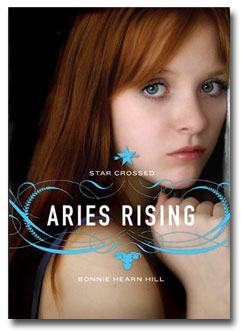
Bonnie Hearn Hill, YA author of Aries Rising, launches her blog tour!

Monday, March 01, 2010
& Book Giveaway Comments Contest!

Bonnie Hearn Hill worked as a newspaper editor for 22 years, a job that, along with her natural nosiness, increased her interest in contemporary culture. Prior to her new Star Crossed series from Running Press/Perseus Books, she wrote six thrillers for MIRA Books, as well as numerous short stories, nonfiction books and articles.

An interest in astrology along with her close friendship with Cosmo Magazine Astrologer Hazel Dixon-Cooper inspired the Star Crossed series: Aries Rising, Taurus Eyes, and Gemini Night.

A national conference speaker, Bonnie founded The Tuesdays, a bonded and successful writing workshop in Fresno, California, and she also teaches an occasional online class. On Fridays she meets with her private critique group (humorous astrology author Hazel Dixon-Cooper, prescriptive nonfiction writer Dennis C. Lewis, mystery novelist Sheree Petree, and musician/thriller novelist Christopher Allen Poe). What happens in those groups ranges from spontaneous applause to "getting filleted," as Bonnie's students and colleagues call it.

You can find out more about Bonnie by visiting her websites:
Bonnie's website www.BonnieHearnHill.com
Facebook Fan Page www.facebook.com/StarCrossedseries

Aries Rising
By Bonnie Hearn Hill

Aquarius Logan McRae is a high school sophomore in Terra Bella Beach, CA and has been working all semester to impress her teachers in order to get into the summer writing camp she desperately wants to attend. But when this ordinary girl finds an extraordinary book, Fearless Astrology, her life is changed forever. Applying what she's learned about the zodiac, she lands her own column in the school paper and a date with the hottest guy in school!

But when Logan threatens to catch the members of a secret society called The Gears, who have been vandalizing school property by reading the stars, she quickly learns that she is in over her head. Will Logan be able to catch The Gears, save her love life, keep her newspaper column, and get into the writing camp of her dreams all through the use of astrology?

Genre: Young Adult
Paperback: 304 pages
Publisher: Running Press Kids (March 2010)
ISBN#: 0762436700

Book Giveaway Comments Contest!
If you received our Events Newsletter, remember, we are holding a contest to win a copy of Bonnie Hearn Hill's novel Aries Rising to those that comment. So, grab a cup of coffee, pull up a chair, and enjoy the chat, and share your thoughts, and comments, at the end. We will randomly choose a winner from those who comment.

Interview by Jodi Webb

WOW: I always like to know which came first, the chicken or the egg. So, how did it work with you: did you decide to write a YA novel and come up with the astrology idea, or did you want to do an astrology related book and then realize it would be perfect as a YA novel?

Bonnie: The astrology came first. One of the members of my critique group is humorous astrology writer Hazel Dixon-Cooper. At one of our group sessions, we were playing around with astrological signs, and I got an idea for a title. As I started playing the what-if game, I knew the book was young adult. Then I asked my agent if she thought I could do that, and she sent me an assortment of YA books she has represented. I was hooked.

WOW: At what point did you decide your book about the discovery of a magical astrology book could become a great series?

Bonnie: The scope of astrology just naturally suggests a series, or maybe it's just the way I think. This nasty little thing happens to me when I'm writing. The book fairy comes and whispers an idea for the next book while I'm still working on the first. I knew that I wanted to do a second one with a ghost in it. Then my publisher offered me a three-book deal, and the book fairy came calling again.

WOW: Ah, the three-book deal. Tell us how you managed to have three books coming out in one year. We're all green with envy!

Bonnie: And I am green from lack of sleep. ;) Actually, it wasn't as crazy as it sounds.

I wrote Aries Rising first. Because I hadn't written YA before, I had to finish it. My critique group read it, and my agent edited it--and I guess it was probably eight or nine months before we submitted the manuscript. It sold in spring of 2008, and I wrote the other two after that.

WOW: Can you tell us a little about the Fridays? Which incidentally sounds like a great name for a 1950's musical group!

Bonnie: I absolutely love the Fridays. I should have formed them years ago, but none of us was ready. You can see photos of a typical session on my website. In 1990, I began teaching a group that became known as the Tuesday Night Writers, and then just the Tuesdays. We had enormous success in any number of genres, and many of the group's members were published.

In late 2006, I realized that some of my students were excellent critics, so I made a deal with four of them. Meet at my house every Friday morning for breakfast. We each get 20 minutes to read or plot or whatever we want. It's a pretty basic concept, and what happens around my table is so exciting it's almost scary. One member, Christopher Allen Poe, drives three hours each way (from Sacramento) to attend. We are very committed, very intense, and we laugh a lot too. One of our members had a bad experience with an agent last year. We were the only ones who really understood what the writer was feeling, and that person's 20 minutes were pretty much therapy. (That works, too. One of our members is a psychologist.) Ultimately, in addition to being each other's ultimate support group, we are professional and focused on publication. Although we do eat chocolate chip cookies and drink a lot of coffee, we don't sit around talking about our kids or spouses. We talk about the market, we talk about books we are reading, and we talk about how we can all improve our manuscripts.

WOW: Your group sounds wonderful! Do you feel every writer should belong to a critique group?

Bonnie: Only if you can create a great one. What can critique groups do for writers? I probably shouldn't say this in public, but the wrong critique group can do a lot of damage. I was lucky because I was able to handpick mine, and I already loved them as people. When I teach writing, I always encourage my students to go off and form their own groups. If I were looking for a critique group and I wasn't teaching a class, I would enroll in one and try to connect with other students. Two of my former students, a very talented man and woman (both Libras, by the way) met in my class and have been working together for several years. He moved to San Francisco, but they are still close and still read for each other.

WOW: I'm a Libra, too. I think we're supposed to be very loyal. Your group writes in many different areas--nonfiction, mystery, YA, humor. I would have thought a group that all writes in the same genre would be better able to evaluate each other's writing. Does having writers from different genres make the group more lively?

Bonnie: That's my Gemini influence, no doubt. I've written short fiction, articles, essays, columns, and I have six thriller novels published by MIRA. My original class was Writing for Publication, and I got all types of people--all ages, all interests, as many men as women, which I really like. For example, Jillian Ward, my youngest student (who just won first place in YA fiction in the San Francisco Writers' Conference contest), is 19, and my oldest, Bob Brown a cowboy poet, is 77.

We have a published cowboy poet, an essayist who published a back-of-the-book piece in Woman's Day, a newspaper columnist, a magazine columnist, a mystery writer, Mary Witte, the author of Redneck Haiku, and of course, Hazel Dixon-Cooper. Hazel, who is the funniest human I know, was a hospital secretary when she came to my group, and she received a six-figure deal for her first two humorous astrology books. I received my three-book thriller deal almost exactly a year later. Pretty amazing for two best friends in a writing group in Fresno, California.

WOW: That is amazing! Can you give our readers a few tips on how to start their own critique group?

Bonnie: Again, I would hang out with writers. Take a class, attend readings and literary events. I don't think you need to get "clubbed," as many people who join local writing groups get involved with running the group instead of writing. Just get to know other people in your community--or online--who are trying to accomplish what you are. Don't trust just anyone with your precious work. Intelligent feedback should improve your writing, not make you feel like slashing your wrists.

WOW: Great advice! So, tell us, what are you working on next?

Bonnie: I just turned in the galleys for Gemini Night, and yes, I am writing. As I said, I'm a Gemini. I always have something on the back burner.

WOW: Well, we can't wait to see what's on your back burner. With you, we never know what's simmering back there! But I'm sure it's fantastic. :)

Want to join Bonnie on her blog tour? Check out these dates and mark your calendar! You can also snag a copy of WOW's Events Calendar HERE.

Blog Tour Dates: Come and join the fun!

March 1, 2010 Monday
Bonnie will be chatting with WOW! Women On Writing at The Muffin. Stop by and share your comments! One lucky commenter will win copy of Bonnie's book!
http://www.wow-womenonwriting.com/blog.html

March 2, 2010 Tuesday
Bonnie will be contributing to the "Because of a Book" feature at Write for a Reader. You can also enter to win a copy of her YA novel, Aries Rising!
http://www.writeforareader.blogspot.com/

March 3, 2010 Wednesday
How can you find time to write when your life is packed with a 9-to-5 job, family, and a few hours of sleep each night? Novelist and former newspaper editor Bonnie Hearn Hill shares her Five Tips for Finding Time to Write When You Have a Full Time Job. Not to miss!
http://hellorhighwaterwriter.blogspot.com/

March 5, 2010 Friday
Bonnie Hearn Hill will be stopping by Mom-e-Centric to introduce her new YA series Star Crossed. Readers can also win a copy of the first book in the series, Aries Rising!
http://www.momecentric.com/

March 9, 2010 Tuesday
Just can't seem to talk to your teen? Margo Dill and Bonnie Hearn Hill, author of the YA Star Crossed series, discuss how books can help you communicate with the teens in your life. Don't forget to enter to win Hill's novel Aries Rising. Maybe it will give you and your teen something to talk about!
http://www.margodill.com/blog/

March 12, 2010 Friday
Bonnie Hearn Hill will be stopping by BookPage.com's The Book Case to explain how she used astrology to help create the characters in her new YA series. You can also win a copy of the first book in the series, Aries Rising.
http://www.bookpage.com/the-book-case/

March 16, 2010 Tuesday
Bonnie Hearn Hill started out as a writer in the fourth grade and along the way she's made a few mistakes and learned a few things. Today she shares her experience with us in Six Things I Wish I had Known When I Started Out. You can also enter to win a copy of Aries Rising.
http://writelikecrazy.wordpress.com/

March 19, 2010 Friday
Stop by for novelist Bonnie Hearn Hill's answers to questions posed by readers on Day by Day Writer. If you have a question for Bonnie, visit the link below to have it answered on this day! And don't forget: Bonnie's favorite question wins a copy of Aries Rising!
http://daybydaywriter.wordpress.com/

March 22, 2010 Monday
Bonnie Hearn Hill, author of Aries Rising, the first book in the series Star Crossed, stops by Books by Their Cover to chat about astrology. You can also win a copy of Aries Rising where the main character discovers an astrology book that gives her power over her world.
http://booksbytheircover.blogspot.com/

March 23, 2010 Tuesday
Cathy C. Hall is taking five on Finders & Keepers today--five questions for author Bonnie Hearn Hill, that is! Stop by for some tips on writing and a chance to win Hill's first YA novel Aries Rising!
http://cathychall.wordpress.com/

March 25, 2010 Thursday
Have you and your daughter ever read your horoscopes out loud to each other? Stop by the Mother Daughter Book Club for an interview with Bonnie Hearn Hill! You can also win a copy of Aries Rising.
http://motherdaughterbookclub.wordpress.com/

March 26, 2010 Friday
Stop by Fresh Fiction today and visit Bonnie Hearn Hill, author of the Star Crossed YA series. Enter to win a copy of the first book in the series Aries Rising!
http://www.freshfiction.com/

We have more dates to come! To view all of our touring authors, check out our Events Calendar HERE.

Get involved!

We hope you are as excited about the tour as we are! Mark your calendar, save these dates, and join us for this truly unique and fascinating author blog tour.

If you have a blog or website and would like to host Bonnie Hearn Hill or schedule a tour of your own, please email Angela and Jodi at: blogtour@wow-womenonwriting.com

31 Days of Aries: Your chance to win an iPod Touch!
The Aries Rising Blog Tour & Book Giveaway continues through March 31st. Destinations will be posted daily, and a free copy of Aries Rising will be given away at each one. At the conclusion of the tour, a drawing will be held for an iPod Touch. No purchase is necessary. You can enter as often as you wish, and you can qualify in three ways:
1. Be an Aries. Just send your birth date (month and day) to starcrossed.contest[at]gmail[dot]com.
2. Write a review and post it anywhere. Send the link to the same e-mail address.
3. Post a fan badge on your Facebook page and send the link to the above e-mail address.
Send your entries to: starcrossed.contest[at]gmail[dot]com. On each entry, include your name, address, e-mail address, and phone number where you can be reached. Deadline: March 31, 2010.

And be sure to comment on this post to enter in a drawing for a copy of Bonnie Hearn Hill's YA novel Aries Rising! And check back in a couple of days in the comments section to see if you won!
Read More »
Powered by Blogger.
Back to Top