Showing posts with label screenplays. Show all posts

Why We Love Wicked and What We Can Learn From It

Sunday, December 13, 2015
Today, I'm taking my daughter to see the musical, Wicked, for the first time. We are both super excited and have been listening to the CD in the car, singing the songs, and discussing the plot for a week. But since this is a blog about writing, I won't bore you with our favorite songs or quotes or characters. Instead, I thought I'd discuss what I feel makes this such a "Popular" show and maybe some of these ideas can help with a project you are working on.

1. It's based on a story most of us know and love. 
This has become a successful tool for many writers, and it's not really a new technique. Think of the number of Cinderella and Peter Pan stories there are or how about even Pride and Prejudice and Zombies? The author of Wicked and the writers of the play and music have shown us a more human side to the Wicked Witch of the West, a character many of us feared growing up. (Come on, you can admit it.) We all want to get the inside scoop, and that's what Wicked does for us--it extends our love for The Wizard of Oz and gives us a new way to look at those classic characters.

2. It's clever.
If you've never seen this musical, you can easily Google "lyrics from Wicked" and read the song lyrics to see how clever this show is. One of the Elphaba's songs (the Wicked Witch of the West who is a mere young lady trying to fit in at school, with green skin and magical powers) has this line: "I'll be  so happy I could melt!" (HA! If she only knew what happens when Dorothy arrives...) Even her name is clever--derived from the initials of the author of Wizard of Oz-- L. Frank Baum (L F B). We also learn the reasons for a lion without courage, a man made out of a tin, and a talking scarecrow. And finally, there's an answer of why those darn ruby red slippers are so important to the green lady. If you can be witty and clever in  your writing (or funny), then do it. Your audience will love it--people love to be reading along or watching a movie and think: ah-ha, I get this--now I am clever too!

3. The universal themes resonate with all of us.
I really think this is the main reason why Wicked keeps selling out show after show. Yes, the music is catchy, and because of the two reasons above. But both the novel and the musical are about a friendship between two women that withstands jealousy, corruption, and near-death and comes out even stronger than when it started. Plus, the themes of power, love, fitting in, family struggles, media frenzy, and more are explored while we are singing and laughing along with the two witches. Universal themes are present in fiction (or should be) as well as memoirs. What are the themes you are exploring and are they important to people? Answer these two questions, and your work will touch the readers who get to enjoy it.

So we are off to Wicked! But before we go, I have to leave you with one of my favorite song lyrics of the entire show and one that I think will mean something to many of the readers of this blog:

Something has changed within me
Something is not the same
I'm through with playing by the rules
Of someone else's game
Too late for second-guessing
Too late to go back to sleep
It's time to trust my instincts
Close my eyes and leap!

It's time to try
Defying gravity


Margo L. Dill is a writing coach and children's writer in St. Louis, MO. Find out more at http://www.margodill.com or check out the class she teaches in the WOW! Women On Writing classroom.

photo of Elphaba by The Western Sky on Flickr.com 

Read More »

Is Your Scriptwriting Guilty of TMI?

Wednesday, September 21, 2011
Is Your Scriptwriting Guilty of TMI?

by Christina Hamlett

How much do you really need to know about someone before you’re hooked into wanting to learn more? The process of setting up character introductions for your screenplay or theatrical script has a lot of similarities to the 1990’s matchmaking invention of speed-dating. Credited to an L.A. rabbi seeking to provide a social forum for Jewish singles, the concept of investing only a few minutes to scope out potential mates isn’t unlike using a few sentences to bait a reader’s curiosity about why your heroine collects ceramic owls, why your hero doesn’t own a car, or why the villagers never go to the lake after sundown.

Like many a bad first date, though, new screenwriters and playwrights have a tendency to not only spill too much too soon but expect every detail divulged to be permanently stored in the recipient’s memory. The result? Excessive backstory doesn’t just slog the pace of the plot; it makes it hard to distinguish what’s actually relevant and necessary in order to follow the action. In other words: too much information.

The use of backstory as a literary device traces its roots as far back as Greek mythology, was frequently employed in Shakespearean works to explain rivalries and revenge, and has long been a mainstay of soap operas to account for brooding obsessions and family secrets. Whether revealed partially, fully, chronologically or intermittently, backstory elements that are used wisely serve the purpose of lending depth and providing a context for understanding what has brought the characters to their present situations and mindsets.

In fiction – as in life – people aren’t born interesting; they become interesting as a product of shake-ups in the status quo that challenge and transform them. Because the majority of storytelling is linear, however, writer often embrace the notion that viewers of the film or play have to be brought up to full speed on everything that has happened in the past before they can possibly begin to grasp the meaning of the immediate problem. This approach either takes the form of copious scenes that recite highlights of the hero’s life, interactions and influences or an extended prologue that focuses on the era, environment and cultural framework in which subsequent events will transpire. Both of these strategies are guilty of violating the “show, don’t tell” rule and forestalling a plot’s official kick-off. They’re also typically comprised of specifics that never make a second appearance (i.e., Tim’s childhood turtle named Horton), much less have any connective value to the development or resolution of the core conflict.

Viewers today have shorter attention spans and more distractions competing for their leisure hours than prior generations. Accordingly, the first 10 minutes of a story for stage or screen creates an expectation of what will follow. That said, if your contemporary murder mystery set in Hawaii starts out with volcanic eruptions and screeching pterodactyls, it better be pithy and pertinent or you’re likely to lose your audience long before you get to your first dead body floating in the Halekulani swimming pool. By tightly focusing on your characters' relationships to the core conflict and to one another in the now, you're on your way to writing a leaner and more marketable script than one which takes too long meandering through life in the past lane.

Former actress/theater director Christina Hamlett is an award winning author, ghostwriter, instructor and professional script consultant whose credits to date include 26 books, 132 plays, 5 optioned feature films and hundreds of articles and interviews that appear in trade publications throughout the world. Website: http://www.authorhamlett.com/

Christina is also a WOW! Women on Writing Classroom instructor. Visit our classroom page to enroll in either Introduction into Screenwriting or Introduction into Playwriting. Classes begin Monday, September 5th and run for 6 weeks. Class size is limited.
Read More »

Script Pimp 2010

Sunday, March 21, 2010
Think you got the best screenplay going? Then Script Pimp is looking for you!

Now in its 8th year, the 2010 Script P.I.M.P (Pipeline Into Motion Pictures) Competition is searching for the best stories told by the best screenwriters worldwide. Entries are judged by literary managers, producers, professional analysts and writers, and development directors from the film industry.

The competition is open to adults 18 years old or older and entries must be original. Submissions should be feature-length screenplays, and all genres, styles, lengths, etc. are welcomed. There’s no limit on number of entries allowed and simultaneous submissions are allowed (i.e. you can enter other screenwriting contests with the same script).

The deadline is May 1, 2010 and there’s a fee of $50 per entry. Submitting scripts in PDF, Final Draft (.fdr), or Microsoft Word (.doc) is preferred.

There will be four Grand Prize winners receiving $14,000 total in cash and additional prizes. Twenty finalists will receive $3,200 total in cash and additional prizes. All finalists will receive a $250 travel voucher to attend the Script Pimp Awards Ceremony July 2010 at Writers Boot Camp in Santa Monica, CA.

Complete competition guidelines are available online at the Script Pimp site. For any questions, contact Contest Director Chadwick Clough by email at comp@scriptpimp.com or by phone at 310-401-1155.

Still interested? Get over to Script Pimp.com and enter. Who knows, your script may be the next Tinseltown blockbuster! Good luck!
Read More »

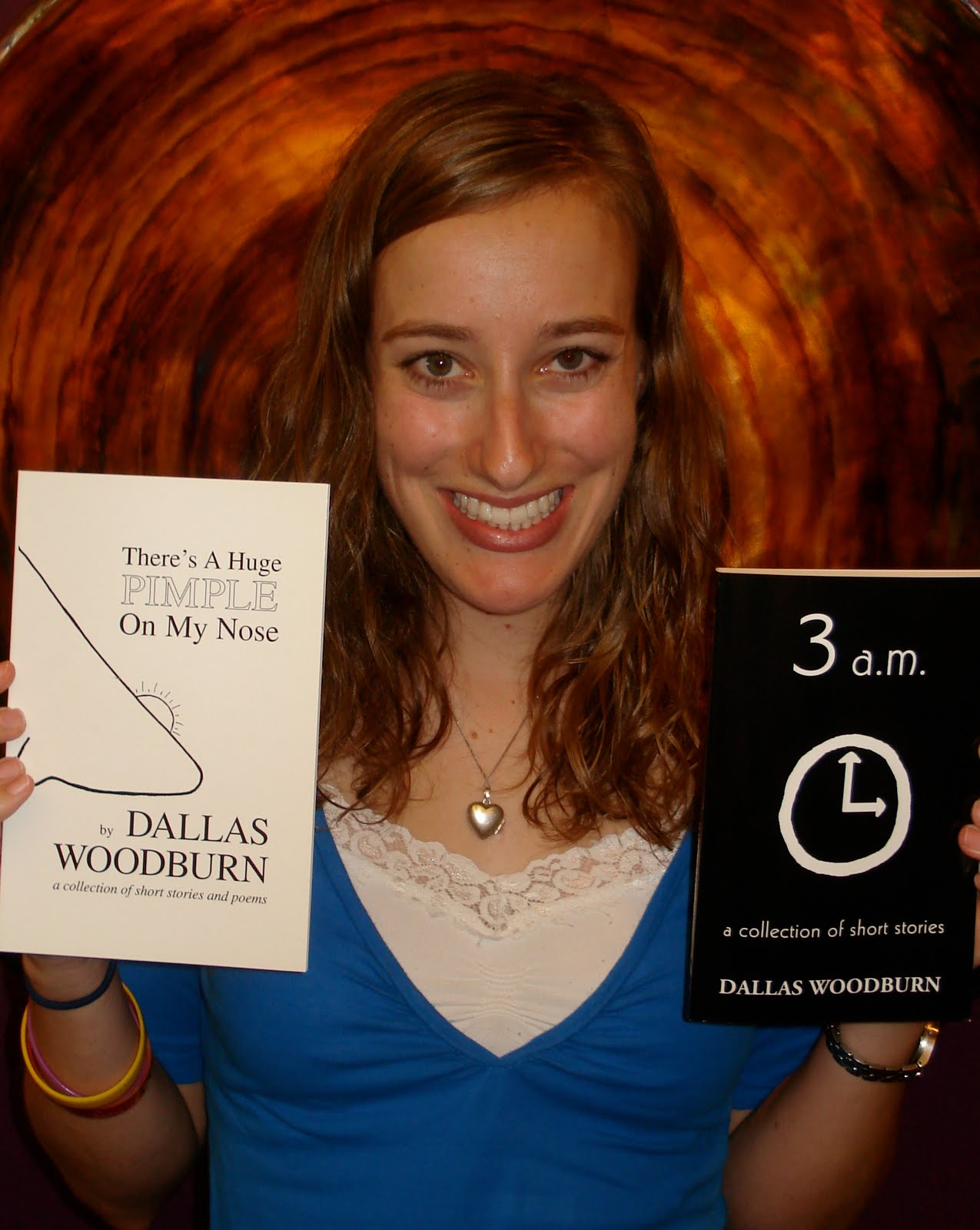
Friday Speak Out!: "From Almost Famous . . . To the Cutting-room Floor," Guest Post by Dallas Nicole Woodburn

Friday, March 12, 2010
FROM ALMOST FAMOUS . . . TO THE CUTTING-ROOM FLOOR

by Dallas Nicole Woodburn

Soon, my face will be on that big screen, I thought, as the plush theater seats steadily filled around me for the red-carpet premiere. I’ll be famous!

Okay, almost famous. Or, maybe, recognizable. Possibly. Around campus.

“Why are you here, dear?” asked the Versace-dressed woman beside me in the center-aisle VIP second-row seats.

I tried, but failed, to hide my smile. “I’m in The Movie,” I said, excitement overwhelming any small dose of humility I possessed.

Okay, so maybe movie isn’t the right word. It was more of a short film; a documentary to celebrate the 125th anniversary of the University of Southern California, where I was a freshman majoring in Creative Writing. As a student with two published books to my name (first editions still available!) they interviewed me twice, for more than an hour each time, asking all sorts of questions: Why did you choose USC? Do you like the writing program? If you see Pete Carroll, will you get his autograph for me?

I spoke about the energy and school spirit on campus, how President Sample (who had come across my second book) wrote me a personal letter welcoming me to the university, and I mentioned I was looking forward to having T.C. Boyle, one of my favorite authors, as a professor in upcoming years. I was thoughtful, I was eloquent, I was charming. “You’re a natural,” the cameraman told me.

Now. The lights went down. I patiently fidgeted through each big-screen interview, until suddenly my face appeared, as huge as Dan Brown’s advance check.

“I’m sooooo excited about having T.C. Boyle as a professor!” On-Screen Me gushed.

The camera cut to Professor Boyle, looking as Hollywood as ever in his trademark red Converse high-tops, a suit-jacket over a black T-shirt, and sunglasses hanging from a bead Zen-like necklace. “I think I provide an inspiration for them,” he said. He paused, then added the punchline – and punch to my stomach: “Because they think, if he can do it, anybody can!”

He laughed.

I cringed.

I waited for the film to return to me – this time Calm Me, regaining face with a more poised comment – but soon the closing music swelled, the credits rolled, the lights came up, and it was Over. Finished. My starring role was reduced to a blink-and-you’ll-miss-it line that made me seem like a teeny-bopper with a crush. Meanwhile, my two hours – minus eight seconds – of brilliant interview lay on the digital-age equivalent of the cutting room floor. I might be “a natural,” but I decided, then and there, to stick with screenwriting.

* * *

“If you're writing screenplays, STOP IT!” Ray Bradbury exclaimed, his voice filling the packed auditorium. “Hollywood’s full of $#*&!”

The audience roared, but his words made me shrink. If the great Ray Bradbury has trouble selling scripts, surely I’m full of $#*& for thinking I can.

And yet, here I was nine months later at the Santa Barbara Writers Conference, teaching a workshop for young writers – and also slipping into the highly acclaimed Walter Dallenbach’s screenwriting workshop whenever I got a chance. Here, I joined a group of two-dozen other Hollywood hopefuls to read our screenplays aloud for “flow,” all of us dreaming that our script will become the next Sundance surprise.

“I was walking in downtown L.A. last week,” Walter told us, “and I randomly asked ten people what problem they were having with their screenplay. Of those ten people, only two gave me strange looks and said they weren’t working on a screenplay – the remaining eight of them launched into detailed descriptions of their plot holes and character troubles.” A few people laughed. “I’m not joking,” Walter insisted. “Hollywood’s full of $#*&&% screenwriters!”

* * *

The final night of the Santa Barbara conference, T.C. Boyle – wearing his trademark ensemble of red high-top Converse sneakers and T-shirt/suit jacket – read a sneak snippet from his latest book. Incredibly, the guy still doesn’t know who I am, even aft er I sent him a copy of my book, introduced myself at the L.A. Times Festival of Books, and cornered him in the English department elevator, where I lamely stammered “Y-y-yes” when he asked what floor I wanted.

Even though a number of his novels have been made into feature films, Boyle echoed Bradbury’s comments, saying: “I don’t fool around with screenplays. I sell the rights and let Hollywood deal with it.”

Later, T.C. – who had been introduced by his full name, Thomas Coraghessan Boyle – signed books. I joined the long line of eager fans, hoping he hadn’t yet gotten a restraining order against me for stalking. Fifteen minutes later, I was staring at my nervous reflection in Boyle’s mirrored sunglasses, while he read my name from the sticky-note placed on the book’s title page to speed up the process. “Dallas . . .” he said, the syllables rolling slowly off his tongue, as if perhaps I was indeed vaguely familiar, then noticed my “Young Writers Program Faculty” name-tag. “How were the kids?” he asked, gesturing to it with his pen.

“I had a lit agent talk to them yesterday,” I said, trying to coolly, and finally, make a memorable impression. “He told the class he’s interested in anything – fiction, nonfiction, thrillers, romance. Anything except science fiction or fantasy. Then, he went around the room and asked each kid, one by one, what kind of book they’re working on, and, one by one, they told him, ‘Fantasy. Science fiction. Fantasy. . .’ Nothing but science fiction and fantasy, all twenty-four of them!”

The moment stretched seemingly as long as a Peter Jackson movie, and then . . . he laughed. Thomas Coraghessan Boyle laughed.

“You’re a natural,” T.C. said. I beamed, even though I knew the compliment was pure Hollywood: full of $#*&.

* * *

Dallas Woodburn, 22, is the author of two collections of short stories and a forthcoming novel. Her short fiction has been nominated for the Pushcart Prize and has appeared in the literary magazines Monkeybicycle, Arcadia Journal, Cicada, The Newport Review, and flashquake, among others. She has also written articles for Family Circle, Writer's Digest, Motherwords, and The Los Angeles Times. Find out more about her nonprofit literacy foundation and youth publishing company at www.writeonbooks.org and http://dallaswoodburn.blogspot.com/

~~~~~~~~~~~~~~~~~~~~~~~~~~~~~~~~~~~~~~~~~~~~

Would you like to participate in Friday "Speak Out!"? Email your short posts (under 500 words) about women and writing to: marcia[at]wow-womenonwriting[dot]com for consideration. We look forward to hearing from you!

~~~~~~~~~~~~~~~~~~~~~~~~~~~~~~~~~~~~~~~~~~~~
Read More »

Tip for Screenplay Writers (and NaNoWriMo Writers Too)

Saturday, November 22, 2008
"I've been doing something that I thought I'd invented myself and then I discovered in a conversation with Jim Cameron and then I read in an interview with George Lucas where he talked about the trick that Francis Ford Coppola taught him and it turns out everybody's doing the same thing. We never read what we write. I know that sounds preposterous but the point is you don’t edit while you’re writing. We don’t even dare look at what we're writing until it looks like there's around a hundred pages. It sounds nuts but when you have a hundred pages and then you finally look at them, you have the aesthetic distance to edit yourself."

-Steven Souza, screenwriter
Read More »

At the Movies

Friday, May 02, 2008
Certain things happen over and over in movies that just don't reflect real life. For some Friday fun, we'll take a look at a few of these silly Hollywood clichés. Here are a handful of examples from a longer list called Things We've Learned from the Movies:

* During all police investigations, it will be necessary to visit a strip club at least once.

* The ventilation system of any building is the perfect hiding place. No one will ever think of looking for you in there and you can travel to any other part of the building you want without difficulty.

* In school, teachers will always be interrupted mid-sentence by the end-of-class bell.

* Television news bulletins usually contain a story that affects you personally at that precise moment.

* It is always possible to park directly outside the building you are visiting.

* A detective can only solve a case once he has been suspended from duty.

* Police Departments give their officers personality tests to make sure they are deliberately assigned a partner who is their total opposite.

* If staying in a haunted house, women should investigate any strange noises in their most revealing underwear.

* The Eiffel Tower can be seen from any window in Paris.

* A man will show no pain while taking the most ferocious beating but will wince in agony when a woman tries to clean his wounds.

* All grocery shopping bags contain at least one stick of French bread.

* Once applied, lipstick will never rub off - even while scuba diving.

* Mothers routinely cook eggs, bacon and waffles for their family every morning, even though the husband and children never have time to eat them.

* Any person waking from a nightmare will sit bolt upright and pant.

* Building ventilation ducts are always clean.

* Grocery shopping bags are made out of brown paper and there is always enough shopping to fill two bags exactly.

*Large loft-style apartments in New York City are well within the price range of most people - whether they are employed or not.

*At least one of a pair of identical twins is born evil.


Maybe you have some of your own ideas to add to the list.

--MP
Read More »

I Support the Writers' Strike, But. . .

Saturday, January 12, 2008
I support the writers' strike. I do. And not only because I am a writer, and I know how hard it is to make any money. I have followed the strike a bit, and after signing my own book contract for the first time recently, I realize how every penny counts. Every right that you give away to a publishing or production company counts. Let's face it, without writers, without a lot of you that are reading this blog, all the magazines, newspapers, blogs, Web sites, books, TV shows, and movies we love wouldn't exist. These works become a part of our daily lives. They enter our dreams, our dinner discussions, even our blogs. Even reality TV shows need writers. Someone has to write Survivor host Jeff Probst's brilliant questions and explanations of the competitions. Have you seen him ad lib as a guest host on Regis and Kelly?

But the reason I bring up this strike today is one of the best television shows that I have watched in a long time is in trouble. I don't watch very much TV, and I TIVO everything I want to watch to save time on commercials. Anyway, I'm not sure if it's all because of the writers' strike or if it is not getting the ratings it needs (although it really should. REALLY, please read on.) Women's Murder Club (ABC), which is based on James Patterson's book series, is an excellent show. It caught my interest one day when I was home and vegging out, watching some daytime TV. Angie Harmon, who stars in the show, was on the publicity circuit and on The View. As soon as I heard it was based on Patterson's novels, I was interested. Even if you don't want to admit it, most writers DREAM of someone calling them and saying, "Uh, yeah, we would really love to turn your book into a TV SHOW or even a MOVIE." Come on, admit it, don't you want to see your characters live on screen? Patterson is with the creative process all the way with this series, which makes it even better in my opinion.

Angie Harmon described the show as a cross between Law and Order and Sex in the City (also a book.) It is that and more. If you haven't caught an episode, go to ABC.com and watch one-- in your spare time, of course. I don't want you to use my advice on this blog as an excuse for not meeting those writing goals you set on January 1. Study the characters, the dialogue, the storyline. What makes me care so much about Lindsay Boxer (Angie Harmon's character?) I don't know, but I want to figure it out, so I can put the same kind of care and skill into creating my main character for my YA novel. Patterson, my hats off to you!

I support the writers' strike. I do. But I want my show back. I don't want the writers to give in. I want them to get fair treatment. I want them to get all the residuals they deserve. I also want all the writers for Women's Murder Club back at their laptops with their coffee and telling me what is going to happen with the Kiss Me Not Killer!

Maybe I should look at this positively. I will have more time to reach my own New Year's writing goals without this series on air. I will have more time to read Patterson's novels, too. But, I'm sure many of you feel this way about your own shows. Let us know. Everyone needs the chance to vent, and here's a place to do it. Happy writing!

Margo Dill
www.margodill.com
Read More »
Powered by Blogger.
Back to Top