Showing posts with label overused words. Show all posts

Self-Publishing Pitfalls

Thursday, May 03, 2018
So I’ve been reading more self-published novels these days and I’m finding a much improved product out there. But as excited as I am to see professional standards in self-publishing, I’m still finding errors. The good news is that they’re not major errors; they’re easily fixable errors!

PROOFREAD, PROOFREAD, PROOFREAD

By far the biggest error I come across is the misplaced, extra word in the sentence:

My heart nearly broke in two in when John’s puppy licked my face.

There is a very good reason why this kind of error ends up so often on the written page. As sophisticated as our technology is, a computer program cannot discern when an extra word is lurking about in a sentence. It’s up to the human writer to correct that sort of mistake. There’s also a very good reason why the human writer misses an extra word: we don’t see it.

When we write, whether it’s a manuscript, email, or tweet, we know what we mean to say and that’s what our brain reads. I can’t tell you how many times I’ve read an email that I’ve sent where I’ve omitted a word in the sentence or added an extra word. I just didn’t see the error because my brain automatically corrected it. So how to guard against this self-publishing pitfall?

Ask a writer friend who has never read the manuscript to do a line proofread. Granted, that’s asking a lot and you’re going to owe that writer friend big time. But a fresh read will give your work the best chance of fixing those kinds of errors. Plus, there’s something else that a new reader can do for you.

GET RID OF REPETITION

We all have a word or cliché or phrase we over use. Trouble is, we’re not aware of it. We love our favorite words, expressions, or phrases because they make us laugh, or because we think they’re different and/or unique, or just because. But it’s because these expressions are funny or different that a reader remembers them. Take, for instance, the word “quirk” used as a verb. As in, “He quirked an eyebrow.” Or, “Her mouth quirked.”

Quirk is a perfectly fine word. But in this day and age, we use it more as a noun than as the verb. The verb usage dates back to the 16th century and means “to move or twist suddenly.” Also a perfectly good albeit unusual verb. And for reasons I can’t explain, it’s become very contemporary and cool to say, “He quirked an eyebrow.” How interesting! How unique!

Yep! But I guarantee that the first time I read it, I’m going to notice it. And if you write an entire book and use it once, I’ll give you a pass. But I’m pretty sure I’m going to read it another five or six times, and I’m going to think about it every time. And what I’m going to think is, “Why did this writer choose to use this weird verb?” A trusted friend will call you on those over-used though interesting-the-first-time expressions. Do your readers a favor and listen.

PUNCTUATION PET PEEVES

I don’t think I need to explain how annoying it is to see a misplaced comma, random quotation marks, or an incorrectly-used semi-colon. But I will also admit that it’s only other writers who will likely be annoyed by punctuation errors.

Or maybe it will just be me. The point is, you can easily fix these self-publishing pitfalls before I download your e-book. And that’s a win for everybody!

Cathy C. Hall spends as much time reading as she does writing, so let her know if you've published a good book! (Though her To Be Read List is very, very long. Also, she's pretty sure that she has never quirked her mouth, but she may have quirked an eyebrow or two.)


Read More »

AutoCrit: A Helpful Tool for Editing Flash Fiction

Wednesday, April 07, 2010
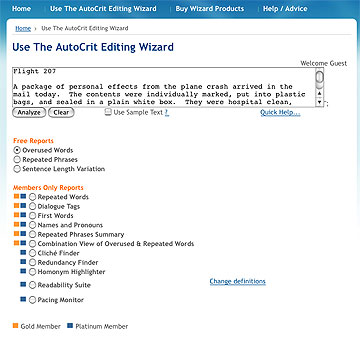
I stumbled across the AutoCrit site today and found it to be a helpful tool for editing your flash fiction stories. The free version allows you to paste a story of under 800 words into a text box, where you have the option of selecting reports on three categories: Overused Words, Repeated Phrases, and Sentence Length Variations. These categories are crucial to analyze when crafting a flash piece.

So, I dug out an old story and pasted it into text box here: http://www.autocrit.com/autocrit/wizardformpage.php


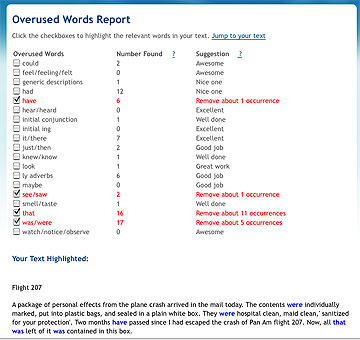
I clicked the "Overused Words" button and clicked "Analyze." The next screen shows a list of typically overused words with red check marks pertaining to your story, as well as suggestions for how many words to remove.

I definitely used "that" too many times--which is a common mistake *that* (delete!) I see a lot in flash fiction, and a bad habit of mine. In most cases, you can safely remove "that"--it doesn't add anything to the sentence--and will help trim your word count.

The AutoCrit said my use of "ly adverbs" was "Excellent," as was my use of "could," "it/there," and "maybe." Other interesting areas are the use of generic descriptions (I got a "Nice one" response), the use of feel/feeling/felt (I got a "Yay"), initial conjunction ("Well done"), and initial ing ("Nice work"). The comments are encouraging and are all wonderful helpers to fix passive voice problems.


Beneath the checklist is your highlighted text with culprits displayed in blue. Drag your cursor over the text and copy-paste it into your MS Word program--you'll notice the blue text copies as well. At least it did with mine.

You can only select one option at a time but you can hit the back button after you've read the results and your text will still be there. Then you can select one of the other options, such as "Repeated Phrases" and "Sentence Length."

Repeated Phrases: This page shows all phrases which repeat within 100 words in highlighted blue text. If you are using a repeated phrase for emphasis it can be very powerful, but remember it should contribute something to the story, so use them carefully. When in doubt, leave it out--especially in flash. It will only eat your word count.

Sentence Length: This page gives you a list of the beginning of each sentence and how many words it contains. It's important to vary your sentence length because similar-length sentences can be dull to read.

The AutoCrit site offers further services to those that subscribe for a fee. I haven't tried their paid services, so I can't offer a review. Their "Members Only" reports include other editing tools such as: Dialogue Tags, First Words, Names and Pronouns, Cliche Finder, Redundancy Finder, Homonym Highlighter, Readability Suite, and Pacing Monitor.

But I found their free online tool to be quite helpful in trimming unnecessary words and a good reminder to really check your story for any issues you might have missed. So if you're preparing to enter the WOW! Women On Writing Flash Fiction Contest, you may want to test your story with this helpful little tool before you hit the send button.

Happy writing!
Read More »
Powered by Blogger.
Back to Top