Showing posts with label Pat Wahler. Show all posts

Tell, Don't Show

Saturday, December 11, 2021

Like all writers, the mantra Show, don't tell has been drilled into my head for decades. It's also what I try to instill in my middle-schoolers. Don't tell the reader your character is angry. Show the reader. What's going on with the character's breathing? Is their face getting red? Are they clenching their fists? Are they pacing? 


I also depend on internal dialogue to flesh out a story. The thoughts that are swirling around in a character's head add so much to a piece. Every instant, we're having a conversation with our self--in our head. Letting the reader in on a character's internal workings enriches a book.


Scripts are different. Way different.
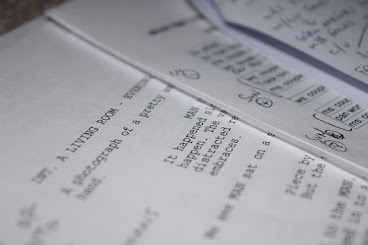

                                                                  olilynch's image by Pixabay


When writing a screenplay, the writer has to tell what the viewer will see--in a straightforward way. Usually, I try to paint pictures with words. Flowery phrases. Similes. Metaphors. Alliteration.


In a script, you don't need no stinkin' similes. In a bare-bones fashion, the screen writer has to tell what the camera sees... what the actor does. And that's it. The goal is to create a visual and emotional moment. Actually, the goal is to create a whole string of emotional and visual moments.


If you're curious how writing a novel is different from writing a screenplay, you can read this article.


I'm halfway through a first draft of a script. I'm transforming my novel, Greenwood Gone: Henry's Story, into a screenplay. While at a writing retreat, a writer friend asked me if there were directors interested in it. Of course. Have you heard of Martin Scorsese? Denzel Washington? Steven Spielberg? The three of them are in a bidding war.


Just kidding. But I can fantasize, can't I? 


The good news: there are screenwriting programs that help you with the formatting. I'm using StudioBinder. After getting accustomed to what I initially thought of as wonkiness, I've found it's almost intuitive. After typing up a bit of action, the program automatically switches to a character and dialogue. Or does it? Is it simply me that has gotten into the scriptwriting groove?


I'm not sure.


I started this as my NaNoWriMo project. A finished screenplay is going to be much tighter and way less textier, so even if I had finished it by November 30, it still would not have been 50,000 words long. I told myself that if I got to the end of the book by the end of November, I'd consider NaNoWriMo a success.


I failed.


However, the way I look at it is this: I have half of a rough screenplay done, and that is a half of a screenplay more than I would have had if I had not done NaNoWriMo.


It's good to be a cup half-full person...


Writing friends--I see some of your pieces as future movies. Seriously. Pat Wahler: Your book I am Mrs. Jesse James would make a superb movie. Linda O'Connell: The memoir I keep bugging you to write? It would make an incredible movie. Renee Roberson: You have dozens of real-life stories about missing people. Your lovely voice narrating the haunting episodes? It would be a definite winner. Angela Mackintosh: The memoir/novel you're still writing (and I haven't even read, but I know it will be mind-blowingly brilliant when it's finished) would be perfect for the screen.


Just sayin'.


Sioux Roslawski is a freelance writer, the proud author of Greenwood Gone: Henry's Story, a rescuer of dogs and a middle-school teacher. You can check out more of her writing on her blog.


Read More »

A Cover is a Cover is a Cover...

Thursday, October 07, 2021

If you saw this cover, would you buy the book?


photo by Sue B. Edwards


I imagine not. However, what if the title didn't look like it was written in blood? And what if the blurb said something like, "Two men form an unlikely friendship, as they team up to fight the battle of their lives" instead of "Across the twilight of fear, the red-drenched, terrifying dream begins..."? Might the book at least prompt you to pick it up and give it a second glance?


(By the way, Fevre Dream by George R. R. Martin is one of my favorites. And bonus: it's not long enough to serve as a doorstop, unlike his Game of Thrones books.)


The cover of a book is huge. I've not bought books because the cover didn't hook me. They might have been incredible books that I passed on... And yet I did exactly that. I passed on the books because either the cover didn't hook me or it turned me off.


A cover that I love is Pat Wahler's book I am Mrs. Jesse James. It's simple, classy, and gives you (what ends up being) an accurate idea of what the novel is about.


Pat's publisher designed the cover. She was lucky. Pat liked the design. If your publisher chooses one you don't like, you might not have any say in the matter.


I was even more fortunate. Margo Dill (my publisher) let me use an artist of my choice, and when the cover was finished,  Margo finalized it with different colors and borders/text placement. I really love it. It's striking, and the black, white and gray color scheme represents the fact that this is a story about racism--what the White people did to the Black people in 1921 Tulsa... and all the gray details in-between.


It also solved a huge problem: I had no idea what the main character--Henry--looked like. The silhoutte the artist cut out of the 1921 newspaper headlines allows the reader to form their own impression of Henry.


Authors--if they're self-publishing--hope their research and getting feedback from writing friends results in a great cover. Authors who are working with their publisher hope that either their input is considered or their publisher makes a wise decision when it comes to what goes on the (front and back) cover of the book.


In reading about what makes an effective book cover, I came across this article that highlights various books and what covers were rejected. I was fascinated with why some didn't make the final cut.


If you have a book (or two or three or more), I'd love to hear about your choices and decisions when creating a cover. If you're a fan of Fevre Dream, I'd love to hear from you (it's a little-known book). And if you're a fan of my book, I'd really love to hear from you...


Sioux Roslawski is the author of Greenwood Gone: Henry's Story, which is the first book she has birthed. Most of her time is spent teaching middle-schoolers (a true labor of love) and taking her dog, Radar, on walks. You can check out her work by checking out her blog.


Read More »

Forget the Sugarplums...

Tuesday, November 13, 2018
These days I ain't got sugarplums dancin' in my head. No, I'm daydreaming about a publishing contract.


Of course, I'm not quite there yet. My manuscript will be finished in the next two weeks (there's just a few places I need to rethread a tiny storyline and a little flashback I need to put in place), and then I'm sending it to my favorite editor-for-hire, Margo Dill, who's agreed to take a second stab at it. (What a glutton for punishment she is.)

Recently I had the pleasure of sitting next to Pat Wahler at an author event. Pat has three books out right now. (Children, can you say "overachiever"?) I had just finished reading her I am Mrs. Jesse James and picked her brain.

Pat makes the path to publishing look like a walk in the park on a flat, tree-lined trail. She's that talented and that much of a professional. However, if I'm really really lucky, I might be faced with choices in the next year or two. Will I bust my butt to get a traditional publishing deal? Or, will I form my own imprint?

I picked a bit more meat off Pat's brain, and these are some of the tidbits she offered up:


  • With traditional publishing, the publisher puts out the money for editing, the cover design and layout, the ISBN number, printing and so on.
  • When a writer forms their own imprint, the author needs to pay for an editor/proofreader, an artist to design the cover, and someone to do the interior design and layout. Of course, this also means the author has the final say when it comes to decisions. The title. The look of the cover. The printer.
  • By taking either path--traditional publisher or creating an imprint--a writer becomes rich  internationally famous exhausted, because the author has to do the marketing. Pat's set up book signings and written press releases. She's created book marks, business cards and advertisements. Multiply that times three (since she has three brand-new books out) and what do you have? You have a writer who's working on their next book, because according to Pat, the best way to sell a book is to publish a new one.
Pat left me with some final words that made publishing fairies dance in my head. She said that when a writer's book is finally published, "Savor the moment--worth all the time, trouble and money it took to get there--when you can officially say, 'It's true. I'm officially an author.'"

I look forward to that moment...


Sioux is a middle school teacher, a dog rescuer, a wife, mother and grammy... along with being a frustrated writer. She's in awe of her writer friends--some write poetic prose, some write historical fiction that's so authentic, it doesn't seem like fiction--and hopes to someday join them with her own book.


Read More »

I'm Not Mrs. Jesse James--But I AM Envious

Thursday, August 23, 2018
Pat Wahler's book, I am Mrs. Jesse James, is being released on August 28... and I'm a bit envious.


Oh, I'm extremely happy for Pat,  let's be clear about that. I'll be at one of her book signings to snap up a copy and I'll continue to sing her praises because of her writerly work ethic and her gift with words, but I've been working on a historical fiction project for almost two years. I've had an editor look at it, and now I'm doing some much-needed deconstruction and reconstruction...

... which made me curious. What did Pat learn along the way that might help me? Or you?

Fortunately, Pat was gracious enough to agree to answer my questions. Here is a bit of what motivated Pat Wahler and what she learned along the way as she wrote I am Mrs. Jesse James.

Why the wife of Jesse James? Why write a novel about her?

Jesse James is discussed almost as much today as he was during the time the Pinkertons chased him after the Civil War. There is an astonishing amount of information on him. I knew he had a wife but found little about her. This piqued my curiosity. What kind of woman was Zee Mimms James? The book came about when I asked myself that question. I felt she needed to be more than a footnote in Jesse's life.

Pat, that is a powerful lesson. You were curious as a writer and a researcher, which will inevitably lead to fueling the curiosity of readers. I'm curious about why historical fiction appeals to you, since you've written in different genres.

I've always had an interest in history, but often textbook-style material didn't appeal to me. I soon discovered that most historical novelists put every bit as much research into writing their book as historians put into theirs. Historical fiction brings the people and places of the past to life in an engaging way.

Yes, research can take us into exciting directions, but it isn't easy. What obstacles did you encounter as you dug into Zee's life?

Research was a challenge. As I mentioned earlier, there wasn't much primary material on Zee. However, as a novelist, this provided opportunity. I read everything I could find on her, Jesse, the James family, significant events in their lives, and the turbulent times in which they lived. From that, I got a feel for how she might think and react, which helped me shape her character.

I love the idea of you stepping into Zee James' shoes and getting a feel for what her life was like. I've been struggling with organizing my manuscript. How did you plan or map out your novel?

Biographical historical fiction provides a built-in basic outline. Census data gives factual information like birth dates, marriages and children. You generally know the places your characters went and why they went there. History tells what events happened around the characters that impacted their everyday lives. The novelist has the fun of filling in the other details.

Pat Wahler


Pat, I'm glad to know that after all the revising and critique was done, you still considered it a fun endeavor. I imagine your journey was paved with some great advice or suggestions. Would you mind sharing a tidbit or two?

Don't wait to start the story! I had to do an entire rewrite on the first three chapters because my editor said beginning with Zee's childhood wasn't necessary. She was right. Too often, backstory gets in the way of connecting the reader with the character. If they don't care about the character, they'll close the book.

You've written a lot of creative nonfiction (short memoir pieces), which take short bursts of persistence. However, writing a novel isn't a sprint, it's a marathon. Pat--what was your typical writing day like?

I'm freshest in the morning, but I can also say there were many times when I sat at my desk most of the day. Especially when deadlines loomed.

Is there any part of the day when I'm fresh? ;) I'll have to think on that. As I've been digging into the story I'm working on, I've encountered some surprises. What most surprised you about Jesse James' wife?

Her love and loyalty, and her willingness to provide a helping hand to others endeared her to me. I think Zee tried to do her best, despite the very difficult circumstances in which she lived.

Pat, so many writers set a project aside, and it ends up gathering dust. I'm sure most writers have at least one cobweb-covered manuscript. You persevered.  Was there ever a point where you almost put the manuscript aside--for good? If so, what made you pick it up again?

I toyed with the idea of writing about Zee more than ten years ago, and that's when I started the research process. During NaNoWriMo in 2009, I did more research and wrote in earnest. Then I discovered a romance writer had just published a novel about Zee. I figured there wasn't any point in continuing and put my book aside for a few years. But the muse nagged. I looked at the multitude of books on any single prominent historical figure and realized I could still tell my own story about Zee. I didn't read the other author's novel until I'd completed mine, and discovered we'd taken very different approaches. Never give up!

Pat, I'm so glad you didn't give up, and I'm looking forward to reading I am Mrs. Jesse James. (Pat's novel comes out on August 28.) You can pre-order it here. 

Do you feel lucky? You could be the winner of a free copy. I've preordered two copies of I am Mrs. Jesse James. Leave a comment here, and in early September, when they're delivered, I'll do it old school and draw a name from a bowl/basket/hat full of names.

Update: Joan Leotta won Pat's book. Joan, if you email me at sroslawski(a)yahoo.com and give me your mailing address, I will send you the book.


Sioux Roslawski has wanted to be a writer since she was 13. She's written lots of creative nonfiction but someday, she hopes to have her manuscript published. If you're wondering why Sioux always has bangs, check out that billboard-sized forehead, and if you're interested in reading more of her stuff, check out her blog.
Read More »

Three Reasons Why You Can't Handle the Truth (of Success)

Monday, October 02, 2017
Recently one of the Muffin writers wrote about her fear of failure. After reading Beth’s post, I wondered. Are we afraid of failure? Or sometimes, is it a fear of success that paralyzes us?

For me, I know it's often a fear of success that keeps me from moving forward on a project. Fear of failure? I don't think so. Why? I teach kids who are 13-15. They're hardly ever equipped with a filter on their mouths.

I've seen my name scratched into bathroom stall walls (such as comparing me to a female canine), so the idea of getting a "no" or a nasty letter from an editor doesn't scare me.

However, getting out of my rut does.

Wondering if my "fear of success" theory about myself was completely whackadoodle, I read an article. I realize that I am scared of succeeding, and this might be why:

1) fear of becoming someone else

I get it. With success, a writer is sometimes transformed into somebody else. Their head grows. They puff up with clouds of self-importance. They become too superior to deal with those poor pathetic writers who haven't made it yet.

photo by pixabay


However, I have writer friends who have gotten books published. Lisa Ricard Claro. Cathy C. Hall. Sean McLachlan. Margo Dill. Sue Bradford Edwards. Pat Wahler. None of them (I don't think) are flouncing around in a feather boa and a tiara and charging for autographs. (Sorry, Sean.)

That’s not it.

2) fear of selling out

Some writers think that "selling out" means self-publishing. Other authors consider the compromises that (I guess) must be made when getting a book published in the "traditional" way as a threat to the writer's artistic integrity.

In my opinion, any way you can get your work out there is fabulous, so I don't think this is why fear of success puts me in a state of paralysis.

3) fear of not being able to cope with success

Ding ding ding. We have a winner. I know what my rut is like because I've been stuck in it for decades. I write for the same markets. I submit. I get more rejections than acceptances. I do occasional author events/book signings. It's a life I'm comfortable with.

However, if I put the finishing touches on my manuscript and wrote a decent query and submitted it and snagged some interest and ended up getting it published? Whew. That kind of success would throw me into unknown territory. What kind of expectations would be heaped onto my back? What new pressures would I have to contend with? That level of success would necessitate me becoming a marketing machine... which I've never thought I'd be good at. More spotlights would be shining on me, which would (hopefully) mean reviews (and hopefully some of them would be positive).

Google image


I get it. Failure and rejection are hard to take but I have age on my side. You get to a certain stage of life and it often equates into a I-don't-care attitude. My day job also helped me build a suit of sturdy armor.

No, for me it's fear of success. And hopefully I can soon succeed in overcoming that fear...

How about you? Are you scared of success? Or is it failure that has you fearful?


Sioux Roslawski is afraid of success, but she's trying to overcome it. During the day she works with middle-schoolers who really are polite but also quite honest, resulting in much laughter and much good-intentioned back-and-forth ribbing. If you'd like to read more of her writing or you'd like to cheer her along, please check out her blog.

Read More »

Three Things People Think About Writers

Sunday, August 27, 2017
          Yesterday a book of Chicken Soup for the Soul books was delivered to our home. It was expected. I'd gotten  a story published in their My (Kind) of America anthology, and it goes on sale on August 29. A few minutes after I opened the box, my husband grabbed a copy and started scanning the table of contents. I knew what was coming--he does it every time. This time, I beat him to the punch.

         "Page 147," I said.

          "Out of..." his voice trailed off. He thumbed to the back. "401. That means you're in the front half."


           According to my husband, the placement of a story indicates its value. The weaker stories are towards the collection's end. The stronger stories they put first. No matter how many times I talk about theme and the juried process the editors put the stories through, he continues with his screwed-up thinking... which makes me think about what other people think about writers.

1.   "You don't have a book published? (Then, you're not really a writer, are you.)" James Patterson has beaucoup books on bookstores shelves, and all he does is outline the plot. Other (unnamed) people write the books. I'm not sure that means he is really a writer.

          On the other hand, I know many people who write every day, submit to many different markets, and their pieces are published all over the place--just not in a book. And I know many folks who write almost every day, and haven't got published... yet. They're all writers, from my perspective.
They do the hard work on a regular basis.

2.   "It's easy to write. (You just sit on your butt and tap away at your computer, right?)" Much to the surprise of people who don't write, the words don't come flowing out the right way the first time. (Except for Cynthia Rylant, the who in an interview spoke about her revising process saying, "I don't really have to revise. It comes out right the first time. I'm guess I'm just lucky that way." Some day I'm gonna slash Rylant's tires...)

         Writing is more slashing and burning than it is lining up the lines and the paragraphs and the pages like a battalion of soldiers. If everyone knew how many words we delete, compared to how many we keep, they'd be amazed... and perhaps a bit more respectful of the craft.

3.   "You're so lucky. You get to make your own schedule. (You get to watch lots of TV and lay around on the couch. I'd love to be able to live that life.)" I know some full-time writers. Cathy C. Hall. Sue Bradford Edwards. Lisa Ricard Claro. Sean McLachlan. I know some people who retired from other jobs and now freelance. Linda O'Connell. Pat Wahler. I know people like me who work other jobs and fit writing (sometimes not very well) into their lives.

        Unfortunately, we usually don't get to make our own schedule. Vegging out on the couch and watching movies isn't something we can do every day. Being a writer might mean squeezing it in, 15-minute increments at a time. It might mean waking up an hour earlier than necessary every morning to have some uninterrupted time to write.

       It also might mean we'd prefer to be working on a manuscript, but a deadline for something else takes precedence.

       How about you? As a writer, what can you add?


Add caption

Sioux Roslawski doesn't have a book on a bookstore shelf with only her name on the spine but nevertheless, she considers herself a writer. Most of the time, she's teaching middle-schoolers how to free themselves enough to write honestly and most of the time (99% of the time) she loves her job and revels in the strong student voices that surround her. Currently she's working on polishing up a historical manuscript for middle grades (she's polishing it until it's nice and shiny); if you'd like to read more of her stuff, check out her blog.       


Read More »

Friday Speak Out: Got Blog?, Guest Post by Pat Wahler

Friday, August 07, 2009
Got Blog?

by Pat Wahler

For a long time I resisted the idea of launching a blog. After all, I’d only started to dabble in creative writing a few years ago. How in the world could a beginner like me entertain others? Besides, I’m a tech-know-not. Setting up a blog certainly must require expertise that I did not possess.

But soon after a writer friend launched her blog, I decided to explore the concept by visiting Blogspot.com. The step by step instructions demonstrated that even I, the most inept of computer users, could publish a pretty darn professional looking blog. Best of all, the site didn’t charge a dime to participate, so why not? My favorite topic, animals, seemed the perfect platform for me, so on November 15, 2008, I launched Critter Alley into the seemingly infinite blogmosphere. Here are a few things I’ve learned since.

Blogging is a wonderful writing exercise. I don’t journal, but now practice the discipline of producing an interesting (I hope!) critter-related story each weekday. The thought of writing for others gives me incentive, and knowing that literally anyone in the world might read my words is an empowering feeling. And since daily stories require material aplenty, I’ve learned to observe life a new way, from a writer’s point of view.

When you report factual information, research is critical. People will be quick to let you know if something you’ve written isn’t quite right. For example, when I blogged about Jim the Wonder Dog, a reader emailed me. He claimed that Jim should have been described as a setter, not a spaniel. I verified his comment and made the correction. Although locating reliable sources and supporting material without violating copyright protection can be a challenge, it’s a habit worth acquiring for your next writing project.

Most of us don’t have publicists. Writers must market themselves. Getting your name out for others to see can only help when the time comes to sell that first novel. After posting a favorable review on a critter related book, I emailed the author to let him know. He not only mentioned my review on his blog, but posted a link to mine. Pretty cool stuff for a novice like me!

Perhaps one of the best things about regular blog posting is witnessing the evolution of your own work. Successful authors preach over and over that the best way to improve skills is to write consistently. My commitment to Critter Alley forces me to write daily. At best, my work turns out to be something noteworthy or thought provoking. On a not so great day, I’ve written coherent sentences with a beginning, middle, and end. Both help make me a better writer.

In short, anyone who expends the effort to blog will learn from it. If you’re a writer and haven’t taken the leap yet, don’t make more excuses. Get yourself to that keyboard and create your opus.

What have you got to lose?


Pat Wahler is a multi-published freelance writer. She lives with her husband, dog, and cat in Missouri where it is not unknown for them to entertain a guest critter…or two…or three. She writes about all things animal on her blog, Critter Alley. http://critteralley.blogspot.com/

~~~~~~~~~~~~~~~~~~~~~~~~~~~~~~~~~~~~~~~~~~~~

Would you like to participate in Friday "Speak Out!"? Email your short posts (under 500 words) about women and writing to: marcia[at]wow-womenonwriting[dot]com for consideration. We look forward to hearing from you!

~~~~~~~~~~~~~~~~~~~~~~~~~~~~~~~~~~~~~~~~~~~~
Read More »
Powered by Blogger.
Back to Top