Showing posts with label National Poetry Month. Show all posts

Why Non-Poets Need to Read Poetry

Thursday, April 18, 2024
A favorite poet.

April is National Poetry Month. If you’re not a poet, you may be tempted to give this post a miss. “Ugh, she’s just going to yammer on about poetry. Yuck.” But bear with me. 

Even if you aren’t a poet, it is an excellent idea to read poetry. Here are five reasons why. 

Depth 

Heaven help us, poems have depth. There is the topic that you see on the surface. “Hey, this is a poem about bluebirds. I adore bluebirds!” But there is also the underlying topic. “Wait a minute. This is a poem about memory and how it shapes the present.” 

If you’ve ever been told that your manuscript won’t stand up to multiple readings, study poetry. If you’ve ever been told that your piece was too flat, study poetry. Need to know how to incorporate multiple themes? That’s right. Study poetry. 

Originality 

Poetry manages to create pieces with multiple layers and all that depth because successful poets do it while spinning wholly unique look at a topic. Want to write about the quietness of nature? Then you’ll have to do it without writing about hummingbirds, egrets, or the stillness of a pond. Why? Because Mary Oliver already did that. 

Because poetry demands a unique approach, it is a great lesson on getting beyond cliché and all that is overused. 

Perspective 

As you read poetry, you get to see the world in many different ways. You get to experience Mary Oliver’s perspective as well as Sherman Alexie’s. Want to know how Naomi Shihab Nye sees the world? Pick up her poetry. 

Poetry is an excellent way to experience the world through someone else’s mindset. It is a way to broaden your view. 

Every Word Counts 

In part, it is because poems are short, but poems are a literary form in which every word matters. Every word has earned its place in the poem whether it impacts the mood, the rhythm, or the pattern. 

If you are writing picture books or flash, you too need to make a case for every word you choose. You should study the type of writing you are doing, be it picture books, flash, or poetry. But it is also an excellent idea to study all three. After all, you never know where you will find inspiration. 

Word Play 

Children’s poetry in particular involves a lot of word play. In addition to rhyme, there onomatopoeia (sound words), assonance (repeating vowels or diphthongs), alliteration (repeated consonants), and just the galloping, romping rhythm of words. 

I’m not going to say that word play makes an appearance in every sentence I write. But when I want a to pack a punch, the words come out to play. Did you know that a string of single syllable words can help create emphasis? 

I will never be a poet. No, really. It just isn’t how I’m wired.  But I can appreciate the poetry of others as well as the lessons poetry has taught me to use in my own writing. 

So, tell me. What poets should I be reading? Favorite poems? Let’s share! 

--SueBE

Sue Bradford Edwards' is the author of 50 books for young readers.  
  • To find out more about her writing, visit her site and blog, One Writer's Journey.  
  • Click here to find her newsletter.

She is also the instructor for 3 WOW classes which begin again on  May 6, 2024. She teaches:
Read More »

Poetry, it's complicated

Thursday, April 12, 2018
In honor of National Poetry Month, I wanted to write about the basics of poetry, but can't decide what they are! I don't feel too bad about it, though, because many writers can't agree on what makes a poem great, much less the basics. I've read positive reviews of poets I don't understand, and negative reviews of some of my favorites. Poetry is complicated. A poet's use of abstract language representing abstract ideas can make it more difficult to comprehend. And many people just don't like it.

There are more forms and formats of poetry than I can name, and more poets than I will ever read. The best ones stir emotions by compressing time and meaning into a few lines of text on a page. They work their magic through the use of form and style using imagery, alliteration, metaphors, repetition, and other literary devices. But these techniques alone can't define a piece of writing as a poem, because writers use them in other formats. Like I said, it's complicated.

So, I'm just going to tell you about one of my favorite poetry books called "Love That Dog," a novel by Newbery-Medal-Winner Sharon Creech. My daughter first introduced me to it when she read it in elementary school, and I've read it many times through the years. The 86-page narrative poem takes us on young Jack's journey of learning to write and appreciate poetry. He asks simple questions of Miss Stretchberry, his teacher, whose answers help him discover his own voice. Perhaps she can help you discover yours.

Every writer should read this book. It not only provides some basic understanding of poetry, but helps clarify and expand our ideas of what a poem (and a novel) can be. And the story is beautiful and heartbreaking, and may make you cry.


Mary Horner teaches communications at St. Louis and St. Charles Community Colleges. She is a certified medical writer, and earned the writing certificate from UM-St. Louis.
Read More »

National Poetry Month: Checking In

Saturday, April 23, 2016
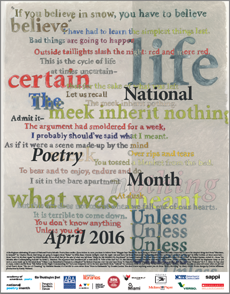
2016 Poetry Poster from Poets.org
It’s April, which means it’s National Poetry Month!

Earlier this month, Jodi Webb posted about National Poetry Month and the 30 activities you can do to celebrate.

I’ve been participating in Writer’s Digest’s 2016 PAD Challenge to write a poem every day in April. Writer’s Digest writer, Robert Lee Brewer, provides a prompt every day, an example poem he wrote, and space for others to share their poems.

As a self-proclaimed non-poet, this is a challenge for me! I have participated for the past several years, never writing 30 poems in the month, yet it has been so rewarding.

Making the switch from prose to poetry allows me to:

  • Concentrate on every single word choice
  • Focus on word order by noticing the rhythm of word choices
  • Enhance descriptions and emotion by using strong imagery
  • Avoid telling rather than showing

And these benefits are in addition to the multiple benefits Jodi already listed!

Like Jodi, I am not suggesting that you need to become a poet. But for those of you who are not poets, I encourage you to dabble in a bit of poetry now and then because it allows you to take residence in a different part of your brain, to see language differently, to feel stories differently. A new perspective can give your writing the boost it needs.

You don’t need to wait until next April to practice writing poetry: the 2016 PAD Challenge prompts are available year round so you can take the challenge at your own pace at a time that’s convenient for you.

How has National Poetry Month been going for you? What have you learned from reading and/or writing poetry this month?

Written by Anne Greenawalt
Read More »

National Poetry Month

Sunday, April 03, 2016
Like most writers, at one time I fancied myself a poet. I wasn't. I could never manage to create emotion and lyricism in just a few words the way poets magically do. So all that is left of my life as a poet is a few badly written (and well hidden) poems and a great appreciation for the people who can
write poetry.

I don't often indulge in reading poetry, but I make an exception in April. This April is the 20th anniversary of National Poetry Month. I know this because a neighboring county -- home to several universities -- celebrates Poetry Month in a big way and I always hear about the events sponsored throughout the county during April. But apparently you don't need universities to organize Poetry Month for you.  The National Poetry Month website has a list of 30 things to do for poetry month, many which you can do on your own or with your writing group. This is not just a list, each suggestion links to a page with additional help. I'm looking forward to Poem in Your Pocket Day! You're sure to find something that would be fun for you.

Maybe you're thinking, "Why read poetry, I don't write it?" I'm not suggesting that you become a poet, but poetry has a place in all our lives. Besides just enjoying it for beauty's sake, as writers poetry gives us a new way to look at words. Poetry illustrates so many "rules" that writing books and teachers are always telling us:
  • Don't use cliched descriptions.
  • Create emotion with your writing.
  • Cut out the unnecessary words.
  • Make your readers think.
  • Use foreshadowing.
Maybe you'll never publish a chapbook of poetry but I can attest to the fact that writing poetry exercises different writing muscles. It makes you think about individual words as more than what they mean, as you consider length, beat, how they "match" words in other lines. Dabbling in poetry (even badly written, half finished poems like those you will occasionally find in my journal) can help make you a better writer, no matter what your genre.

I'd love to hear which of the 30 poem activities you're doing to celebrate National Poetry Month.
Read More »

April Is National Poetry Month: “What Will Your Verse Be?”

Tuesday, March 31, 2015
I am a fiction writer and an academic scholar, and wouldn’t use the term “poet” to label myself, but I do use poetry to make my prose pop.

Every April – National Poetry Month – for the past three or four years, I have (tried) to participate in Robert Lee Brewer’s Poem-A-Day Challenge, which is to write a poem based on a prompt every day of the month.

I say I have “tried” because I usually end up missing a few days (OK, sometimes an entire week), but even if I just try to write a handful of poems during the month, I see a vast improvement in the literary quality of my prose. It challenges me to think differently about language.

I encourage all of you – even those of you who do not identify as “poets” – to do something poetry-related this April. Here are some suggestions:


If I cannot convince you of the merits of poetry, perhaps Robin Williams in Dead Poet’s Society can:


What will your verse be?

Written by Anne Greenawalt, writer and writing instructor
Read More »

Get Ready for National Poetry Month in April

Sunday, March 23, 2014
April is National Poetry Month, and although it’s not quite April yet, I wanted to post this now so you have enough time to dust off your poetry-writing skills and get started on time with this nation-wide celebration!

To get in the mood, check out the performance poetry by Sarah Kay below, as well as the rest of the performance poetry playlist.


I often get so busy that it is half way through the month (or sometimes half way through May or June) when I realize National Poetry Month has come and gone and I had done nothing to participate.

Although I am a poetry appreciator, and I have about a half-dozen journals full of poetry written in adolescence, I don’t know if I'd consider myself a poet. I fell out of touch with this art form when I steered towards prose and academic writing.

Last April, however, I discovered the Poem-a-Day (PAD) Challenge on the Writer’s Digest website and tried it. I did not quite write 30 poems in 30 days (I may have written 11...), but the experienced tapped into my inner poet and helped me to find ways to write more expressively in my creative fiction and academic writing.

All people – writers/non-writers, poetry enthusiasts/poetry neutralists – can benefit from taking a moment to read, write, and/or think about poetry, whether it is in April...or at a later date.

What Is National Poetry Month?
According to the Academy of American Poets,
“National Poetry Month is a month-long, national celebration of poetry established by the Academy of American Poets. The concept is to widen the attention of individuals and the media—to the art of poetry, to living poets, to our complex poetic heritage, and to poetry books and journals of wide aesthetic range and concern. We hope to increase the visibility and availability of poetry in popular culture while acknowledging and celebrating poetry’s ability to sustain itself in the many places where it is practiced and appreciated.”
Poets.org answers this question and many more on its National Poetry Month FAQ page.

How Can You Participate?
The American Academy of Poets has created a list of 30 ways to celebrate poetry, including:
  • Read a book of poetry
  • Put poetry in unexpected places
  • Put a poem on the pavement
  • Write a letter to a poet
In addition, Writer’s Digest is again hosting its PAD Challenge (which I will be attempting again this year).

And the Poetry Foundation is offering back copies of Poetry Magazine in April, which are free for individuals, classrooms, and reading groups.

A quick Google search may also announce other opportunities in your hometown.

How do you plan to celebrate?


Written by: Anne Greenawalt, writer and writing instructor
Read More »

Blog Commenting and Poetry

Thursday, April 19, 2012

I really wanted to wax poetic today because April is National Poetry Month and I do so love poetry, even if I’m a so-so poet. But I just left a comment on a friend’s blog, and I flipped (my Cathy-the-Writer doll) with joy! So I think I’ll wax poetic about that instead.

Perhaps you’re wondering how one can make commenting on a blog such a delightful experience. Let me count the ways.

Make it easy to leave a comment.

Most of us use a blog template, so we don’t need to do any fancy HTML stuff to manage comments. We just check a couple boxes. On whatever host you use for your blog, look for Settings. Depending on which boxes you check, you will either encourage or discourage readers to comment.

Here’s the simple way to encourage commenters: Allow a person to leave a name and a link and go. What that means to you, as the administrator of your blog, is this: Don’t check every one of those dang little boxes. The more comment moderation you enable, the more difficult you make it to leave a comment!

Yes, I know you worry about spam. And if you get a TON of visitors on a highly visible blog, you may need to check those boxes that will require commenters to verify (nonsensical) words before they can leave their (honest-to-goodness) words. But for most of us, it’s a matter of trusting the automatic spam detectors to do their job—and occasionally cleaning up when they don’t.

Wouldn’t you rather be slightly annoyed than annoy your readers? I’ve found that folks like me who take the time to read blogs will take a few seconds more to comment. But if it takes up too much time, these same folks (like me) will get frustrated and move on.

So check your Settings. Clear those tiresome boxes. Trust your spam detectors. And your blog commenters will be flipping out (in a good way)!

Now, I realize that I did not do justice to my reference to Elizabeth Barrett Browning’s lovely sonnet, or even wax poetic. So I offer this:

Roses are red, violets are blue,
Make commenting easy and I’ll flip for you!

Um, yeah. I warned you about the so-so poetry.

Read More »

Spring Forward!: Five Writing Exercises to Season The Poetic Muse

Monday, March 28, 2011
Spring Forward!: Five Writing Exercises to Season The Poetic Muse

by Melanie Faith

With a renewal of vegetation and the lengthening of sunnier days, April and National Poetry Month are just around the corner. What better time to set pen to page in poesy? As Violet Gartenlicht said: “Spring in verses,/Verses in spring.” Follow these five tips to inspire your own poetic regeneration.

• Pairing diametric opposites is often useful in amping up the thematic tension in a poem. Write a list of five or ten opposite pairings. Perhaps Republicans vs. Democrats, teacher vs. students, parent vs. teen, angel vs. demon, passive vs. aggressive, or even more abstract opposites, such as red vs. blue or square vs. circle. Draft a poem where two of the opposites have an argument with each other. By the end of the poem, there should be enough context clues to let the reader know who “wins” and why.

• Write a poem in which you begin with one phrase or image and then circle back to that image or phrase by the end of the poem. It is important to note that the reader’s understanding of the opening phrase or image must be deeper after the insights of the middle of the poem.

• Free-write a new poem in which two characters know each other intimately in one social setting and are thrown for a loop when experiencing each other in new surroundings. It might, for instance, be two divorced partners at a child’s school play or two best friends who learn something about each other while playing board games or seeing each other at the gym rather than at the local coffeehouse.

• Study the final image of a poem draft. Does that image contribute to a deeper meaning in the poem? If not, it’s possible that your poem would be better served with another final symbol or image. Frequently, poets write past the most resonant symbol. Look in the middle of the poem and compare the meaning of an image found there with one placed at or near the ending. Try to invert the order of these images, to see which makes a stronger ending. If there aren’t any strong imagers to bring to the end of the poem, draft a new ending. I’ve heard it said that a good poem should be like a suspense movie haunting-- the experience resonates meaning, questions, and thought long after an initial appearance.

• We’ve all experienced awkwardness, and probably plenty more than we’d ever care to repeat. Pen a poem in which the speaker appears calm and confident externally and yet inside, the speaker is struggling with either his or her own awkwardness or the awkward behavior of another person. What is being said (or, more likely, not said) between the characters?

These and a myriad other tips and poetic exercises will be presented to get your pens moving as part of WOW! Women on Writing's online class Spring Forward!, starting on April 8 and currently accepting sign-ups.

Melanie Faith holds an MFA in poetry from Queens University of Charlotte, NC. She recently had an essay about editing poetry published in the Jan/Feb 2011 issue of Writers' Journal. Her poetry is forthcoming from Tapestry (Delta State U., Spring 2011) and her essay about Thoreau and the internet is also forthcoming, from Front Range Review (U. of Montana, Spring 2011). A travel essay was featured in Quicksilver (U. of Texas, March 2010), and another published essay (Shape of a Box, Oct. 2009) was nominated for a Pushcart Prize. Her work won the 2009 Anne E. Sucher Poetry Prize for the Iguana Review.
Her current poetry chapbook, Bright, Burning Fuse, was published by Etched Press (www.etchedpress.com) in Dec. 2008. She has been a small town journalist, an ESL classroom teacher for international students, and (currently) a literature and writing tutor at a private college prep high school. She has enjoyed teaching poetry and essay writing classes for WOW! for two years.

Once again, Melanie's interactive workshop Spring Forward! starts on Wednesday, April 8th. The class is limited to 10 students, so make sure you reserve your spot today. Click here to sign up now!
Read More »
Powered by Blogger.
Back to Top