Showing posts with label Darcy Pattison. Show all posts

The Art of Color-Coding a Manuscript

Monday, June 27, 2022
Back in May, I shared how I used an outline and beats and book-mapping in my latest manuscript. All of those methods were in the beginning to the middle to the end-of-writing/revising and though it may seem like a LOT, the writing process with this novel has been the smoothest yet. 
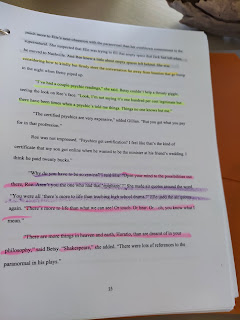
BUT I promised you a last quirky tip that I opted to use this time once I was at the stick-a-fork-in-it, this-book-is-done stage. So here it is: COLOR-CODING! 

Oh my word, I love color-coding. Not just with manuscripts; I’ve used color-coding for all sorts of organizing! But I don’t have time to go down that rainbow rabbit hole. Today we’re here to see how color-coding your manuscript can be helpful and why you might want to try it for your next project.

First, the process. I heard about this technique from author and publisher, Darcy Pattison. She recommended shrinking the manuscript and using different colors to highlight parts of the work-in-progress. That way, with the pages laid out in front of you, one can see with a quick glance the strengths and weaknesses (or whatever particulars one is looking to fix). 

I didn’t shrink my manuscript; I spent about $25 to get it printed, mostly because I didn’t want to squint for hours. Next, I ordered amazing gel highlighters in about 20 different colors. These are typically referred to as “Bible Highlighters” as they work well in highlighting and allowing easy print readability (and they don’t bleed through). And then, I worked out what I needed to look for and the color key.


For the first 25 to 50 pages of the cozy mystery, I wanted to hone in on characters. This is an ensemble group and I wanted to see—through the use of color (gray, dark yellow, neon yellow, purple)—that there was a good balance. I also wanted to make sure I saw pink and green. Er, theme and setting.
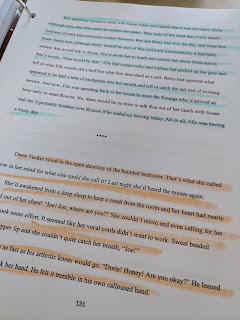
I tried to be more intentional (though not too heavy-handed) with my theme (pink). I needed the theme to dip in and out, like a big toe in the pool. And setting (green) is a bit of an Achilles' heel with me. I prefer getting right to story and dialogue with the result that the richness of setting, which can also help with tone and story, gets left behind. So I had a simple goal there: I needed to make sure I saw green in each chapter, and a plush green in the set-up of the story. 

There are two distinct mystery arcs in this novel but since I’ve used a day-by-day titles for chapters, the arcs weave in and out. Each arc had its own color (the gel highlighters ran out!) but again, I wanted to “see” the story, in this case, for pacing and tension. 

 As I highlighted the printed manuscript, I was not editing. (Okay, I circled three or four words that
weren’t working.) The colors, as Pattison had suggested all those years ago, helped me to “see” the novel in parts and in its entirety and I was very satisfied with the end result. You might want to use the color-coding at an earlier stage (first draft, for example) before doing massive edits (I used the book map for major editing). I’ll happily admit that I used color-coding at the very end because I kinda wanted to celebrate and see the novel in all its artsy glory. 

That, and the fact that I wanted a bit of fun while I waited for my beta readers and editor to weigh in. There may be more writing work ahead for this cozy mystery but I’ll always have my color-coding.

Read More »

Size DOES Matter--There Are Times When Shrinkage is a GOOD Thing

Saturday, January 21, 2017
Okay, so I'm working on a manuscript. A historical novel for middle grades. I began it on November 1st as a NaNoWriMo project that I did, surrounded by my middle-schoolers. They wrote every day. I wrote every most days.


Let me introduce myself. Hi, I'm Sioux and I'm a slacker. It's been 32 days since my last revision.


I checked on my revision history on my NaNo piece, and I haven't done a single solitary thing with that WIP since December 19. Part of why I'm in a rut is my fault. I'm wallowing in a I'm-stuck-and-I-can't-get-back-up attitude. Part of it is someone else's fault. (There’s a person who has access to a crucial primary document. I've called repeatedly and left messages. I've emailed him even more repeatedly. Short of physically stalking him--he's in D.C.--I'm at a loss.)


In the meantime, there is something I can do… I can shrink down my manuscript, so I can see the whole forest instead of just the individual trees. This can be done in a few, simple steps, but it will take some time.


  • Make your margins as small as you can. The font, too. 8-font will allow you to still read it. Single-space it. This will result in a 200-page manuscript getting reduced to 30-50 pages.


  • Spread out the pages. If you live in a tiny “starter” house like I do, you might have to do this in sections. If you have a large open space that you can block off from snooping spouses, galloping dogs and curious cats, you can lay out the whole thing.


  • Choose some things you’re going to look for. I’m going to check on some character threads. I have some real-life characters who appear in the beginning in a minor way, and then in the end I plan on tying them into what happened. I want to make sure there is an occasional mention of them in the middle, so the reader doesn’t think, ‘Whoa, who is this?’ at the end. Using a highlighter, perhaps I’ll color those parts green.


       Getting mired into the history and ignoring the characters is also a concern. I want to track
the inner dialogue of the main character, to make sure those moments are evenly
interspersed. Maybe with my highlighter, I’ll color those parts blue.

photo by katemessner.com


           Humor, too. My piece focuses on a dark subject, a bit of our history that should cause us a
lot of shame… and yet it’s not well-known and it’s not in any history books. Occasionally,
I'm going to need a little levity to lighten things up.  I think I’m going to mark all the funny parts pink.


I remember a while long time ago, a blogger friend (Margo Dill? Mary Horner?) wrote about this technique. I was reminded of it last night when a group of teacher-writer friends met. We’re reading Kate Messner’s Real Revision (it’s on page 72-73) and it hit me upside my head. I should do this. It would get me doing something, and maybe pull me out of my rut.
          Darcy Pattison, another writer, has some guidelines that she uses. She calls it the


All this revision talk makes me curious. What revision tricks do you have up your sleeve? Stuck-in-a-rut minds want to know...


Sioux Roslawski is a St. Louis freelance writer, a member of the infamous WWWP writing critique group, a dog rescuer for Love a Golden Rescue, a wife, a mother of two, a grandmother of one and a middle-school teacher. Like many educators, she delights in great ink pens, Sharpies, highlighters and free Krispy Kremes in the teachers' lounge. If you'd like to read more of Sioux's stuff. go to Sioux's Page.


Read More »

Revision: A Necessary Evil

Monday, January 27, 2014
Using a shrunken manuscript to assess my work.
I love revising. I get to see the changes that a manuscript goes through, starting with my first clumsy attempt and eventually reaching the point that I’m willing to send it out into the world.

The best techniques I know for revising fiction is the Shrunken Manuscript. I found this technique in Darcy Pattison’s book, Novel Metamorphosis: Uncommon Ways to Revise.

In a shrunken manuscript, you reduce the font and margins and single-space your text. You want your manuscript short enough to see all at once when you spread it out on the floor. No, you aren’t going to be able to read it but you will be able to take a visual survey because shrunken manuscripts are meant to be marked up. What you mark might include:

  • Main plot vs subplots. If you suspect various subplots come into play too late, are resolved too early or simply disappear for lengthy periods of time, mark the text that deals with each. Then you can look at your marked up manuscript and see which parts of your plot come into play, page by page.
  • Narrative vs action vs dialogue. This is a good one if you have problems balancing these three elements. My early drafts tend to be action heavy with little space given over to either narrative or dialogue. I can’t lie to myself about this balance when the evidence is spread out before me.
  • Dialog. If a sidekick has a tendency to talk over your strong, silent main character or your villain is prone to monologue, mark the dialogue for each of your primary and secondary characters. You’ll see when someone is stealing the show and when your main character needs to speak up.
  • Individual Characters. Do you introduce characters early on and then lose track of them? Or perhaps you suspect two minor characters are attempting to highjack the story. Mark where each character is present and check your character balance.
  • Character details. Does your critique group comment that your characterization feels slight? Then get out your highlighters and mark the details given for each character in your story. You may be surprised to find that too much remains in your head and never makes it into the story.
  • Emotion. Mark each emotional shift in your story and you can survey the emotional variety in your overall story but also the variety to be found in each character.
  • Description. Suspect your setting is weak or possibly even nonexistent? Then mark all of the text that plants your story in a specific place or describes this setting.

Prepping a shrunken manuscript can be time consuming, but it is well worth the effort. It is a technique that lets you see for yourself what is in your story as it now stands. You’ll see where the balance is off and be able to judge what you need to do to fix it. And, who knows, maybe you’ll come to enjoy rewriting as much as I do.

--SueBE

Author Sue Bradford Edwards blogs at One Writer's Journey.
Read More »

Start Your Novel by Darcy Pattison (Review and Giveaway)

Sunday, July 07, 2013
You probably recognize the name Darcy Pattison, if you're a regular reader of The Muffin because you've been reading her wonderful writing advice RIGHT HERE! She's out with a new book for novel writers that's also full of writing wisdom and savvy tips to improve the beginning of your novel titled, Start Your Novel: Six Winning Steps Toward a Compelling Opening Line, Scene and Chapter.

We've all heard agents, editors, and even readers state that they don't give a novel very long to catch their interest before they put down the manuscript or close up the book. In today's fast-paced and competitive society, you have to catch a reader's attention from the first sentence of your novel. That's what Darcy's book is going to help you do!

After she shares with you why editors focus on page one of a novel, even if writers think it's unfair, she dives into the six steps. The first is to clarify your idea. In this chapter, Darcy has included twenty-nine plot templates, which are possible slants or directions a story idea could take, and uses the familiar story of Cinderella for all of us to understand how to use templates. She writes, "I consult the plot templates when I'm first thinking of an idea for a novel and again when I start a revision."

Some of these templates are: "Adventure comes to you. A stranger comes to town." or "You go to adventure. You leave town." or "Someone is wronged and vows to take revenge on someone else." You fill your novel idea into these templates to see the best direction to take while writing it. In this section, she also provides some great questions you should ask yourself about your characters' emotions.

After your idea is clarified, Darcy moves on to discuss your writing skills. She claims there are two skills that are essential for novelists, and these make perfect sense. Novelists must be able to: write in scenes and write with vivid imagery. A valuable tidbit in this chapter is that Darcy helps define a scene: "a scene is a series of connected actions which contain a small story question. Will John get a home run in this game?" We all know what a scene is, of course; but when writing one, sometimes we lose focus. Darcy's book helps you get it back whether you are a beginner or an expert.

By the middle of the book, Darcy writes about planning the first chapter. No wonder novel writing is so hard—there's a lot to do to prepare to even write the first sentence. Start Your Novel helps you through this process with easy to understand instructions and examples. What's great about this third step is that she first shows us how NOT to open a novel—no back story (and then she helps you figure out how to work in your back story), no characters waking up, no giving away the ending, and more. She does provide writing prompts to help you figure out where to start to catch your readers' attention!

The fourth step is dedicated to that all important FIRST LINE. This is another great chapter, full of examples from published novels and some explanation as to why that particular first line worked. The fifth step is to WRITE. Darcy gives some important advice about writing first drafts—you must get something down on paper. You can fuss over the exact details later. So, if you are still playing around with the first line and you have nothing more of your novel written, pick the line you like the best so far, and keep writing.

Finally, the last step, which writers either love or hate but have to do anyway, is REVISE. She helps you revise that first chapter and again covers some ways that novelists make mistakes and how to avoid these when revising.

There are a lot of writing craft books on the shelf, and many of them are dedicated to novel writing. What I like about Start Your Novel is that Darcy has focused on one of the most crucial sections of a successful novel—the beginning. If you turn readers off at the beginning, then no one will read your brilliant middle or incredible ending. Darcy's latest book would be helpful for anyone struggling to begin a novel, whether you've written one or one hundred.

And we have an e-copy to giveaway! So, enter with the Rafflecopter form below for your chance to win: Start Your Novel: Six Winning Steps Toward a Compelling Opening Line, Scene and Chapter. 

a Rafflecopter giveaway
Read More »

How Well Do You Know Your Characters?

Wednesday, March 13, 2013
My swimmer will see the world
differently than your detective.
But how?
Last fall, I attended a revision workshop led by The Muffin’s very own Darcy Pattison. One of the things that Darcy emphasized was that we not only include plenty of details in our writing, but that we include the right details in our writing.

As I picked through my manuscript, something hit me. Yes, I had enough detail for the reader to experience the setting, but I hadn’t chosen the details that my character would most likely notice. I’m a very visual person with an acute sense of smell and am easily distracted by sound, thus I had sight, smell and sound covered.

What was missing were the kinesthetic details, details that focus on movement and how things feel to the touch. My character is a swimmer who is always being told by his teachers to be still. Clearly, I needed to work motion details into my story, because these are the kinds of things that my character would notice.

As I started working attention to motion into my story, I realized that my character may not see the world in black and white, but he would definitely see it in terms of constricting stillness vs glorious motion. That’s just how he’s wired.

Another character that I’ve been working with is a flashy girl who lives in a circus. She does everything with a certain flash and pizzazz so that is how she divides things – allowed to use her pizzazz vs not allowed to use her pizzazz.

A character who can speak to wolves notices more to do with scent and sound than do her fellow humans.

The character who is an incarnation of Persephone is still giving me fits. Obviously, she’s going to be tuned into plants and the natural cycle, but I’m not sure how it will color her perceptions of those around her.

Do you know your characters well enough to know how they see the world? What details would they notice that you would overlook? What is their good vs their bad? Remember, you are answering this for your character. If her answers too closely resemble your own, you might have a bit more work to do.

–SueBE

Read more of SueBE's writing at her blog.
Read More »

Friday Speak Out!: 100% Success in Writing Contest, Guest Post by Darcy Pattison

Friday, December 23, 2011
100% Success in Writing Contest

by Darcy Pattison
Note: This is an especially poignant post for me to run this week because our troops have pulled out of Iraq and are returning home soon. The story is about a girl waiting for her father to come home from his military posting. Just remember--the Iraq conflict may be done, but troops are stationed throughout the world and there are still military families who will be missing their loved ones during this holiday season. This story is for them.

I have won 100% of the stories for kids writing contests I’ve entered. Of course, since I’ve only entered one, it's easy to say. I’m picky about what I enter and I may never enter another one. Here’s why I did enter “The Help” Children’s Story Contest (www.takepart.com/thehelp).

In August, I returned from vacation and saw info on a writing contest related to the movie, “The Help,” based on the novel of the same name by Kathryn Stockett. I live in Little Rock, home of the infamous Central High Crisis over Civil Rights, when the Arkansas governor called out the National Guard to prevent nine black children from attending Central High School. Today, the National Park Service runs a National Park at Central High to commemorate the struggle for civil rights as it played out here. Everyone I know was talking about this new movie, The Help, and loving it.

But I’m skeptical about contests. And I had criteria.

What’s the benefit to winning this writing contest?

For me, the benefit to winning this contest was publicity. "The Help" is a high profile movie and stories for kids are not. To be associated with this amazing story could only help my career.

Who is the judge of this writing contest?

Lou Berger, children’s author and former Head Writer for the popular children’s television series Sesame Street, judged the children’s story contest entries. It was important that the judge was credible and a good judge of writing.

What is the fine print of the writing contest?

Of course, a contest often has simply awful contract details, often so bad that they will grab all rights and you get nothing. Ever. In this case, the contract said the contest retained NONEXCLUSIVE rights. Before I signed the contract, I verified that I still retained the copyright and could exploit it as I wanted.

What is the prize of the writing contest?

The prize was professional illustrations that would be licensed to me to be used as I wanted. Good news. As a children’s book author, I can write a text but I can’t illustrate on a professional level. The "draw" of professional illustrations meant that the story would become a book. See more at 11ways.darcypattison.com (Order in paperback, Kindle or Nook.)

Also important was the dollar amount of the prize, because I am responsible for taxes on that amount. It’s a bummer to win a prize and then have to pay taxes on it! Fortunately TakePart also offered a small cash prize. When the cost of illustrations and the cash prize were added together, the cash will just about pay the taxes. I would be out zero dollars.

Did I have a likely story that fit the contest rules?

Finally, I had to have a story that fit the contest! I looked over my files and chose one I liked, but had seen several rejections. I added a Nanny and took out 200 words to wind up one-word under the 400-word limit.

In this case, the benefits, the fine print, the prize, the judge, and my story all matched up. I entered. I won!

***

Author and writing teacher Darcy Pattison blogs at Fiction Notes (www.darcypattison.com). Read more about "The Help" Children's Story contest at the 11 Ways to Ruin a Photograph website http://11ways.darcypattison.com.
~~~~~~~~~~~~~~~~~~~~~~~~~~~~~~~~~~~~~~~~~~~~

Would you like to participate in Friday "Speak Out!"? Email your short posts (under 500 words) about women and writing to: marcia[at]wow-womenonwriting[dot]com for consideration. We look forward to hearing from you!

~~~~~~~~~~~~~~~~~~~~~~~~~~~~~~~~~~~~~~~~~~~~
Read More »

Why Do We Write: Autonomy, Mastery, Purpose

Wednesday, December 14, 2011
I just received a quarterly royalty statement and it wasn't stellar. The money just isn't there. Why do I keep doing this, writing for kids and writing how-to-write articles and books? Why do we keep working in the face of surprisingly little money?

I've been reading DRIVE: The Surprising Truth About What Motivates Us by Daniel H. Pink. He says that business has traditionally been built on the idea of carrots and sticks. If you do well, we'll reward you (with money, fame, perks, etc), and if you do poorly, we'll punish you. Unfortunately, the carrots and sticks approach works best for routine jobs and only for those type jobs. Think assembly lines. For those jobs where you want something done exactly the same each time, where compliance to a strict method is important, use the rewards and punishments system.

Writing is seldom a routine job. Instead, for work like ours, Pink says we are motivated by three things: autonomy, mastery and purpose.

Writers certainly have autonomy. For fiction at least, we often write on spec, or the speculation that someone might like what we write. We determine the audience we will target, topics we'll discuss, the characters we'll create. We decide when we write, how we write and what editors/publishers we work with. Everything about a writing career is autonomous.

A second motivator is mastery, spending time to become an expert. When you are engaged in a subject, totally fascinated and you find that time stands still while you write, then you are working toward mastery. Pink describes this altered state as being in "the flow." In fact the best predictor of productivity is the desire for intellectual challenge, "the urge to master something new and engaging."

A sense of purpose is the final motivator and it's a powerful one. People who champion a cause are more likely to be engaged and to work with autonomy. Even brief reminders of a purpose behind your work is enough to increase productivity. My purposes revolve around two things: creating great literature for kids and helping other writers to reach their potential. When one of those purposes is activated in a piece of writing, I am willing to work harder--regardless of the results on that royalty statement.

Ours is a profession that thrives on autonomy, mastery and purpose. Do I want money? Yes! But oddly enough, Pink recommends business people provide adequate monetary incentive--make sure people can take care of their family and commitments. After that baseline is met, increasing pay doesn't increase productivity much; instead, an environment that encourages autonomy, mastery and purpose will increase productivity.

Why do I keep writing in the face of less-than-stellar royalty statement? Because I'm doing what I want, when I want; I am engaged and fascinated by this process of putting words on the page; and I do it for the kids and for other writers. I love my job. That's why I write.

Author and writing teacher Darcy Pattison blogs at Fiction Notes (www.darcypattison.com).
Read More »
Powered by Blogger.
Back to Top