Showing posts with label Christy O'Callaghan. Show all posts

Why I Returned to Hippocamp

Saturday, September 28, 2019

By Christy O’Callaghan

The draw of Hippocamp goes beyond the craft and business workshops, which are plentiful, but for me it was all about the people. The interactions with the other attendees my first year made all the difference and brought me back for a second. Hippocamp is a conference put on by Hippocampus Magazine with a focus on non-fiction writers. I, like many people, don’t have the time or money to spend on something that doesn’t offer a benefit, so returning for a second time is a big deal.

The rapid-fire workshops run in forty-five-minute session all day Saturday and Sunday morning and are packed with information. There are four options per time slot with a mixture of craft and business. At this point in time, anyone who is in a creative field is also a businessperson. Out of the nine I attended last year I had one workshop I felt wasn’t great. That’s not bad. This year I walked away with some nugget of information from every single workshop. The ones I attended ranged from improving my Instagram platform, to the need for a writer’s website, to lyrical essay styles, meditative writing, how to manage my Imposter Syndrome (that terrible voice in my head), and how to read as a writer. I met up with friends in between workshops to share what we learned.

Last year the only person I knew was my husband who tagged along as a guest. For a small fee guests can attend the evening events and the meals. This was a feature I appreciated since writing has become an important part of my life and it allowed my partner to participate. During the workshops however, I was able to focus and network. This time, I knew some fellow attendees from the previous year. Two of my fellow workshop mates from a different program were also there, one was even a presenter. I finally met in real life an Instagram friend I’ve known for almost two years. As the weekend progressed, I watched attendees run into friends they hadn’t seen since their MFAs. These human connections, I’m discovering, are amazing and vital.

Attending something like this is always reminiscent of summer camp. You have those returning campers who already know each other as well as all the camp stories and songs and where all the bathrooms are located. Then you have the first timers, which is made a little more obvious since it says so on their badge. I remember my first year at the Friday night potato bar as I filled my martini glass just hoping I’d meet people before the end of the weekend. By Sunday breakfast, though everyone’s relaxed and saving seats for new friends.


The Saturday night keynote speaker was Nick Flynn. He was open and sharing about his struggles with homelessness, recovery, and figuring out how to be a father. Isn’t this what non-fiction is all about? Sharing, connecting, and allowing ourselves to be vulnerable so that we and others can feel less alone. I found him inspiring and relatable. While I waited in line for him sign my copy of his memoir Another Bullshit Night in Suck City, I texted with my sister who is in the early stages of recovery and potentially facing jail time and told her about Nick. When it was my turn I told him about my sister. He wanted me to share with her that he was proud of her and he knew how hard it was. These words meant everything to her, which in turn meant everything to me.

Over my two years at Hippocamp, I learned several lessons about myself as a writer through both the workshops and my interactions with fellow attendees. One is that I need to take myself seriously. If I don’t who will? Another was that I needed business cards. I am now on my second run and made them to match the website which I started this past spring. Last year I listened to an over forty panel that helped me think about my place in this business as someone who is starting out twenty years later than I expected. I even starting a blog about it. Another workshop introduced me to WOW! Women on Writing which couldn’t make me happier. This year with the added knowledge I gained, I’m planning to build off the platform I’ve started and who knows what will happen by next August.

Yes, there was a lot to learn, such as the difference between a braided and hermit crab lyrical essay. To not say “welcome to my webpage” on you website. To slow down when you read so you can learn from that author. However, for me, what has made the difference is feeling a part of a community. Returning for a second year gave me the chance to thank a fellow attendee I met last year. She could tell I felt overwhelmed, but also wanted to learn. Her conversations and advice made all the difference for me. I was thrilled to have an opportunity to thank her in person.


Hippocamp Conference takes place the last weekend of August in Lancaster, PA. To learn more go to https://hippocamp2019.hippocampusmagazine.com/. Hippocampus Magazine has a 3-fold mission to entertain, educate, and engage. They focus on providing a platform for established and emerging non-fiction writers not only through the conference, but through their magazines, contests, and book division. For more information go to https://www.hippocampusmagazine.com/.

***

Christy O’Callaghan lives in Upstate, New York. She works with incarcerated adults seeking employment. Her favorite pastimes include hiking, gardening, swimming, and collecting sea glass—anything in the fresh air. You can learn more about her, her blog about being an over 40 newbie writer, and her work at www.christyflutterby.com.
Read More »

The Layers and Shapes of Disquiet (International Literary Program)

Thursday, August 08, 2019


by Christy O’Callaghan

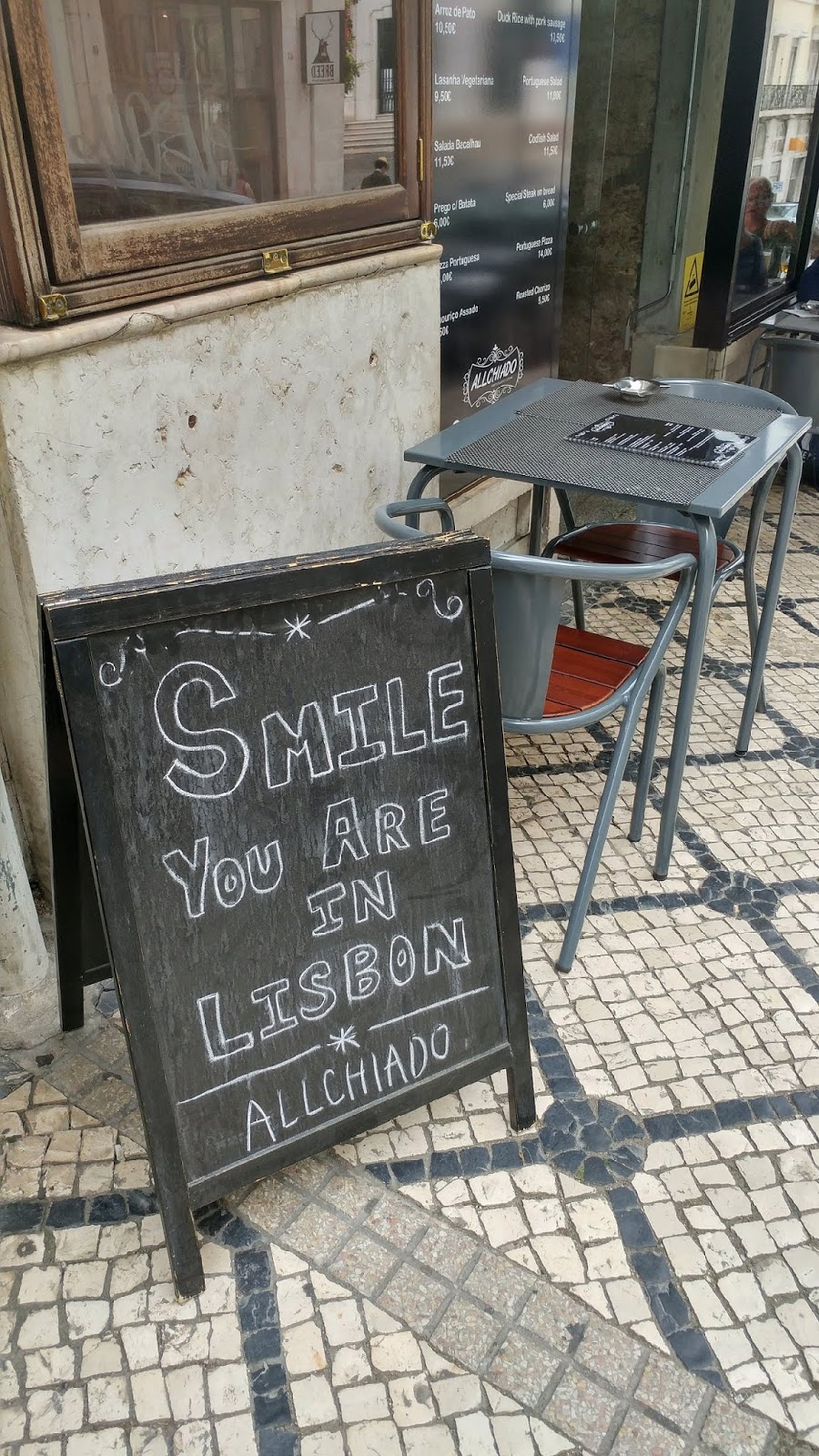
For me, the 2019 Disquiet International Literary Program in Lisbon, Portugal was about three words: layers, shape, and Sophia. If I’d taken the two weeks on my own to go to Lisbon, I would have enjoyed the city, especially the restaurants that let you sit for hours until you beg to pay your bill, the mosaic paths, tiled walls, Fado music, funky bathrooms, and the variety of tiny chairs to fit inside small shops and spaces. However, on my own, I wouldn’t have experienced the amazing workshops, the other attendees, or had the chance to meet local writers.


I took the non-fiction track with writer David Leavitt. We met in the basement of Livraria Ferin, the second oldest bookstore in Lisbon dating back to 1840. Our group always ran long as we shared, supported, and challenged each other. Each day we workshopped two of the attendee's pieces up to thirty pages in length. Our workshop covered accuracy, formatting, storytelling, language, voice, where a writer wanted their piece to go, and sometimes whether the writer wanted it to be non-fiction or fiction. Unlike fiction, non-fiction often includes discussing a writer's life to understand a piece and the direction if can take, so our workshop allowed for that natural discussion. After the workshop, participants often ate lunch together to talk. I haven’t attended many workshops, so I asked, “How does this compare?” Everyone said it was the best they’d ever attended, including some people with MFAs.


The primary workshops met Monday, Wednesday, and Friday mornings; on Tuesday and Thursday, we could take a secondary workshop. I selected Visual Storytelling taught by Pulitzer Prize-winning photojournalist Deanne Fitzmaurice. She taught us storytelling through photographs using layers, focus, light/shadow, the rule of thirds, color pallet, and feel, when to zoom in and when to step back. All aspects of writing but captured through a camera. She told us that as we worked our story would present itself. I find writing is the same way. You start in one direction and end up someplace different.


For me, the common themes that emerged were layering and shape. They appeared not only in my workshops, but on literary tours, in talks about Fernando Pessoa (the author of The Book of Disquiet), the history, and the structure of the Lisbon itself. Viewed from the waterfront, buildings rise like steps from the lower section that the locals call new because an earthquake, a tsunami, and fires destroyed it all in one day in 1755, and climb up to the older and higher sections of this small capital city.

Shape was another major theme. David Leavitt told us we don’t have to kill our darlings, as is often advised. Instead, he said to ask, “Does it ruin the shape of the piece?” I sat in on the Poetry Editing workshop with John Hennessy, the poetry editor of The Common Magazine, and he discussed the shape of a poem and how the white space can evoke a feeling, room to breathe, and yet another layer. This is true for prose as well.

Adding layers and shape to the Disquiet experience were not only the writers leading the workshops and the fellow attendees but the Portuguese writers who held readings and discussions. As an American, it can be difficult to grasp the impact of a true dictatorship. Two years before I was born the forty-eight-year dictatorship ended. My lifespan is the difference between freedom and oppression. For places as old as Lisbon, a three-thousand-year-old city named by a God, forty-four years is a blink of an eye. It’s still fresh in their minds. Three of the female Portuguese writers helped me better understand this layer.

I met Teolinda Gersão as I stood outside the bookshop where she was presenting. “Welcome to the city that is always under construction,” she said to me. Her words rang through my head as she shared the history of Lisbon and told us about her book, The City of Ulysses, which I’m reading right now. She said today as people, “We want to find home,” and that “The world feels rootless.” I believe she’s right about that. I also agree with her that “History lies a lot,” because the victor writes it, but “myth doesn’t.”

Another woman I had the opportunity to see was Dulce Maria Cardoso. Her family moved to Angola when she was an infant and returned after the Angolan War of Independence in 1975. She went from a more modern country to one discovering itself and attempting to modernize. Americanize as she referred to it. She discussed what it was like as a young woman to move backward in time as she returned to a country she wasn’t familiar with and watched it attempt to catch up. Soon I’ll be reading her book, The Return.


The third woman who I will carry in my heart forever was Sophia de Mello Breyer Andresen. Her name appeared on the door to my hostel room, on the tote bags given upon arrival, and on my travels around the city. She is to Lisbon what Edna St Vincent Millay is to Camden, ME. We attended a reading of her poems at the adorable bookstore Menina e Moça on the famed Pink Street. Since she passed away in 2004, her translator Richard Zenith and her daughter, who owns the bookstore, Cristina Ovídio performed bilingual readings of Sophia’s work set to music. Her grandson even read a poem he’d written. When they finished, they passed around slips of edible paper with the following poem:


The Day
Spend the day with yourself
Let nothing distract you
A poem emerges so young and so old
You can’t know how long it has lived in you


After we read it a few times, we ate the paper to take the poem inside ourselves and make it a part of us.

Anyone can Google a country, read a history book, or familiarize themselves with a location, but to experience the words and hearts of the people who live there is different. To learn about history so removed from my own and to see a country healing itself through creative endeavors helped me to understand it on a deeper level. To have had this opportunity through Disquiet added shape and layers for me as a human and as a writer in a way I could never have done on my own.

To learn more about the Disquiet International Literary Program, visit www.disquietinternational.org. There are a variety of scholarships, fellowships, and a contest. The contest includes fiction, non-fiction, and poetry which are processed through Submittable. 2019 was their tenth year of the program, and they had over fourteen hundred applicants to the contest. I wasn’t the contest winner, but she was in my workshop, and I learned a great deal from her. However, I was honored to receive a scholarship to attend.

Along with the contest and scholarships, there are Luso-American Fellowships for four North American writers of Luso descent. Disquiet has made an effort to increase the awareness around Luso-American voices and launched their first book Behind the Stars, More Stars, which is an anthology of Luso-American alumni of the Disquiet program. Disquiet has a residency following the two weeks in Lisbon. I had a chance to attend the residency in Sao Miguel in 2018, and it was a true pleasure.

***


Christy O’Callaghan lives in Upstate, New York. She works with incarcerated adults seeking employment. Her favorite pastimes include hiking, gardening, swimming, and collecting sea glass—anything outside in the fresh air. You can learn more about her, her blog about being an over 40 newbie writer, and her work at www.christyflutterby.com.

Read More »

Erica Dawson and the Power of Turning Fear Into Poetry

Thursday, June 06, 2019
2019 has been a banner year for the fierce and expressive poet Erica Dawson. She’s taking the poetry world by storm with her three award-winning and passionate books of poetry: When Rap Spoke Straight to God (Tin House, 2018), winner of the 2018 Florida Book Awards Gold Medal for Poetry; The Small Blades Hurt (Measure Press, 2014), winner of the 2016 Poets’ Prize; and Big-Eyed Afraid (Waywiser Press, 2007), winner of the 2006 Anthony Hecht Prize. Erica spent a spell discussing her writing rituals and how opening herself up as a writer helped raise her work to new heights.

***

WOW: Erica, I know your schedule’s packed, and I appreciate you taking the time to speak with our readers. Your poetry is so powerful and evocative. What was the inspiration for your latest book When Rap Spoke Straight to God? Was there one moment or a series of events that converged to start you down the path of writing this powerful long-form poem?

Erica: So much of the inspiration came from my frustration with what was happening around me during the months leading up to Trump’s election. Tampa appears to be a very liberal city, in terms of the political landscape of FL; but, there were Trump bumper stickers everywhere, red hats everywhere. Things started to feel a little more tense. I was called racial slurs more than ever. Before we even knew Trump would seek office, I began to feel uncomfortable as a black woman in the South. I felt uncomfortable. That fear came out in the small, individual poems I’d been writing and publishing.

Then, I read some of those poems at the Disquiet International Literary Program in 2015. After the reading, during the Q&A, the author Eileen Myles said my poems felt unfinished, that she could tell I had more to say. And Eileen was right. So, I set out to write a long, book-length piece, to give myself room to say when I needed to say.

WOW: It’s incredible when someone else can see something in your writing and offer a positive nudge. When did you realize words have value, influence, and strength? Why did you choose poetry over prose? Who’s the poet that grabbed and shook you into true love?

Erica: I was always obsessed with language. I loved thinking about the way words come together—their rhymes, the cadence. And I was always interested in poetry, as a reader or listener. My mom always played music; and, she read us a lot of poetry. I loved the rhythm. But, as a writer, I dreamed of writing a novel. I wanted to tell stories. I studied fiction in college until a professor suggested I may be better at poetry than I was at prose. (It stung at first, but again, like Eileen, totally right.)
It was Shakespeare and Anne Sexton who hooked me in. That was it. Game over.

WOW: Ah Anne Sexton, she can sink a hook into a reader’s heart for sure. Do you have a writing process, routine, or ritual? So many writers work full-time jobs as well as writing. Between running the Tampa, FL low-res MFA program, traveling to literary conferences, reading events, and speaking engagements (to name a few), how do you create space and time to write?

Erica: Silence. And mostly at night. I’ll take breaks for a one-song one-woman low-volume dance party. Then resume silence.

It’s super hard to create the space and time. But, writing usually finds its way to me. I’ll have a sleepless night and, boom, there’s an idea. Or sometimes I’m on a plane and hoping to drift off and, boom there’s another idea. I’m pretty sleepless in general, really, so that’s when I find the space. But I don’t force myself into it. That’s never really worked for me.

WOW: The curse of the writer are sleepless nights. I must try the dance party, but I’ll have a louder volume. Both you and WRSSTG have received so much praise, and deservedly so, could you talk about the road you took to get here? With making the brave, bold choice to be political, vulnerable, and controversial in your writing, do you ever worry how your mom or the sketchy dude on the corner might react? How do you handle negative thoughts that creep in?

Erica: This past nine months or so have been a dream. I can’t put it into words. I’ve gone to so many new places, met so many gifted artists of all kinds, made new friends, been featured in the New York Times Magazine and Oprah’s O Magazine. I’ve been on national TV! Last Tuesday night, I was a literary host at PEN America’s annual gala, alongside amazing writers like Zadie Smith, Franny Choi, Gregory Pardlo, Salman Rushdie. It’s absolutely insane.

I definitely had to push my self hard while writing the book. I had to make myself say anything. Say everything. I had to be honest. I had to be imaginative. But I had more fun writing this book than the previous two. After I got out of my way and found the courage I needed, I felt free in so many ways. It sounds cheesy, but it’s true.

My mom is ridiculously supportive of everything I do. The sketchy dude in the corner happens. The mansplaining guy who has a comment instead of a question happens. The woman who doesn’t appreciate the swearing and leaves during the middle of the reading happens. In a lot of ways, I love it (when I feel safe) when people don’t like what I’m reading. I like to think I’ve gotten under their skin, that I’ve made them uncomfortable, I’ve made them reconsider their own views. That’s pretty cool.

WOW: What’s next?

Erica: We’ll see what happens.

WOW: I, for one, can’t wait! It’s always heartening to hear about the generosity and encouragement writers have for one another. Especially when it’s taken and used to create bodies of work filled with such depth. Thank you, Erica, for sharing with us and congratulations on your fantastic year!

***

Christy O’Callaghan lives in Upstate New York. She works with incarcerated adults seeking employment. Her favorite pastimes include hiking, gardening, swimming, and collecting sea glass—anything outside in the fresh air. Her work’s appeared in various publications including the anthology Before They Were Our Mothers: Before Rosie Started Riveting, and The Sonder Review, among others. You can find her on Instagram @christyflutterby or by emailing her at chrityflutterby[at]yahoo[dot]com.
Read More »
Powered by Blogger.
Back to Top