
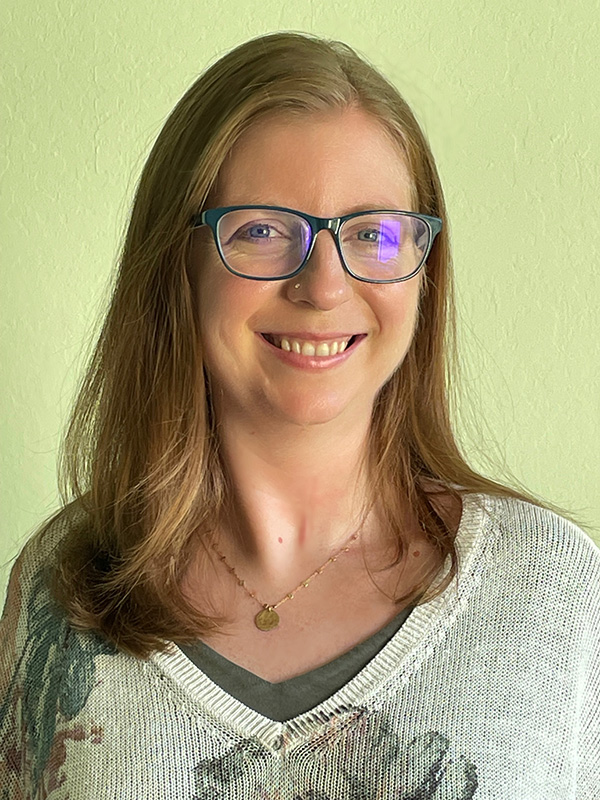
If you haven't done so already, check out Amethyst's award-winning essay "Learning to Walk Again, Again, Again" and then return here for a chat with the author.
WOW: Congratulations on placing in the Q1 2026 Essay Contest! How did you begin writing your essay and how did it and your writing processes evolve as you wrote?
Amethyst: I wrote the first draft of this essay in grad school in a class called Subatomic Writing, taught by Jamie Zvirzdin, who wrote a craft book by the same name. The book is humorous and uses particle physics as a metaphor for the components of language and writing that come together to make words carry more energy and clarity (sound, grammar, syntax, punctuation, rhythm, emphasis, pacing, etc.). She was a phenomenal and inspiring teacher. Between her class and the book, through some kind of alchemy, a lot of writing concepts I’d been circling for years clicked into place.
The final assignment for the class was to write a 700-word essay, in the vein of the flash essays found in Brevity. I’d been thinking about this essay for some time, about my complex relationship with the seemingly simple act of walking, about footsteps, about starting over again and again and again. Thinking is writing, is drafting. With the challenge of this assignment, I knew I was finally ready to write it and that the distilled form of a flash essay would be potent.
WOW: That’s great that the class and the assignment helped to bring out a story that had been percolating in you for some time. What did you learn about yourself or your writing by creating this essay?
Amethyst: I learned how much I adore the lyric essay and that maybe I do have a bit of poetry in me. I’m obsessed with the sound and sense of words, the rhythm of sentences, and how they interact together to echo or reinforce meaning. I always read my work out loud multiple times during revision and listen to how words flow and sound together and especially for anything I trip over. Then sometimes I read it to someone else and if I skip over something, it’s probably because I need to do the hard thing and cut it even if it might be a darling.
Most importantly, that semester and especially in this essay, I found that elusive mythical thing—my writing voice. Frustratingly, I still must search for it in early drafts, but when it starts to sound like me, I know it. I’ll always be grateful for that. Also, this essay was one of the most vulnerable things I had written at that point. At the same time, I was just so dang proud of it, and I wanted to share it. It’s a bit of a contradiction writing personal creative nonfiction and being a quiet introvert who likes to hide, to not use that voice. I’m constantly reminding myself to claim it.
WOW: Yes, it can be so challenging to find and claim and use your voice! Sounds like a formidable experience you had that semester. Please tell us more about the memoir you’re writing (what’s your focus, what’s your process like, how far into the process are you, etc.).
Amethyst: My process is quite messy at this point because I’m still in the early drafting stages and trying to just get everything down. I’m almost finished with the first draft, though I tend to edit repeatedly way too early, so this might be more of a second draft. The book is called The House with Ten Doors and is a coming-of-age memoir about growing up in an unconventional mixed-race family of eight children, five of whom were adopted. On a farm in the desert near Truth or Consequences, New Mexico, my father built a magnificent house with ten doors to the outside, one of which led to nowhere—a drop from the second floor. Maybe even as he built it, he was thinking of exits, of escape. That house could not hold onto everyone. Ten people moved in, but, due to mental health issues, death, and my parent’s divorce, in a matter of five years only four were left.
WOW: What an intriguing synopsis! Thanks so much for sharing that with us. Which creative nonfiction essays or writers have inspired you most, and in what ways did they inspire you?
Amethyst: There are so many! I’m obsessed with Melissa Febos and recently finished her memoir The Dry Season. Her writing is so sharp and delicious with fully realized layers of personal experience, research, and reflection. I especially want to recommend her craft book Body Work for anyone writing personal narrative and trying to navigate writing about things that feel deeply intimate, like our relationship with our bodies, desires, and traumas. I also recommend Chloe Cooper Jones’ essay collection Easy Beauty about navigating disability in a world that is shaped to exclude and create shame around bodies that don’t conform. She is a beautiful, humorous, and unflinching writer that will make you feel seen or see in new ways, depending on your experience. This collection taught me the power personal narrative has to reclaim space and experiences that have been denied and inspired me to not shy away from sharing my own disability experience. Ultimately, writing and reading memoir and creative nonfiction is a chance at connection, something we all need. It invites understanding of lives like and unlike our own; it invites seeing and being seen.
WOW: Thank you for those fabulous recommendations. If you could tell your younger self anything about writing, what would it be?
Amethyst: You are already a writer. Never doubt yourself. Just keep going and the writing gods will meet you halfway.
WOW: Excellent advice. Anything else you’d like to add?
Amethyst: I’m honored to have my essay selected as a finalist for this contest. Thank you for your time and thoughtful questions!
WOW: You’re very welcome! Thank you for sharing your writing with us and for your thoughtful responses. Happy writing!


0 comments:
Post a Comment