It’s all in the name.
PlottersParadise.com is the novel planner of your dreams! This platform for plotting provides a fun way to plan a novel, check the structure of your story, or just log ideas.
Thanks to Tal from Plotter’s Paradise and Angela from WOW! for granting me paid access.
My first impression: Plotter’s Paradise is a good-looking, colourful and engaging website made by and for writers. It’s easy to sign up and navigate, and I like the cartoon-style creator profiles.

As a planster who is trying to become a fully-fledged plotter, Plotter’s Paradise provided just what I never knew I needed.
You can work your way around the menu, up down or in any order, but the first step I took was to name my project and choose a cover image. On Plotter’s Paradise you’ll find there are plenty of cover images to choose from, but I chose to upload my own.
Basically, you are building your story. Take whatever you know about your idea and put it into Plotter’s Paradise. Let the system keep it safe and secure, ready for the construction of a brilliantly plotted manuscript/novella or short story.
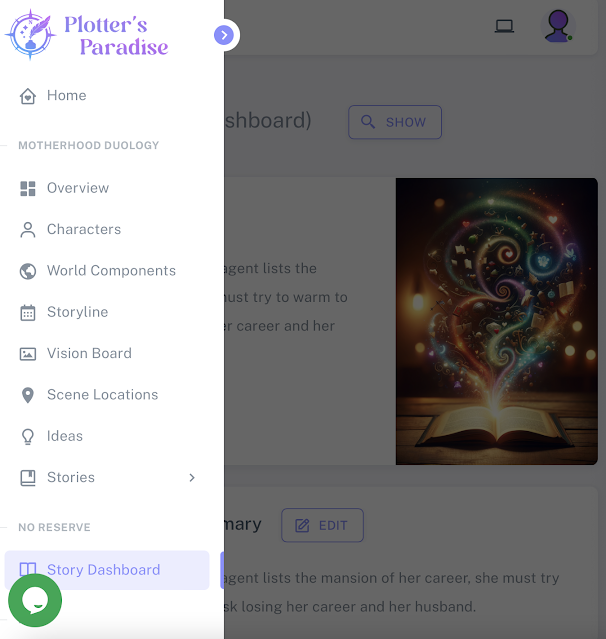
Or if you are using the site to help you plot because you didn’t plot that well to begin with (guilty!) and you need to wrangle your words into a better structure, then you might like to skip to the Story Dashboard.

There are currently two outlining options: Free Form or Fractal Method.
As someone who loves guidance, I loved the Fractal Method.
Your starting point is the Single-Sentence Summary. Just like a logline, that will come in handy when you’re query ready at a later date, there are examples of single-sentence summaries, so you can get a feel for what you need to craft for your own story. And if you need another example, simply hit the refresh button for more.
As every story has a main plot; let’s start with that.
Plotter’s Paradise helps you look at your plots and ensure they have all the ingredients for a compelling story. Such as Status Quo, Inciting Incident, First Effort, Second Effort, and Final Effort.
All steps come with instructions, examples, and encouraging comments when you add something new!

Once your main plot and subplots are plugged in, the program prompts you to go further with summarising each act and then expanding on that to create a detailed overview. Like a synopsis! Who doesn’t like the sound of that?
This program made summarising my story easy—the entire manuscript!
Text like this helps to see what you’ve got so far, so you’ll know if something’s missing or if the story doesn’t flow.
And you can edit at any time.
Now you have the bones, it’s time to look at the scenes. Scenes are created from a single sentence to a full description, and then characters, plots, and locations can be linked. Similar to the Story Grid template, you also look at the main change, conflict, and stakes of each scene. Then the mood of the scene is selected, giving each scene a colour code to help you monitor the tone of your story.
Scene cards can then be dragged and dropped into any order you like, so feel free to keep creating cards and playing around with the order until it’s just right.

By the time you have done all that, you’ll be well and truly ready to write!
I loved the guided creation process that prompted me along the way, helping me to make sure my plots were hitting the right beats and ensuring I had scenes that fulfilled every aspect of my story along the way.

The character profiles are fun and great to have and refer back to, and I love how they link back to scenes, so you know where and when each character features.
Also, I loved how Plotter’s Paradise encouraged me to pull out all my plots and look at how they intersect, and what scenes they feature in. The ability to tag plotlines and characters or keywords is great!
There’s also a dark mode for anyone who likes to write at night!
Join now for free to see if you like the idea of prompted short story or novella plotting or sign up for $9.90 per month or $97 per year to experience all the features of full manuscript plotting. No payment details are required to use the free version. Cancel at any time (monthly or yearly).
You can input all your ideas with the security that all your material is only visible to you.
Happy plotting!

Kelly Sgroi is based in Melbourne, Australia. Represented by Beyond Words Literary Agency, Kelly is looking forward to what comes next in her writing journey. She’s an enthusiastic member of the writing community and is published by WOW! Women on Writing, Dream Journal, The Endometriosis Foundation of America, Endometriosis Australia, and a few Medium publications. Visit her website at www.kellysgroi.com.