by Mari Coates
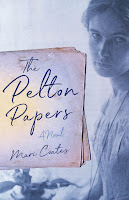 Inspiration. Where does it come from? If I search it out, it eludes me, flits off and leaves me alone. I knew I wanted to write about the artist Agnes Pelton long before she began speaking to me and long before I first saw her mystical abstracts. I’m not a writer of fiction who makes things up. I need an anchor—an image, a place, a person. Fortunately, I had anchors galore: the portraits Pelton painted of her close friends, my grandparents; that same year my mother and uncle as children; a later pair of desert landscapes; a view of her windmill studio on Long Island.
I also had transcriptions of my grandfather’s letters and had seen his beautiful large-format family photographs. I found that he and I shared a penchant for imagining the lives of others, tagging his photographs with captions about his neighbors in his rural New York City neighborhood. I was inspired by the joy evident in these images. Really, though, it was the simple fact of his own life—here so vividly and then gone—another introvert who, I felt, would welcome my intrusion into his life and thoughts.
So, I began a novel about him. While reading through a series of letters he wrote from California in 1906 to family in Brooklyn, I found a reference to his friend Agnes Pelton and decided to bring her into the novel: another artist of fragile constitution, raised as he was in the very conservative Protestant sect called Plymouth Brethren.
But once I saw Pelton’s abstracts, the landscape of my imagination was flooded with color and upended by an urgent need to understand. Who are you, I asked Agnes. I began using my daily train commute to start scribbling. I recommend it: a pad of paper, a pen or pencil, and whatever pops into one’s mind. It was on one of those mornings, mulling over how she had come to make these astounding works, when a voice came to me and said, “I want! I want to make BIG pictures that COVER a BIG piece of paper!” All right, I thought, let me help you with that.
* * *
MARI COATES lives in San Francisco, where, before joining University of California Press as a senior editor, she was an arts writer and theater critic. Her regular column appeared in the SF Weekly with additional profiles and features appearing in the San Francisco Chronicle, East Bay Monthly, Advocate, and other news outlets Her stories have been published in the literary journals HLLQ and Eclipse, and she is grateful for residencies at I-Park, Ragdale, and Hypatia-in-the-Woods, which allowed her to develop and complete The Pelton Papers. She holds degrees from Connecticut College and the Warren Wilson MFA Program for Writers. Find her online at maricoates.com
~~~~~~~~~~~~~~~~~~~~~~~~~~~~~~~~~~~~~~~~~~~~
Would you like to participate in Friday "Speak Out!"? Email your short posts (under 500 words) about women and writing to: marcia[at]wow-womenonwriting[dot]com for consideration. We look forward to hearing from you!
~~~~~~~~~~~~~~~~~~~~~~~~~~~~~~~~~~~~~~~~~~~~
Read More »

I also had transcriptions of my grandfather’s letters and had seen his beautiful large-format family photographs. I found that he and I shared a penchant for imagining the lives of others, tagging his photographs with captions about his neighbors in his rural New York City neighborhood. I was inspired by the joy evident in these images. Really, though, it was the simple fact of his own life—here so vividly and then gone—another introvert who, I felt, would welcome my intrusion into his life and thoughts.
So, I began a novel about him. While reading through a series of letters he wrote from California in 1906 to family in Brooklyn, I found a reference to his friend Agnes Pelton and decided to bring her into the novel: another artist of fragile constitution, raised as he was in the very conservative Protestant sect called Plymouth Brethren.
But once I saw Pelton’s abstracts, the landscape of my imagination was flooded with color and upended by an urgent need to understand. Who are you, I asked Agnes. I began using my daily train commute to start scribbling. I recommend it: a pad of paper, a pen or pencil, and whatever pops into one’s mind. It was on one of those mornings, mulling over how she had come to make these astounding works, when a voice came to me and said, “I want! I want to make BIG pictures that COVER a BIG piece of paper!” All right, I thought, let me help you with that.
* * *
 |
| photo by Lynn Shepodd |
~~~~~~~~~~~~~~~~~~~~~~~~~~~~~~~~~~~~~~~~~~~~
Would you like to participate in Friday "Speak Out!"? Email your short posts (under 500 words) about women and writing to: marcia[at]wow-womenonwriting[dot]com for consideration. We look forward to hearing from you!
~~~~~~~~~~~~~~~~~~~~~~~~~~~~~~~~~~~~~~~~~~~~