Because writing is all about rhythm. Whether you’re writing nonfiction, fiction, poetry, whatever—even just jotting down your thoughts for the day—writing is about sinking into a flow of words pouring out of you. You know that feeling, that sweet spot. When writing just happens.
Oddly related digression: The rapper Lil’ Wayne doesn’t write down any of his lyrics. He’s been rapping for over 20 years without a single word written. His process is to listen to the beat, get into the rhythm of what the music is saying to him, then he says, “Alright. Record.” And the words just flow once he starts rapping them.
That’s how I consider knitting. Or running. Or showering. Or cleaning. Or just breathing, really. Doing something other than writing, but feeling the rhythm of life around me, writing in my head the whole time, getting that beat of an essay to build up. Then go.

This is a new process for me. A few years ago, I’d handwrite over 100 pages—front and back—each month to figure out what I had to say. In 2014 alone, I filled up 14 college-ruled spiral notebooks just getting the words out of me, used up both sides of 1,400 sheets of paper to sort through the words and discover what my stories meant to me. And I write small.
“Slow down,” one (ultimately unhelpful) mentor in my MFA program advised me. She thought that because I was churning out essays and racking up publications like crazy cakes, I wasn’t really considering what the words were saying. What she didn’t understand was that I wasn’t rushing through the words. I was voraciously getting them out of me to see what each essay wanted to explore.
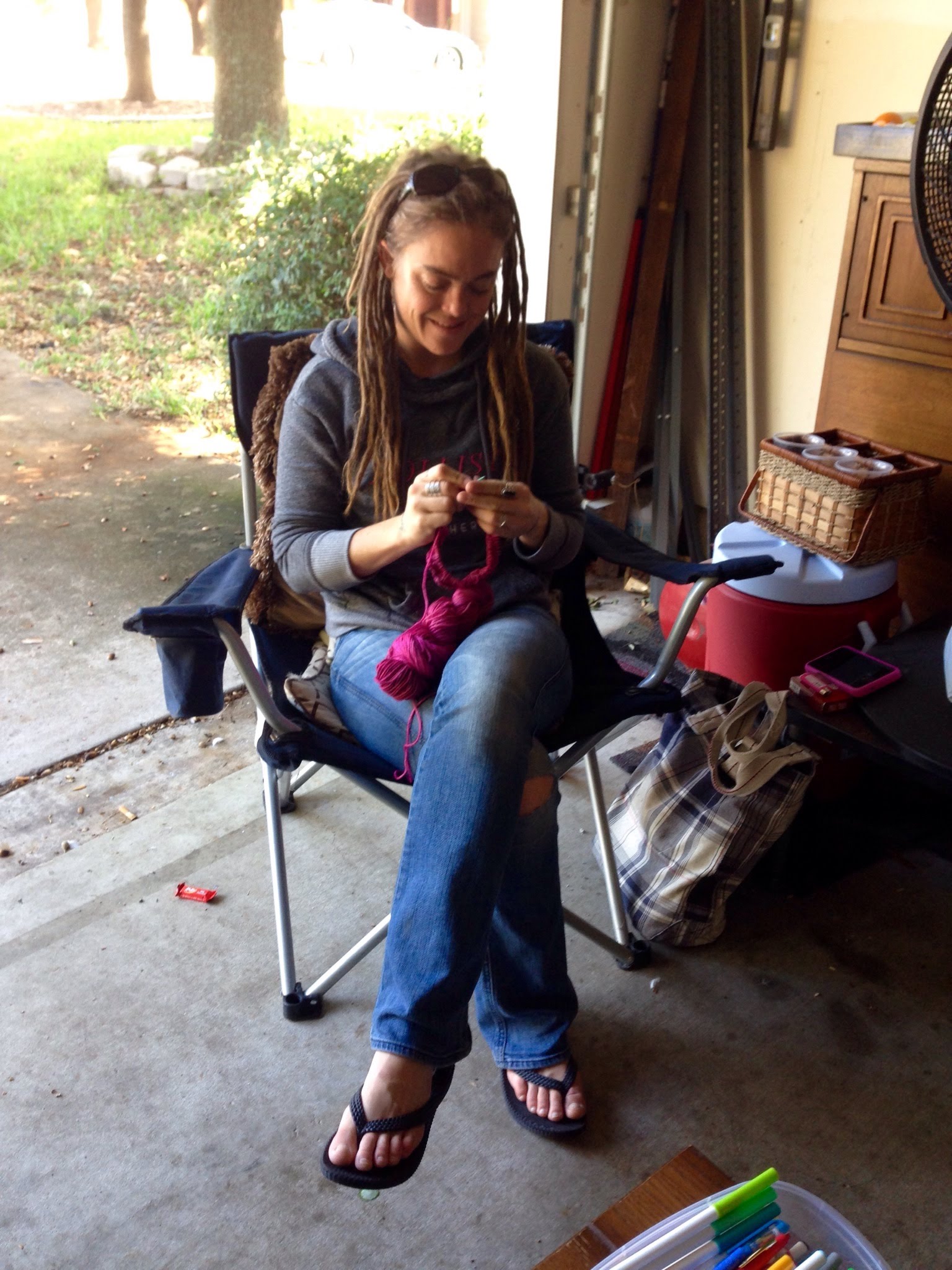
So now with all the knitting, there’s less writing. This isn’t necessarily a bad thing. My first drafts are stronger than they used to be when they do appear. I sit and I knit and I write in my head and so when pen hits page I know more of what I’m doing and where I want to go with it. They’re more intentional words. Now, I fill up about 3 or 4 notebooks a year, and while this means I’m not getting published on a monthly basis anymore, the words that I do get out of me have more depth. Not that I was surface-level writing earlier, but after publishing over 200 essays, you have to dig deeper and think wider to find your story.
I’ve written extensively about my father. Those moments of interactions that embedded themselves in the story of myself before he died. Moments that I turned to in a number of essays to hold them up. To look at them. To see what they had to offer me in the notion of narrative.
I’ve written about these moments—have perhaps even written all of my father’s story out of me. I didn’t think I had anything dad-related left to write. Then, when knitting one day and syncing up the rhythm of my thoughts and fingers—memories melodically pulsing through me—I remembered a shirt he used to wear around the house when I was growing up. I hadn’t thought about that shirt in I don’t even know how many years. Decades, probably. It said: “Why do men die before their wives? Because they want to.”
Considering my father died 16 years ago—when he was just 54—and my mother is now approaching 70, this shirt is beyond ironic.

Without all that knitting and not physically writing, I don’t know when that memory might have come to me. I want to say it wouldn’t have, but that’s probably just because, as a writer, I’m trying to justify the hours I spend every day knitting instead of writing. Regardless, in this different approach to writing, I found something new to say about something I thought I was done saying things about.
Point here being two-fold:
1. No matter how many times you write about something, there is always more to say about it because each time you approach the narrative it’s inherently from a different personal space and explored with different words and written in a different rhythm.
2. Sometimes the best way to write is not to write. Not that I’m discouraging you from writing, rather I think there’s so much writing that can happen when we’re not physically writing, and we need to foster that.
Need to sit. Consider. Need to knit. Get rhythmic. Because some of the best writing might happen when you’re not writing.
There is no wrong way to write, no incorrect path to crafting prose and poetry. You just have to be open to the narrative. Let it come to you. Let it come out of you. Let if form inside you and then give it form on the page.
Sometimes you just have to sit with the words to understand what they have to say and how you want to say them.
***

Chelsey is also a WOW! Women on Writing instructor. Check out her upcoming workshops, Curiosity and Creative Nonfiction and When Life Fissures: Writing About Grief in Fragments, both starting August 16th!