Showing posts with label freelance writing for magazines. Show all posts

Ask the Book Doctor: Making Money Writing

Saturday, September 16, 2023

By Bobbie Christmas

Q: How do we support ourselves while we’re writing our books?

A: If you’re writing nonfiction, you can write a proposal and several sample chapters instead of the whole book. If the information is current, compelling, and well written, and if the proposal follows the guidelines about how to write a book proposal, you may succeed in selling the book and get an advance against future royalties. Still, the advance may not be enough to live on while you write the full book. My advance from Union Square Publishing for the first edition of Write In Style paid only about a month’s expenses, so I continued to edit books and write articles to maintain my income while I wrote my book in my free time. 

If you write fiction, you can try your hand at freelancing for magazines and websites while you also write your novel.

Writing and selling articles is a great way to make some money while you’re also writing your book, but you need to know how to write an article and how to find work, and writing articles can be a full-time job in itself.

Long ago at a local meeting of The Writers Network I asked attendees how they supported themselves while they wrote their books. The consensus was that most kept their day jobs and wrote their books at night and on weekends.

In reality most of us writers don’t make enough money off our books even after they are published anyway, so we’d better have another solid source of income, no matter what.

Q: Tell me about breaking into magazine writing.

A: Oh dear, entire books have been written on the subject. I can’t possibly give the answer the full attention it deserves. Instead I recommend reading a few books on the subject. Although I haven’t read the book, I looked at a few, and I liked Complete Idiot’s Guide to Publishing Magazine Articles by Sheree Bykofsky best of all, because it covers a great deal of territory, including how to handle your taxes when you get paid. I’m a little prejudiced because Sheree has been a help to me from time to time. She’s a literary agent in New York.

In brief, editors need to see that you can write a good article and are familiar with the jargon and craft of journalism. For example, the lead paragraph of an article can be referred to as a lede or a lead. When editors read your clips (examples of articles you’re written), they want to see you know how to write a strong lede, follow the tenets of creative writing, and use good grammar.

At the time I began freelancing full-time—when dinosaurs roamed the earth—I used the Yellow Pages to find local magazine publishers. I made appointments to show off my portfolio and get to know the editors. In this way I was able to get articles assigned to me regularly. Today you’re not limited to local publications. The internet is filled with information on periodical publishers and how to query them.

Q: How can I go from free to fee writing?

A: Good for you for writing for free! You’re building your portfolio.

Many accomplished writers began by writing free articles. Some do it to get experience and build a portfolio. Others began writing as volunteers for nonprofit organizations. I began by writing and editing for my school newspapers and then for charitable and educational organizations. After I gathered enough bylined articles to build a solid portfolio, I used it to land a full-time job as a reporter and editor with a newspaper. Over the years as my skills and portfolio grew stronger, I moved into corporate communications, without ever revealing that my original portfolio had all been written for free.

I’ve progressed into editing books and magazines, so I no longer seek freelance writing assignments. When I did, though, I had much more success when I met with publishers, showed them my copious and varied portfolio, and asked for assignments. Nowadays I recommend that freelancers have a website that displays some of their published articles. Websites have become essential for anyone in business, and trust me, freelance writing is a business.

As a business owner you must constantly market yourself. No client lasts forever. Editors change, companies fold, work dries up, and if you aren’t always looking for more and new clients, you will find yourself out of work.

Even though printed periodicals have slowly dwindled, other opportunities have arisen. Companies need copy for their websites. Businesses and organizations need newsletters and blog entries. Query all the websites, periodicals, and other paying markets that appeal to you. Never stop looking. If you hone your writing skills and approach publishers in a professional manner, you will soon go from free to fee.

Never make the mistake of undercharging, though. Rather than settle for low rates, you may need to use a few negotiating skills. Going from free to fee is one thing, but getting paid a fee that’s worthy of your time is more important than merely getting paid.

Even when you are accustomed to getting paid for your work, you may find times when you want to charge less or nothing, such as when writing for a nonprofit that speaks to your heart. Don’t hesitate to follow your passion and use your skills to help people and organizations that make the world a better place.

***

Send your questions to Bobbie Christmas, book editor, author of Write In Style: Use Your Computer to Improve Your Writing, and owner of Zebra Communications. Bobbie@zebraeditor.com or BZebra@aol.com. Read Bobbie’s Zebra Communications blog at https://www.zebraeditor.com/blog/.
Read More »

Friday Speak Out!: How to Maintain a Professional Rapport with Editors, Guest Post by Clara Freeman

Friday, November 22, 2013
Recently, I spoke with an editor of a lifestyle and entertainment magazine I’d done work with several years ago. I looked the editor's publication up beforehand, to refresh my memory about their guidelines, and to get a feel for what new trends the magazine was incorporating since I’d last visited their publication.

Confident that my work as a motivational columnist was a step up from the published article in the entertainment section from days of old, I decided to reconnect with the editor and pitch a new idea for the premiere issue of the magazine. Needless to say, the interchange went well. It was agreed that I would pen a “motivational moment” column for the magazine for which I would be compensated.

When the contract arrived, however, there was one slight eye-opener that I hadn’t bargained on. The editor selected the title for my agreed upon column, from which I was expected to write the article! I was dumbfounded to say the least and a bit disappointed. But, I signed on the dotted line and produced the column with the magazine’s headline.

In the end, the transaction with the editor went off without another hitch. I was paid for my work and asked to contribute to the magazine on a regular basis. In declining the offer (in lieu of paying markets) I asked that the editor to consider spreading the word about my expertise in the personal development and empowerment genre, to which she readily agreed.

The few nuggets of magazine etiquette I’ve learned over the course of several years of writing for magazines could fill a very small hole, but, they are valuable pieces of gold that’s worth it to any writer trying to break into the print magazine market.

Do the research. It doesn’t matter if you’ve written for the magazine before. Times change and magazines change along with the times. Here are a few other facts to consider when making your pitch to magazine editors:

1. Make sure your pitch stands out by answering the editor’s question of “What’s in it for me?” In other words, what’s the take away value that will guarantee the editor’s satisfaction and outshine your competitors who are vying for the same gig?

2. Maintain a polite and professional attitude.

3. Be open to suggestions and don’t quibble about the magazine’s intent for your piece. I admit I had several titles to choose from for my article, but, accepted the magazine’s title which complimented their vision. My column title remained intact, so the article’s title wasn’t something to make a big deal about.

4. End the experience on a positive note and offer to write for the magazine again. Also spread the word about the positive treatment you received from the editor and always address them by their names!

5. Continue to write and hone your skills as an expert in the areas of your interest and don’t be afraid to approach editors with your article suggestions that will help make their magazine sparkle. And, if you do get rejected? No worries, just hit them up again the following year with an even better pitch.

* * *
Clara Freeman is a freelance writer, motivational author and coach. A former nurse, certified in leadership and coaching, she parlayed a longtime nursing career into a business brand for women empowerment, where she serves as advocate and mentor to women on the path to living authentic lives. Her articles have been published in numerous magazines, including Costco Magazine, Working Nurse Magazine, and Women in Business 101 Magazine and Today’s Chicago Woman Magazine.

To learn more about Clara’s work, visit her website at
http://authentic-woman.net . You can also download a copy of her popular eBook, “My Life toward Authenticity-My Authentic Woman Story

Follow Clara on Twitter @ C50something.
Facebook - clara.freeman.904@facebook.com
~~~~~~~~~~~~~~~~~~~~~~~~~~~~~~~~~~~~~~~~~~~~

Would you like to participate in Friday "Speak Out!"? Email your short posts (under 500 words) about women and writing to: marcia[at]wow-womenonwriting[dot]com for consideration. We look forward to hearing from you!

~~~~~~~~~~~~~~~~~~~~~~~~~~~~~~~~~~~~~~~~~~~~
Read More »

Want to Break Into Medical Writing? Interview with Medical Writer Nancy Monson

Thursday, July 26, 2012
by Rosrin Wuithiran

Award-winning medical writer Nancy Monson has been writing professionally for the past 20 years. Writing for both consumers and medical professionals, she has covered medical topics for websites, videos, blogs, and more. Her articles range in topics in health, nutrition, psychology, and medicine and have appeared in Woman’s Day, Glamour, and Fitness, among many titles. She has also written health books such as Craft to Heal: Soothing Your Soul with Sewing, Painting, and Other Pastimes and The Smart Guide to Boosting Your Energy. Nancy also offers a medical freelance writing how-to book, Just What the Doctor Ordered: An Insider’s Guide to Medical Writing at www.medicalwritingbook.com.

She is a member of the American Society of Journalists and Authors and the Association of Health Care Journalists. You can find her writing porfolio at www.nancymonson.com. WOW! is excited to speak with Nancy about the world of medical writing.

WOW: Welcome, Nancy! What steered you into the field of medical writing?

Nancy: I actually fell into the field about 25 years ago. I originally wanted to be an actress, but I always had a facility for writing.

WOW: So how did you get started in medical writing?

Nancy: I got a job as a freelance typist for a New York City medical communications company, working evenings, so I had days free to go to acting auditions. Over the course of several years, a couple of editors at the company realized I had potential and gave me opportunities to go to medical meetings and report on presentations, and taught me to edit medical materials.

WOW: That's great they encouraged you to get into the field. Do you have a medical degree?

Nancy: No. I have a Bachelor of Science degree magna cum laude in communications from Boston University’s College of Communications.

WOW: Did not having a degree cause a problem? Did editors inquire whether you had the sufficient background to write on medical subjects?

Nancy: No, not really, because I started when the medical communications industry was still fairly young and that wasn’t an issue. They were looking more for editors and writers and were willing to teach people the medicine. I’ve since been in the business for so long and I have so much experience that it’s not an issue. I also have a lot of contacts who know I’m very competent and dependable. However, it appears that advanced degrees are being requested more and more of medical writers.

WOW: How difficult is it to find references and experts to support findings and statistics for your articles?

Nancy: It’s not difficult thanks to the Internet—it used to be a lot harder when I physically had to go to a medical library and do research. The National Library of Medicine website Pubmed provides access to abstracts of thousands of new and old articles each year, so that’s the first place to go to do research.

WOW: That's a fantastic resource! So where do you find experts for your articles?

Nancy: Through literature searches and recommendations from other experts and organizations.

WOW: How do you find medical journals to write for? Or is it a mixture of medical publications and general interest magazines?

Nancy: Actually, I don’t write for medical journals. Rather, I write continuing medical education (CME) custom publications for healthcare professionals, patient education brochures, and web tools, and these projects are typically offered to me by clients I’ve known for a long time and who I keep in touch with to let them know I’m available. I also write consumer magazine articles and blog posts on health and nutrition topics; I get these assignments by pitching story ideas to editors at magazines that interest me, such as More, Shape, Vivmag.com, and Weight Watchers Magazine. Finally, I write books, as well as assist doctors, psychologists, and other authors with writing their books and book proposals.

WOW: It's great to know medical writing can be so diverse. How did you find topics of interest or how were you able to punch up topics to suit the needs of publications?

Nancy: I don’t need to find topics of interest for the medical writing—I am assigned those projects by medical communications companies and organizations. For the magazine articles I write for consumers, I peruse medical journal articles and medical meeting news releases, and read the newspaper for reports on new studies that could serve as the “newspeg” for a magazine article.

WOW: Were there any surprises you encountered (such as non-health oriented periodicals being interested in health and medical topics)?

Nancy: I was lucky enough to move from medical writing to consumer magazine writing in the early 1990s. Health and nutrition writing was a new niche back then, and my medical writing experience and contacts with medical experts helped me to succeed in that area. Today, health and nutrition are staples of most consumer magazines, given the interest most people have in the topics.

WOW: What propelled you to write your books?

Nancy: My first book, The Smart Guide to Boosting Your Energy, was offered to me. It was part of a series and seemed like a nice way to try my hand at book writing. My second book, Craft to Heal: Soothing Your Soul with Sewing, Painting, and Other Pastimes, is a labor of love and was a concept that I developed and pitched to many publishers (through a book agent). I’m very interested in crafts, hobbies, and creativity, and I uncovered research that these pursuits can have mental, physical, and spiritual benefits. I look at the book as a self-help guide to tapping these benefits for yourself. My third book is an e-book with a co-author, Linda Peckel. It arose out of the question from my fellow consumer writers “How do you become a medical writer?” It’s called Just What the Doctor Ordered: An Insider’s Guide to Medical Writing.

WOW: How did you make the choice of selling books on your own rather than trying for a big publisher?

Nancy: My first book was published by John Wiley and Sons. Craft to Heal was purchased by a craft publisher that folded, so I ended up self-publishing the book. That’s been a great experience, as I have complete control over the copy and cover. I also have control over the marketing, which is good and bad, as that’s a massive effort (but I’m told it’s a massive effort even if your book is published by a mainstream publisher). I revised the book with some new research and text this past summer. The third book, my co-author and I wanted to get out quickly, so we wrote the copy based on our many years of experience in the field of medical writing, and contracted with a web designer to create the e-book and our website.

WOW: With 300-plus articles and works under your belt, do you feel you have reached a limit of topics? Or did you decide to delve into other writing realms?

Nancy: Oh no, not at all! There are always new health and nutrition studies coming out, and updates to stories to be made, as well as seasonal health and nutrition stories (called “evergreen” stories—for instance, stories about breast cancer in October for Breast Cancer Awareness Month). I have, however, moved into writing about other topics that I enjoy, such as psychology and relationships, as well as crafts, hobbies, and creativity.

WOW: That's wonderful you've been able to branch out, and you sound passionate about your book projects--and crafting! (smiles) So what was the best advice you received for medical writing?

Nancy: Pay attention to details and take your time: you have to be accurate. You can’t get medication dosages wrong or fake your understanding of a study design. On the other hand, be dependable, too. Make your deadlines.

WOW: Great advice . . . especially about the medication dosages! All of those details are so important to get right before submitting. What is your typical routine in producing an article?

Nancy: It varies depending on the project. If I’m writing a CME publication, it starts with my doing some preliminary research on the topic and creating an outline. I then participate in a conference call with the medical experts who have been selected for the project, and we review the outline and they give me guidance on what to cover, relevant studies to cite, and other things. These publications must be evidence-based (meaning they are culled from solid research and heavily referenced), as well as clinically useful and balanced rather than promotional in nature. Next, I go off and write the publication, which can take a month or more. When the first draft is ready, it is sent out to the client and the medical experts for review. It comes back to me for revisions, usually at least once, and sometimes twice. It can be a challenge at this stage of the game to reconcile sometimes disparate comments and changes from advisors so everyone is happy with the content. Next, it goes to editing and layout, before ultimately being published and distributed.

WOW: It sounds like a very detailed process. What do you feel is the biggest contribution to your success in a writing career?

Nancy: I feel I am very dependable and always make my deadlines. My copy is also very clean, because I pay attention to details and check my work before I submit it.

WOW: How did you get into continuing education writing? (Where medical professionals take courses to further their studies and to renew their licenses)

Nancy: I knew that I didn’t want to do promotional or marketing writing about drugs. I wanted to educate health professionals and patients, so CME (continuing medical education) was the natural way for me to go.

WOW: How do you find topics for continuing education writing?

Nancy: I am assigned these projects, so I don’t need to come up with the topics myself. I do specialize in certain subject areas, however: women’s health, nutrition, dermatology, neurology, and psychiatry/psychology.

WOW: How about for the consumer magazines you write for . . . Have you had disappointments/regrets in certain topics you queried?

Nancy: I may get excited about a topic, put a lot of effort into writing a query letter, and have it quickly shot down by an editor. That’s disappointing because it’s not always easy to come up with saleable article ideas and a lot goes into crafting a good pitch (magazines are demanding more and more of freelance writers in this regard, even asking them to get quotes from experts).

WOW: How did you deal with the query rejection?

Nancy: I refashioned the query and sent it to another magazine. Some queries never get picked up, and that’s just part of the experience of being a freelance writer.

WOW: What tip can you offer to someone interested in medical writing?

Nancy: Immerse yourself in the medical literature so you get a feel for the style and lingo—that means reading the New England Journal of Medicine or JAMA. Those journals are available at many public libraries. WebMD is also a good source of consumer health information; they have a medical site called Medscape for health professional information. And consider taking courses through the American Medical Writers Association.

WOW: Thank you, Nancy, for sharing your writing life with WOW!
Read More »

Top 3 Reasons Why You Should Try Freelancing

Wednesday, November 30, 2011
Besides impressing others by being able to say, "Oh, I'm a freelance writer,"  or "Yes, I've been published in Family Circle," there are other reasons why pursuing a freelance writing career or even working part-time as a freelancer are good for you as a writer. 
  1. Flexibility: One of the best benefits of being a freelancer is the flexibility. I'm not going to tell you it's easy--because it's not. You'll work hard, and you'll work long hours; sometimes just to get one article finished or five query letters researched and sent in. But you can generally do this work at 5:00 a.m. or 5:00 p.m.--whatever your schedule calls for. Freelancing is perfect for stay-at-home parents who have a different schedule almost every day or even writers working day jobs but hoping some time to freelance full time. I would say my favorite thing about freelancing, besides how interesting it is to write different articles and meet a wide variety of people, is the flexibility!
  2. Extra  income: That's the joy of freelancing--you get paid--or at least, you are supposed to. And in real, live money--not copies and not t-shirts or other merchandise. Whether you write for small or large markets, glossy magazines or your local paper, a paycheck should accompany your hard work. It's hard for me to tell you how much you should get for your submission--until you break into the national magazines, you are probably not going to be funding your child's college education. But you could easily fund next year's Christmas purchases or that cruise vacation that you wanted to take with consistent querying of small to medium-size markets.  And I always encourage my students to go for the glory--why not send in that query to O the Oprah Magazine first before you send it to a regional woman's magazine? You never know when an editor might love your idea. 
  3. Your resume: If you're freelancing while you're working on your memoir, a nonfiction book proposal, or your novel, you're also building your resume or platform and collecting clips. You also probably have a bio included in several of these freelance publications, where you can list your blog, your website, your upcoming work, and so on.  Any exposure you can get for your upcoming work is great. Any networking you can do while freelancing is doubly great. And finally, you are getting all types of writing and publishing experience that is invaluable during these experiences.
If I haven't convinced you yet, then here's a reason I know will convince you to give freelancing a try. (smiles) You become better at TRIVIA! (Think of all the trivia nights you can attend--people will be fighting over you to be on their team.) You are bound to learn interesting tidbits of information about your community, history, sports, and so on while researching and writing articles. In other words, you are building your trivia knowledge. 

If you're interested, but you have no idea where to start, my freelancing class is being offered in January 2012 (starts on the 9th). It's great for anyone starting out with freelancing or who has been doing it for a while without much success. To view the syllabus and sign up, click here


Read More »

MAGAZINE WRITING SUCCESS e-course Starts Wednesday May 20

Saturday, May 16, 2009
Have you checked out WOW!'s brand new Workshops & Classes page? If you subscribe to our newsletter, you probably saw all the great new e-courses we're offering. The first class to kick off our summer season is Wendy Meyeroff's Magazine Writing Success Course! Wendy is still accepting students, so if you're interested in learning the craft of magazine writing and marketing your work to this lucrative market, be sure to take advantage of this opportunity!

MAGAZINE WRITING SUCCESS: THERE IS STILL WORK IN MAGAZINE WRITING. HOW TO GET IT—AND KEEP BUILDING ON IT, by Wendy Meyeroff

START DATE: Wednesday, May 20, 2009

DURATION: 6 weeks

COURSE DESCRIPTION: This is a class for writers who’d like to build a portfolio (and make money). Magazine articles are a great place to start. The class not only discusses writing non-fiction articles for well-known publications (e.g., Cosmo, Good Housekeeping, Wired), it teaches students to look beyond them and points out other avenues for both income and recognition. This is NOT a how-to-write class; it’s about finding saleable story ideas, marketing yourself and your work, and getting the best price for it. At the end of class, students receive a free e-zine summarizing top 10 class highlights, for easy review.

WEEKS AT A GLANCE:

Week 1: Broadening Your Horizons. Includes introducing students to outlets beyond well-known publications

Week 2: Tricks of the Trade to Help You Get In (Includes a Checklist for Magazine Analysis)

Week 3: Creating More Effective Query Letters

Week 4: Setting Your “Hourly Rate”

Week 5: The Art of Negotiating

Week 6: Going Green: Extra Income Through Recycling Your Articles

ABOUT THE INSTRUCTOR: I started as a reporter and then also an editor at a variety of trade magazines (pharmacy, optical and telecommunications). My work on the pharmacy magazine eventually got me a freelance assignment: a newspaper column, “Health & Beauty Hotline,” which was distributed to over 250,000 readers weekly for three years. These clips got me into Family Circle magazine and then to Woman’s Day, Working Mother, and Weight Watchers (plus many other publications). That led me to become one of the first writers for webzines, like CBSHealthwatch.com. And all of this helped me get commercial contracts for much more money down the line.

Visit our Workshops & Classes Page for full details! http://www.wow-womenonwriting.com/WOWclasses.html
Read More »

When did I become such a mercenary?

Thursday, April 09, 2009
I'm a writer. I'm a blogger. Yep. We established that a few posts back. But here's my dilemma.... Am I a writer because I get paid to write? Or because writing is my creative outlet? Or both? Or neither?
If I write an article for a magazine or newspaper and I am paid that feeds the belief that I am a writer. If I blog and I'm not paid--in the same manner as a print article--does that feed the same belief that I'm a writer/blogger?
The reason I ask is that frequently, as a writer, I've been asked by friends about their becoming a writer. I recommend a few books, wish them luck and, if they find their skin is thick enough, we enjoy future discussions about this editor or that one. It's part of the networking of writers. But go to a writers' conference and, friendly and fun as it may be, we're all in line to pitch the same editor, competing with one another. Just as my mentoring writer friends did with me, when my friends want to understand how the business works and I'm happy to encourage them, suggest some books and then let them go find their way.
Blogging seems to work in the reverse. At blogging conferences, it seems, there is a joi d'vivre and everyone is happy to see and meet everyone else. There isn't the same competition. My blog is mine, yours is yours. We reach different audiences and I don't have to convince an editor to buy my ideas or words.
More and more I'm being approached to talk to friends and acquaintances who want to start their own blog. But blogging has a technical and business element that is missing from writing for magazines. The talks are more in depth, balancing technology, terminology and the business of writing. Is it wrong to want to monetize these talks? Do you have this dilemma? I hope this analogy works, but could it be the difference between the casual cocktail party conversation talking about your health with a doctor and making an appointment to actually talk to a doctor?

Elizabeth King Humphrey is a creativity coach and the moderator/main blogger for CoastalCarolinaMoms. She is also a freelance writer and can hardly wait to stop thinking money and starting thinking creativity...or at least gardening. Check it out at TheWriteElizabeth. In between answering comments, she'll be playing in the dirt...flower and vegetable seeds at the ready.
Read More »

Ten Ways To Get Cheap (Or Free) Magazine Samples

Thursday, September 11, 2008

Aside from being fun to read, we as writers need to study the publications we're trying to break into. I've gotten loads of cheap magazine subscriptions through various online discount sites, and even ebay. Here are some additional ways to obtain the magazines you're interested in, from freelancer Pam White.

--MP


1 - Join a reading or writing group. Ask members to bring in their
already-read magazines and have an exchange. Do the same with interest
groups you belong to or know about - playgroups (parenting, home, cooking, family mags), business networking groups (entrepreneurs, home business, finances magazines), church (religious, devotional periodicals).

2 - Offer to take a friend to the doctor’s office. Okay, that sounds goofy but I love taking my children to the orthodontist, pediatrician, and dentist offices so I can scan the table of contents and skim the articles in the parenting, children’s, family, travel and money magazines. I bring a notepad and take plenty of notes. Find an article in an old magazine that would help your research? Ask the office to make a copy of it; offer to pay.

3 - Subscribe. Remember if you subscribe to a magazine that is for business purposes, you can deduct the cost of the subscriptions if you itemize your taxes. I am a food writer so I keep all receipts for food and writing magazines, and food and writing books to deduct as business expenses.

4 - Take up publishers on their free copy offers. It used to be that all magazines would let your send in a postcard and check the "bill me" square and you’d end up with two or three issues before they cut you off for not paying. These days, we cannot even be inadvertently dishonest. I get mailings from magazines offering me one free issue. I will send in the postcard and usually have a bill to pay before I’ve read the free issue. I then can decide to subscribe or put the bill in the postage paid envelope and decline to pay.

5 - Look for the online issues of particular magazines. It’s true that many use original content online (another good market to explore) but even the different content will show you what type of material the magazine is looking for.

6 - Read newspapers online. Do you want to write travel articles? Visit the major newspapers online. Most hire freelancers to cover a great deal of their special interest articles. Contact information for, in this example, the travel section editor will likely be available on the website.

7 - Write for guidelines. Look in The Writer’s Market. If you are looking for parenting magazines and find one that sounds about right to you but you’ve never seen, write for the writer’s guidelines and request a sample issue. Double check the listing of the magazine to see if there is a reduced price or you have to send a stamped envelope to receive a free copy.

8 - Go to the library. This is so obvious! Make a bi-weekly appointment to go to the library and review the magazines you want to write for. Make notes. Use the library’s copier to photocopy the table of contents, or an article or two to review at home.

9 - If your public library doesn’t carry the magazines you want to know
about, travel to a college library. They are set up for your kind of
research. While most require student identification to use the reference materials, you can read the periodicals unimpeded.

10 - Bookstores! Grab a pile of magazines, buy that over-priced latte and carefully review the magazines you’ve found to study (remember, if you spill on it, you buy it!)

(c) Pamela White, 2006 About the author: Pamela White published Food Writing, the free ezine for food writers from her website: www.food-writing.com She teaches food writing classes, and her book, Make Money as a Food Writer in Six Lessons, is available at Amazon.com.

Photo courtesy of PinkMoose, flickr.com
Read More »

Mistake Noted

Tuesday, August 05, 2008
Not too long ago in my zest and zeal to send out query letters, I began coming up with ideas for queries that related to life as I was living it. And how was I living, you may ask? During this rampant, query-writing fest I had a two-and-a-half year old running around and a two-month old nursing every 3 hours. Life was crazy, and maybe I can blame the query faux pas I committed on sleep deprivation and hormone fluctuations.

I came up with what I thought was the greatest idea for a story: how to breastfeed in public. My own mom didn’t give me many tips except “Just put a blanket over your shoulder,” and the lactation nurses weren’t much more helpful (they told me to just wear big shirts). I figured if I was having a hard time other moms were probably having a hard time, too, and would appreciate a how-to article that showed them the ropes.

I had my sources lined up, a body of research and I knew which magazine I was going to pitch the story to: American Baby Magazine. I looked through old issues to make sure that they hadn’t covered my exact topic but found that they did lots of articles about feeding new babies.

I wrote the query, thinking that I had the golden ticket for making it in the glossies with this pitch. With trepidation, I mailed off my query and began to wait. The odd thing was I didn’t have to wait very long.

I received back a letter a week later that said thanks but no thanks. Instead of being devastated, truthfully I was a little relieved. After all of my research on different tips and tricks for breastfeeding in public, I had exhausted my brain on the topic and it was no longer very interesting to me. I was glad was not to be required by an editor to make that story happen.

My relief aside, I did want to understand why the story was rejected. I don’t know for sure but some clarity came a few weeks later when I was telling a friend about that particular query. I told her it was about breastfeeding in public and she looked at me almost startled.

“Omigosh, Sue,” she said, “that is such a controversial topic. Ask three women about it and you’d get four opinions back. If I was an editor I wouldn’t want to touch that topic with a ten-foot pole.”

I sat there a little more than stricken by my friend’s bluntness, but I thought she was right. In all my research, in all my consideration of whether or not women would want to hear about my topic, I had not taken into account that the subject of breastfeeding in public was too taboo for that particular magazine. Now, if I had pitched it to, say an OB nurse quarterly, or a publication of the La Leche League, perhaps I would have gotten a different response. Since I chose to pitch it to a national magazine that needs to carefully take into account the sensibilities and opinions of a wide audience, I’m not surprised that this one was quickly overlooked.

Of course, I don’t know for sure why this query was rejected by that magazine; there could have been many other reasons besides the topic being controversial. Through the experience, though, I learned to take into consideration a different aspect of what a publication may look for or avoid in an article.

-Susan L. Eberling
Read More »

Are All-Media-Worldwide Rights Becoming the Norm?

Thursday, June 26, 2008
Rosie is concerned!

As a publisher, I can understand the benefit of adding the clause of "all-media worldwide rights" to a work-for-hire contract, but as a freelancer myself, and one who supports freelance writers, I just can't agree with it.

In a nutshell: let's say you were accepted to write an article for so-and-so's print magazine and signed a work-for-hire contract with the term "all-media worldwide rights" in it. That means the publisher can republish your work in any format they choose--online, video, print, television, radio, etc.--without paying you anything further. How is this possible? It is, and it's becoming standard practice in the U.S., as mentioned in a recent Folio Magazine article.

What I don't completely understand is why. Even if the readers are exactly the same--which they couldn't possibly be--there shouldn't be any reason for non-payment. If you think about it, the two avenues should be set up to monetize different income streams. Print has its advertising, and so does web--there should be a budget for both. There's definitely a separation between the two, or there should be. Many have the ability to pay freelancers at least a percentage, or a reprint rate, so why is this practice becoming the norm? My only guess is that the majority of freelancers are rolling over and taking it. And so are editors.

At one time, magazine editors were the voice for their writers, but not so anymore as management gets a tighter grasp and a new generation of editors--who don't know any different--step in. But, it's not all doom-and-gloom! There are common-sense solutions you can use to protect yourself. ASJA (American Society of Journalists and Authors) offers this piece of advice:

"We have a suggestion. Get the contract before you start working, try negotiating, and if they refuse to offer an alternate document or make reasonable changes, go elsewhere. The market ultimately speaks, and even though publishers and editors like to pretend that writers are a dime a dozen, they know it's not true. It's too hard to find the talent and dedication to get a good story. Try pitching different types of stories to other markets, or take your ideas to their competitors. When the writers they want don't want them, the tune will eventually change. It won't be the first time, and it won't be the last."

ASJA is a great organization with sound solutions. Too bad they stopped publishing their "Contracts Watch" newsletter in 2007--it was such a great resource to find out the latest on publisher's contracts, as well as an advocate for writers in the trenches. But you can still view their online archives and read quotes from freelance writers and ASJA's answers here: www.contractswatch.com.

So, what do we do about "all-media worldwide rights" becoming the norm? I don't have the solutions, but do recall the recent writer's strike by the Writers Guild of America and their victory, albeit somewhat slim, on being awarded residuals from DVD and "new media" compensation. That aside, one thing you can do is to look out for certain clauses in any contract you sign: (the clauses below were published in the print version of Folio Magazine's article--a sample from CXO Media's freelance contract)
  • Payment: $______ for all-media world rights in perpetuity upon acceptance of publication.
  • CXO will own all-media world rights for the Work including perpetual and irrevocable license to print, reprint and distribute the work in any fashion or medium.
  • You specifically waive any and all "artist's rights" you may have pursuant to any state or federal statutes regarding the Work purchased by CXO.
And, if you check out the previously mentioned Folio Magazine article, read the comment submitted by a publisher. Basically, since the publisher purchased all rights for both print and digital, it allowed the publisher to resell the article to a service, who then resold it elsewhere, and gave them a percentage of the profit from the sales...without paying the writer any profit. She admits it wasn't fair to the authors, but only after she realized that the new sellers resold it until the stories were everywhere and it ultimately undermined the value of the stories.

I know I'm going to get flack for this post from my peers, but c'est la vie. I simply don't think it's fair to treat freelancers this way.

What do you think? And what should freelancers do?

------

Join these discussions and more by subscribing to the Premium-Green Markets: the Women's Guide to Freelance Writing and Markets
Read More »

The Birth of the Digital Newsstand

Sunday, April 20, 2008
Did you know that digital magazines are booming? It’s a market that has been out for less than five years, but it’s just now beginning to take off, and I can understand why. Have you ever wanted to read a magazine right now, at the very moment you think about it, but you can’t get to the bookstore, newsstand, or market? I know I have. Well, now you can go to a virtual newsstand and purchase that publication to view immediately. Not only can you read your favorite magazine right away, you can also interact with the content. Some magazines even go a step further--adding video and audio to the mix. I know nothing beats sitting down with a magazine and leafing through the glossy goodness, but it’s great to have that option available at your fingertips.

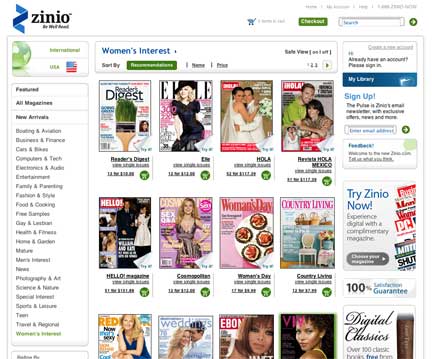
One of those sites is http://www.zinio.com, which calls itself "The World’s First 24/7 Global Newsstand" and has over 850 titles from 20 countries to choose from. Readers can purchase single issues or subscriptions, and read the magazines anytime, from any location, and in any language. Here’s a screenshot:


What does this mean to freelance writers?
In my opinion, I don’t think it will affect us at all. In fact, it may help. Statistics from "Digital Magazine Study" show that readers are more likely to visit advertiser’s sites on a digital version as opposed to print. That means that publishers can track the effectiveness of ads in real time--and we all know that a magazine with a lot of ads has more money to spend on freelance writers. In addition, writers may also receive extra payment for publishing the same piece online. Bonus!

What does this mean to publishers? By going digital, publishers lessen print and circulation costs, gain real time statistics, interactivity, and strengthen their brand. They also have the ability to tap into markets that may have been out of their reach before, such as international. On the production side, it’s not that much different than putting out a print magazine. There are companies that will take the print files that are done in programs such as InDesign, and convert them to a web friendly version, complete with analytics, rich media, and social capability. Sites such as:

www.nxtbookmedia.com
www.olivesoftware.com
www.texterity.com
www.imirus.com
www.editionduo.com
www.advancedpublishing.com
www.pressmart.net

But are readers willing to make the total switch? I still enjoy curling up with a good book or magazine, but like the idea of being able to view something immediately if I’m researching information. What do you think?
Read More »
Powered by Blogger.
Back to Top