Showing posts with label Linda O'Connell. Show all posts

Tell, Don't Show

Saturday, December 11, 2021

Like all writers, the mantra Show, don't tell has been drilled into my head for decades. It's also what I try to instill in my middle-schoolers. Don't tell the reader your character is angry. Show the reader. What's going on with the character's breathing? Is their face getting red? Are they clenching their fists? Are they pacing? 


I also depend on internal dialogue to flesh out a story. The thoughts that are swirling around in a character's head add so much to a piece. Every instant, we're having a conversation with our self--in our head. Letting the reader in on a character's internal workings enriches a book.


Scripts are different. Way different.
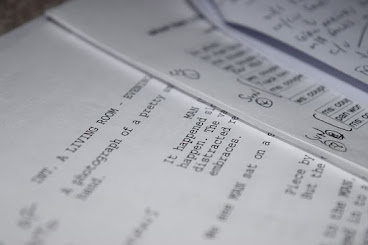

                                                                  olilynch's image by Pixabay


When writing a screenplay, the writer has to tell what the viewer will see--in a straightforward way. Usually, I try to paint pictures with words. Flowery phrases. Similes. Metaphors. Alliteration.


In a script, you don't need no stinkin' similes. In a bare-bones fashion, the screen writer has to tell what the camera sees... what the actor does. And that's it. The goal is to create a visual and emotional moment. Actually, the goal is to create a whole string of emotional and visual moments.


If you're curious how writing a novel is different from writing a screenplay, you can read this article.


I'm halfway through a first draft of a script. I'm transforming my novel, Greenwood Gone: Henry's Story, into a screenplay. While at a writing retreat, a writer friend asked me if there were directors interested in it. Of course. Have you heard of Martin Scorsese? Denzel Washington? Steven Spielberg? The three of them are in a bidding war.


Just kidding. But I can fantasize, can't I? 


The good news: there are screenwriting programs that help you with the formatting. I'm using StudioBinder. After getting accustomed to what I initially thought of as wonkiness, I've found it's almost intuitive. After typing up a bit of action, the program automatically switches to a character and dialogue. Or does it? Is it simply me that has gotten into the scriptwriting groove?


I'm not sure.


I started this as my NaNoWriMo project. A finished screenplay is going to be much tighter and way less textier, so even if I had finished it by November 30, it still would not have been 50,000 words long. I told myself that if I got to the end of the book by the end of November, I'd consider NaNoWriMo a success.


I failed.


However, the way I look at it is this: I have half of a rough screenplay done, and that is a half of a screenplay more than I would have had if I had not done NaNoWriMo.


It's good to be a cup half-full person...


Writing friends--I see some of your pieces as future movies. Seriously. Pat Wahler: Your book I am Mrs. Jesse James would make a superb movie. Linda O'Connell: The memoir I keep bugging you to write? It would make an incredible movie. Renee Roberson: You have dozens of real-life stories about missing people. Your lovely voice narrating the haunting episodes? It would be a definite winner. Angela Mackintosh: The memoir/novel you're still writing (and I haven't even read, but I know it will be mind-blowingly brilliant when it's finished) would be perfect for the screen.


Just sayin'.


Sioux Roslawski is a freelance writer, the proud author of Greenwood Gone: Henry's Story, a rescuer of dogs and a middle-school teacher. You can check out more of her writing on her blog.


Read More »

Make Somebody's Day

Saturday, April 17, 2021

These days--these days of wearing masks and trying to keep apart from each other and not living "normal" lives and living with a constant undercurrent of fear of a microscopic enemy--we all need help. A boost. A reason to smile.


This post began a while ago when I went to the bank. The drive-thru, since nobody gets IN the bank building these days...


(which makes me think of what a terrible time this is for bank robbers. I mean, they've been out of work for months. They're probably depressed, watching Jerry Springer instead of holding up bank tellers, because I imagine it's difficult to make an appointment to get into the bank... and then rob it.)


... Back to the bank drive-thru.


As I waited for the magical cylinder to drop down the chute, I glanced over at the person to the right of me. In fact, I glanced over several times. 


Apparently the teller said something humorous, because the woman in the car next to me laughed, and then smiled more than once during the conversation.


I thought, She has a great smile. Not a runway model smile. A genuine, quirky, dimpled smile. So that she didn't think I was a creeper or a Karen, I rolled the passenger window down and complimented her on her smile.


She smiled again and said, "You just made my day!"


Really? Is it really that easy to bring some joy into someone's life? And then I thought about it. Little things can have a big impact. And then I thought even more... on the things writer friends have done for me lately.

                                                                   image by Pixabay

Here are some ways you can make someone's day:


1. Offer to interview a writing friend--Linda O'Connell was so generous to interview me on her blog. Her questions made me think, and my book got some extra exposure.


2. Write a reveiw on Amazon or Barnes and Noble--I check occasionally nineteen times a day to see if there are any new reviews on my book. 


3. Volunteer to do a dental read-through. A dental critique is when the reader takes tiny picks and mirrors to look at the grammar, punctuation, potential tense problems and everything else.


4. Catch the sparkly gems in a writer's work--There are a couple of details in my brand new novel that only a few people will get. One friend sent her favorite lines from my book to her 700 followers. It makes all the time spent writing worthwhile.


5. Voluteer to be a beta reader--Writers need some feedback before a manuscript is sent out to agents and publishers. 


How about you? What have you done for a writing friend or what has been done for you? A grateful mind wants to know.


Sioux Roslawski is a middle-school teacher and a freelance writer. Her book, Greenwood Gone: Henry's Story, just debuted almost two weeks ago.


Read More »

The Power of a Word

Friday, March 13, 2020
What can a gesture do? What impact do words have on us? What can one question do?

I admit it. I'm a huge fan of the televison show The Voice. I love hearing about a singer's journey, the obstacles they've overcome, the rejection. Singing is the dream that's kept them alive... and when they get up on the stage, singing to the backs of the four judges, putting all their hope in one basket, they're putting that dream on the line.

When one of the judges turns their chair, you can sometimes see the singer's reaction immediately. Some others hold it in until the song is over, and then they almost collapse.


image by Pixabay

There have been a number of times when gestures have impacted me as a writer. Also, over the years there have been more than a few times when some words kept me stumbling forward as a writer. Words, and small gestures, can be extremely powerful.

To say "thank you" to a bunch of folks, and to remind myself of how lucky I am, I'm going to share some gestures and some words of encouragement that I've been graced with.
  • A couple of years ago, J. Glenn suggested I join a writing accountability group. Even though I've been AWOL from my group for way too long, the Butt-Kickers keep me in line as best they can. (I promise I will re-emerge at some point. Things are too dark right now.)  Those few words of advice from Joanne made all the difference.
  • More than a year ago, I finished a manuscript. It was a piece that I'd been immersed in for several years. A tattered shoestring tied my heart to the story. 
          A writing critique friend offered to read it. Overjoyed, I ran to a nearby college that offers dirt-
          cheap printing (a penny a page) in their library, and made that copier whir and whir and whir.

          I gave her the stack of papers held together by a binder clip... and I held my breath. What if  
          she told me, "It sucks"? Worse: what if she hated it, but was too kind to say it was sucky?

          The next day, I heard from her. The. Next. Day. She had stayed up, could not put it down. 
          This writing colleague has a discerning eye. She's a well-known writer in St. Louis. And she 
          liked it. She really, really liked it. (Thanks, Linda.)
  • Many, many years ago, a poet had a contest (I think that's how it happened). The prize: she'd write a poem about whatever topic we gave her. I won, and she wrote a spectacular poem about inspiration and young people. That poem is hung with pride in my office/spare bedroom... and it still inspires me. Shay, you're a wonder with words.
  • I've gotten resource ideas from Cathy Hall and Lisa Ricard Claro.  They took the time to send me a name or a link that I could use as I submit and submit and submit. The Butt-Kickers have helped (and tried to help) countless times and in countless ways. I've had the privilege of working with an editor (Margo Dill) who went above and beyond with her deft hand and eye. I'm incredibly grateful for everyone who's part of my writing life. 
I guess the point of this rambling is this: Reach out to your writing colleagues. Do something for writers who aren't necessarily close friends. Give them some encouragement. Offer to be a beta reader. If you hear of an editor or publisher that might be interested in someone's work, get in touch with that someone and let them know.

We all need some help now and then...


Read More »

Everybody Needs a Hand Up

Thursday, May 30, 2019
These days, writing is harder than it used to be. The industry's flooded with books. The publishers are pickier. So are the agents. Everybody (including me) thinks they are a writer. It's like we're grains of sand on the beach... and we want to stand out like a black shark's tooth among that tannish-gray sea of sand.

These days, we need a hand from our fellow writers. I have gotten invaluable assistance from colleagues... and I continue to depend on the kindness of strangers, along with the support and guidance of blogosphere acquaintances and writing colleagues.


photo by Sioux--part of a sculpture in Chesterfield, Missouri... The rest of the
piece includes part of a leg, a foot, an arm and a face


What kind of help do I benefit from? Here's some of it:

Writing Accountability Groups: Several years ago, a writer (J. Glenn) recommended starting a writing accountability group. immediately, I knew that having a group to hound me when I got lax would be beneficial.

This is the second year I've been part of an accountability group (the Butt-Kickers). Currently, I've been MIA for a couple of weeks. Am I writing more--this minute--to make up for my procrastination? Well, no. (But I do feel guilty.)


Beta Readers: In the last year I've been lucky enough to have two beta readers wade through my manuscript. (Linda O'Connell was one of my beta readers.) When they were through, I got the manuscript copies back with thoughtful (and thought-provoking) notes scrawled in the margins. Those are true friends--friends who commit to reading a not-perfect draft and are willing to be honest. Their encouragement and belief in my manuscript buoyed my spirits.

Editors: Last year I mustered enough courage to decide on hiring an editor to assess my manuscript. I was fortunate enough to choose Margo Dill. Not only did I pay for her expert services once, I did it twice. (My manuscript needed major revisions. In all honesty, it needed to be completely rewritten so after I used the wrecking ball on it and got the crane out and rebuilt it, I hired her to take a second look at it.) What I got from Margo was so much more than I expected. Because of her numerous suggestions, it's now a manuscript I'm proud of.

Writing Groups: I belong to two different writing groups. We bring copies of the piece we want critiqued, get feedback on our story/essay and get to offer suggestions on the pieces the other writers bring. Don't get me wrong--my stories are vastly improved after a critique session, but I think the biggest benefit is that it gets me writing on a regular basis. We meet every couple of weeks, which means I have to have something to share every couple of weeks.

Right now, when it comes to submitting, my spirits are lower than I'd like. What keeps even a trickle of activity going is the help I get... from my writing accountability group... from my writing friends--both local and afar, known and not-really-known.

How have you helped a fellow writer lately?


                                      There's not many songs that begin with Ringo singing all by himself...


Sioux Roslawski is a middle-school teacher by day and a procrastinating freelance writer by night. When she's not avoiding writing or drooling on the couch (asleep), she rescues dogs for Love a Golden Rescue. Sioux's currently begging and pleading with agents to give her manuscript a once-over. If you're curious, check out her blog.


Read More »

Three Things People Think About Writers

Sunday, August 27, 2017
          Yesterday a book of Chicken Soup for the Soul books was delivered to our home. It was expected. I'd gotten  a story published in their My (Kind) of America anthology, and it goes on sale on August 29. A few minutes after I opened the box, my husband grabbed a copy and started scanning the table of contents. I knew what was coming--he does it every time. This time, I beat him to the punch.

         "Page 147," I said.

          "Out of..." his voice trailed off. He thumbed to the back. "401. That means you're in the front half."


           According to my husband, the placement of a story indicates its value. The weaker stories are towards the collection's end. The stronger stories they put first. No matter how many times I talk about theme and the juried process the editors put the stories through, he continues with his screwed-up thinking... which makes me think about what other people think about writers.

1.   "You don't have a book published? (Then, you're not really a writer, are you.)" James Patterson has beaucoup books on bookstores shelves, and all he does is outline the plot. Other (unnamed) people write the books. I'm not sure that means he is really a writer.

          On the other hand, I know many people who write every day, submit to many different markets, and their pieces are published all over the place--just not in a book. And I know many folks who write almost every day, and haven't got published... yet. They're all writers, from my perspective.
They do the hard work on a regular basis.

2.   "It's easy to write. (You just sit on your butt and tap away at your computer, right?)" Much to the surprise of people who don't write, the words don't come flowing out the right way the first time. (Except for Cynthia Rylant, the who in an interview spoke about her revising process saying, "I don't really have to revise. It comes out right the first time. I'm guess I'm just lucky that way." Some day I'm gonna slash Rylant's tires...)

         Writing is more slashing and burning than it is lining up the lines and the paragraphs and the pages like a battalion of soldiers. If everyone knew how many words we delete, compared to how many we keep, they'd be amazed... and perhaps a bit more respectful of the craft.

3.   "You're so lucky. You get to make your own schedule. (You get to watch lots of TV and lay around on the couch. I'd love to be able to live that life.)" I know some full-time writers. Cathy C. Hall. Sue Bradford Edwards. Lisa Ricard Claro. Sean McLachlan. I know some people who retired from other jobs and now freelance. Linda O'Connell. Pat Wahler. I know people like me who work other jobs and fit writing (sometimes not very well) into their lives.

        Unfortunately, we usually don't get to make our own schedule. Vegging out on the couch and watching movies isn't something we can do every day. Being a writer might mean squeezing it in, 15-minute increments at a time. It might mean waking up an hour earlier than necessary every morning to have some uninterrupted time to write.

       It also might mean we'd prefer to be working on a manuscript, but a deadline for something else takes precedence.

       How about you? As a writer, what can you add?


Add caption

Sioux Roslawski doesn't have a book on a bookstore shelf with only her name on the spine but nevertheless, she considers herself a writer. Most of the time, she's teaching middle-schoolers how to free themselves enough to write honestly and most of the time (99% of the time) she loves her job and revels in the strong student voices that surround her. Currently she's working on polishing up a historical manuscript for middle grades (she's polishing it until it's nice and shiny); if you'd like to read more of her stuff, check out her blog.       


Read More »

How To Get Your Story in a Chicken Soup for the Soul Book

Thursday, March 10, 2016


A few days ago, a group of my writer friends in Missouri met at a local library to present a panel discussion on writing for Chicken Soup for the Soul books. They know a thing or two about writing these kinds of stories; among this one group, they’ve probably published in over fifty different Chicken Soup titles.

Yep, they’re that good.

But you don’t have to be that good to get your story published in a Chicken Soup title. You just have to follow a few steps:

1. Check the Chicken Soup website regularly for the book topics they need. The editors will give you the subject and lots of ideas about what they’re looking for in that topic.

2. Follow the guidelines for a Chicken Soup story. Don’t go over those 1200 words (and keeping your word count at around 750-850 is even better).

3. Submit your story as soon as possible. The closer you submit to the deadline, the more stories there are ahead of you!

I know what you’re thinking. Is that all there is to getting a story in a Chicken Soup for the Soul book?

Well, those are the basics. Considering that there might be 3,000 stories submitted for each topic, it’s a bit more challenging to actually get a story selected. So I asked a couple of my writing friends from that Missouri group to share their best tips.

Linda O’Connell said, “I have more success when my opening paragraph is filled with images that illustrate the book title. For the beach lovers book I wrote, ‘The ocean tugs on my Midwestern soul with the same intensity that the moon pulls the tide.’ Any landlocked beach lover can relate,” she said. “Your opening has to engage the reader.”

Linda should know. She’s been published in 23 Chicken Soup for the Soul books!

And then there’s Sioux Roslawski who has a badge on her blog stating that she’s a 10x contributor. But by my last count, she’s been published in at least 15 titles! Here’s what Sioux had to share:

“Relive the memory like a movie. You have a story idea, a moment in your life that would make a great Chicken Soup story? Go back to that instant, and take your time as you retell it.

See the story in your head, like you're in a movie theater. Pretend it's happening to someone else. Imagine what your facial expressions were, your gestures. If aromas or sounds would help tell the story, sneak them in. Be sure to include a bit of dialogue, even if you don't remember exactly what was said. (It's okay to make up things like that, as long as you stay true to the tale.)

And then let the story unfold... as you put it down on paper.”

Finally, here’s advice that I think any of us, from 1x to 20x contributor, would share: If you live in Missouri, get yourself in that writing group! (But if you don’t live in Missouri, then read plenty of Chicken Soup for the Soul books to get a feel for what the editors like. And then write, submit, repeat until published!)

~Cathy C. Hall
Read More »

Friday Speak Out!: Anthology Success Recipe, Guest Post by Linda O'Connell

Friday, November 15, 2013
In everything you do, even the most mundane tasks, without even thinking about it, you have a strategy, a plan, a recipe for success.

Occasionally I grocery shop without a list, and I have to return to the store. Whether I'm shopping or writing, when I don't have a plan, I have to repeat my actions; then my work piles up and I feel overwhelmed.

While some writers can toss a few words onto the page and write a great story without effort, most of us need a formula. I have been published in 20 Chicken Soup for the Soul books. Each of my stories has had universal appeal, a beginning, middle and end, a uniqueness. Sometimes it was my message and other times my adventure that made my story stand out from the others. With each story, I followed a recipe and then flavored it my way.

Imagine you're scoping out Facebook and come across a recipe for the perfect cake. You would like to enter it in a contest for an upcoming church bazaar. You gather necessary tools and ingredients, mix, bake and create a masterpiece. The only problem is, you and half the population in your church discover the same recipe, bake the cake in a foil 9x13 pan and frost it with chocolate icing. Lined up on a countertop, you can't distinguish yours from the others. What about your masterpiece will earn you the blue ribbon prize? Is it how you decorated it? The elegant presentation? What will be the attention grabber?

Anthology competition is tough. Chicken Soup for the Soul receives a 1,000 or more submissions for each title call out. Editors whittle selections down to 200 and then select 101 stories for publication. Following writer's guidelines is similar to following a cake recipe.

• Choose the preparation tools and technique that works for you. Do you free-write and then edit, or edit as you go? Always edit one last time.

• Every cook adds their own touch, something special which distinguishes their product from the rest. Season carefully. Adding a shot of bourbon (expletives) or a dash of cayenne pepper (wisecracks) to a Chicken Soup story won't spice it up. Your recipe will flop. However, tossing in metaphor, blending humor, sprinkling inspiration will catch an editor's attention.

• Your title must have immediate appeal. Chicken Strips or Chicken Fingers, which recipe heading is more creative and interesting?

• Sometimes like similar cakes at a bazaar, there are too many of the same type of story submissions. Therefore, not every one of them gets chosen. Rejection has little to do with you and your product, and more to do with market needs.

• Just as the last bite of your cake should be as tasty as the first morsel, your story ending should be as delectable as your opening. Leave the reader with a wonderful taste, a powerful, uplifting message, a desire to try to replicate your success. Write from your heart.

* * *
Linda O'Connell, an award-winning, multi published writer, beach lover and preschool teacher from St. Louis, MO blogs at http://lindaoconnell.blogspot.com
~~~~~~~~~~~~~~~~~~~~~~~~~~~~~~~~~~~~~~~~~~~~

Would you like to participate in Friday "Speak Out!"? Email your short posts (under 500 words) about women and writing to: marcia[at]wow-womenonwriting[dot]com for consideration. We look forward to hearing from you!

~~~~~~~~~~~~~~~~~~~~~~~~~~~~~~~~~~~~~~~~~~~~

Read More »
Powered by Blogger.
Back to Top